First Adult T. Rex Trackway Found in North Dakota's Hell Creek
A 66.5-million-year-old trackway in North Dakota preserves four giant footprints from a full-grown T. rex, capturing how the tyrant walked before extinction.

Written by AI. Helen Papadopoulos
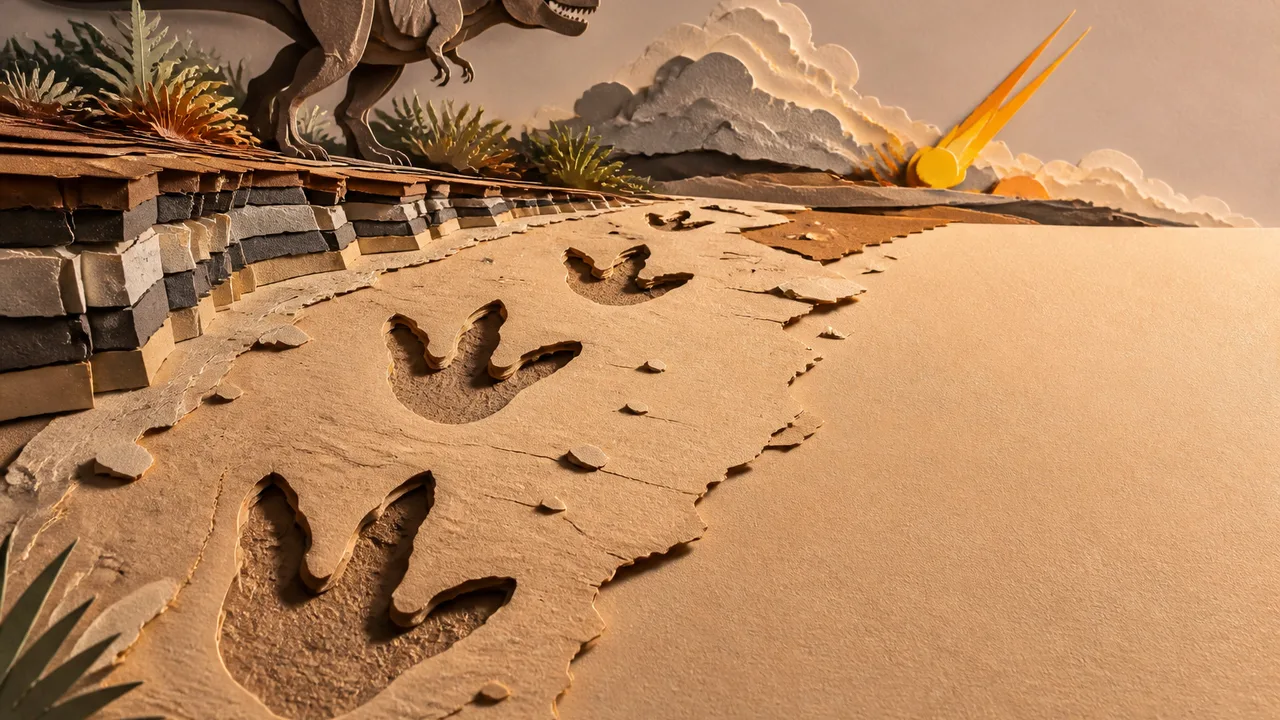
Four footprints, each about three feet long, run across a slab of North Dakota rock for roughly 23 feet, and paleontologists say they were made by a full-grown Tyrannosaurus rex about 66.5 million years ago, shortly before the species went extinct. According to Sci.News, the trackway from the Hell Creek Formation is being described as the first-ever adult T. rex trackway, a claim that sounds modest until you consider what it fills in: nearly every reconstruction of how this animal moved has been inferred from bones, models, and a great deal of wishful thinking.
What Bones Cannot Say
A skeleton is a biography of structure. It tells you limb length, muscle attachment scars, the mass of a skull. It does not tell you how the animal arranged those limbs in time. Gait, stride, speed, weight distribution as the foot met the ground: these are behaviors, and behavior fossilizes poorly, except when it fossilizes literally, as mud turned to stone under a walking foot.
That is what ichnology, the study of traces, trades in. A trackway is a compressed filmstrip: four frames of a body in motion, spaced by a stride we can measure. The spacing of the Hell Creek prints, as Gizmodo reports, is being read as evidence of how T. rex actually walked, and phys.org frames the discovery as capturing the animal at a walking pace. A seven-ton predator ambling across a floodplain, unbothered, unobserved, six months or six centuries before the asteroid.
The Puzzle of Attribution
Here is where honesty requires a pause. Tracks cannot be matched to a species the way a skull can. An ichnologist sees a three-toed print, roughly three feet long, from sediments that also contain the bones of a very large tyrannosaur, and makes an inference. In the Hell Creek Formation, that inference is fairly comfortable: the only animals producing footprints of that size in that fauna were tyrannosaurs, and full-grown ones at that. All That's Interesting attributes the prints to a full-grown tyrannosaur on precisely this grounds-by-elimination logic.
But the attribution carries real uncertainty, and the reporting on this find shows it. ScienceAlert notes a detail that should recalibrate how anyone pictures the animal: the footprints are, in a sense, human-sized, meaning the actual impression of the foot on the mud is comparable in scale to something a person could stand in. A Tyrannosaurus rex, the most famous giant in the history of life, left a footprint you could plausibly cover with both arms outstretched. The animal's apparent enormity lives mostly above the ankle, in legs built like industrial equipment and a skull the length of a canoe.
The open question, and it is a genuine one for the researchers, is whether the track-maker was T. rex itself or a close relative. The Hell Creek record makes T. rex the overwhelming candidate, but trace fossils get their own names in the formal literature precisely because the maker is usually unknown. This is a tyrannosaur trackway from the right time and place, described as a T. rex trackway on strong circumstantial evidence.
Why the First One Took so Long
Adult T. rex trackways should not be rare in principle. T. rex lived for roughly two million years across western North America, in populations large enough to dominate their ecosystems, and it walked everywhere it went. The scarcity of tracks is a statement about preservation and discovery, not about the animals.
Trackways need three coincidences. First, the ground had to be the right consistency: soft enough to record detail, firm enough to hold the impression, and preferably wet, which is why most trackways come from lake margins, river floodplains, and tidal flats. Second, the prints had to be buried quickly, before sun, wind, or scavenging feet erased them. Third, the burial had to be gentle enough that the sediment layer survived 66 million years of compaction, uplift, and erosion intact, with the print's underside or cast preserved as a surface someone could find.
Then comes the human part: someone has to be looking. Track surfaces are flat, featureless things to an untrained eye, and many have almost certainly been quarried through, plowed over, or weathered away unrecognized. The record of dinosaur behavior is thus doubly biased, filtered first by ancient accidents of sediment and again by modern accidents of attention.
A Landscape at the End
The setting adds its own weight. The Hell Creek Formation preserves the final chapter of the Cretaceous in North Dakota and neighboring states, the last few million years before the end-Cretaceous impact. The rocks record a low, warm, river-laced coastal plain, a landscape of floodplains and shifting channels where Triceratops and Edmontosaurus herds moved through swamps under a canopy of dawn redwoods and palms.
Sediments associated with that final interval, as the reporting notes, place this animal in the last act. The trackway's value runs in two directions at once. Behaviorally, it records a gait, a stride length, possibly a speed. Environmentally, it records a condition: mud of a particular consistency at a particular moment, which is a data point about the ancient hydrology as much as the ancient animal.
Reading Motion, Reading Bias
The comparative context makes the find easier to weigh. Trackways of other large theropods are known from elsewhere in the Mesozoic, and multi-track sites have occasionally been interpreted as evidence of group movement among tyrannosaurs. This new trail holds four prints from what appears to be a single animal, so it argues nothing about social behavior by itself. Anyone hoping for a glimpse of pack hunting will have to keep hoping; the evidence here is quieter than that, and the sources do not claim otherwise.
What the trackway does argue against is the old image of T. rex as a lumbering, tail-dragging brute. The trail shows no drag mark, no wide sprawling stance; the prints fall in a line consistent with the bipedal, tail-held posture that skeletal studies have argued for since the 1960s and 1970s. Motion here confirms anatomy. That is the ordinary miracle of trace fossils: an independent line of evidence, made by the animal itself, that checks the reconstructions built from its bones.
The Ordinary Rock Problem
The last thing the discovery underscores is the least glamorous. Much of deep time is still sitting in ordinary-looking rock, unopened. The Hell Creek badlands are among the most heavily prospected vertebrate fossil localities on Earth, worked continuously for more than a century, and they just produced the first adult T. rex trackway ever found. Whatever the fossil record contains, our sample of it is a fraction of a fraction, and headline discoveries keep arriving from places people have walked over for generations.
A bone tells you what an animal was built from. Four prints in 66.5-million-year-old mud tell you that, one afternoon near the end of the Cretaceous, a very large predator walked across a floodplain at a pace that suggested it had nowhere urgent to be. The individual is anonymous; the moment is not. Someone is probably standing on the next trackway right now, in North Dakota or Mongolia or the Niger delta, unaware of what is under their boots.
Helen Papadopoulos
More Like This
How the Corvus Won Rome Its Navy and Drowned Its Crews
The First Punic War's ugliest weapon beat Carthage at sea, then killed more Romans than any battle. What the raven's rise and quiet erasure reveal.
WW1 Trench Life: What the Western Front Was Really Like
From Pals' Battalions to the Vickers gun, a new documentary unpacks the grim machinery of survival on the WW1 Western Front in unflinching detail.
Baiae: The Sunken Pleasure City of Ancient Rome
Beneath the Bay of Naples lie the ruins of Baiae, Rome's most scandalous resort. New 3D scanning reveals what volcanic geology buried and the sea swallowed.

Alexandria's Library Was More Than a Library
Dr. Roy Casagranda's lecture on the Great Library of Alexandria reveals a research institute, innovation hub, and the ancient world's most powerful idea engine.

Medieval Knights: The Gap Between Code and Conduct
Medieval knights lived by a strict code of chivalry—and routinely broke it. A look at the real training, politics, and moral failures behind the armor.
Searching for London's First Roman Road Under Lambeth
Time Team investigates whether London's first Roman road ran through Lambeth Palace gardens—and why the Romans crossed the Thames there before building Londinium.