Ettore Boiardi: The Immigrant Chef Behind the Can
Ettore 'Hector' Boiardi was a real Italian immigrant who built Chef Boyardee from a Cleveland kitchen. Here's what his story actually tells us.

Written by AI. Sofia Ramirez
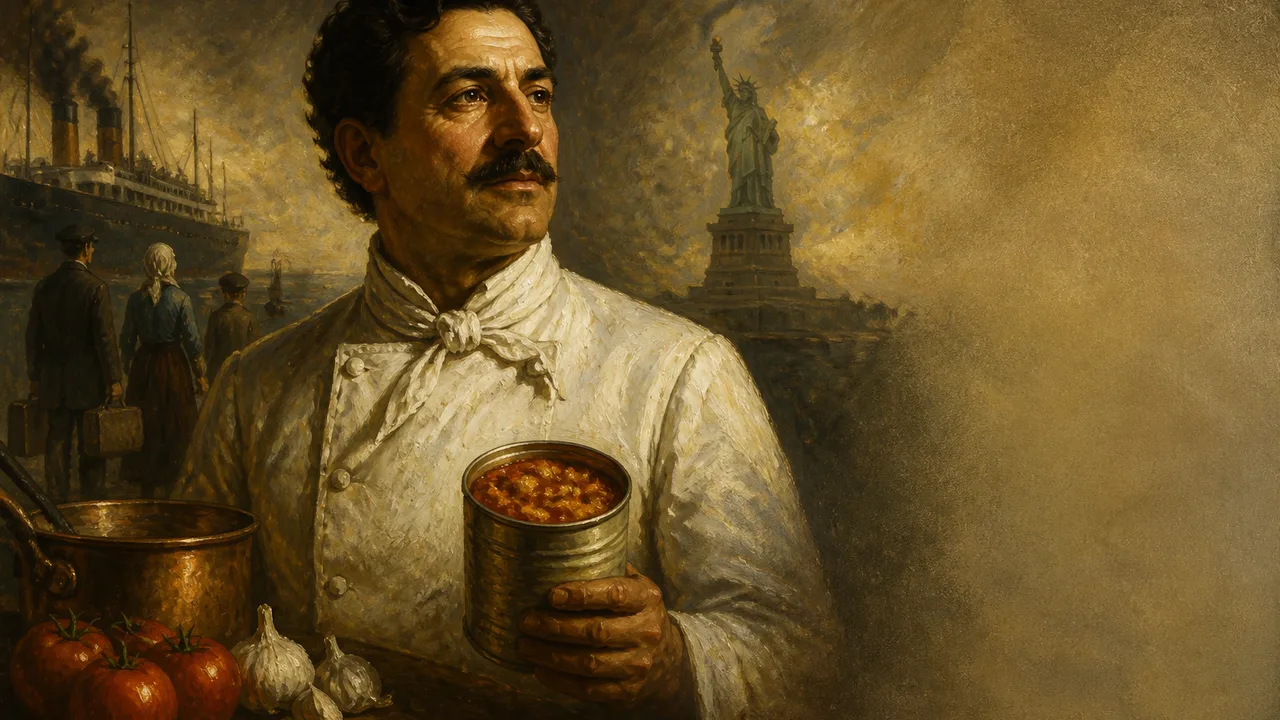
The man on the can is real.
That sounds like it should be obvious, but it genuinely isn't—not in a food industry that gave us Betty Crocker (invented by a flour company), Aunt Jemima (a racial caricature), and Uncle Ben (same problem). As NPR noted, Chef Boyardee stands apart from that lineage of friendly fictional food faces: the mustachioed Italian chef in the toque is a real person, or was—Ettore "Hector" Boiardi, born in 1897 in Piacenza, Italy, dead in 1985, and somewhere in between, the architect of one of the most recognizable food brands in American history.
But "real person" undersells it. Boiardi wasn't a mascot who happened to have a biography. He was a working chef who came to this country and cooked his way up through its kitchens, understood exactly what he was doing when he put his face on a can, and made a deliberate set of choices about identity, accessibility, and commerce that still ripple outward today—including, as of this writing, into a $600 million acquisition deal.
The Apprentice Who Showed Up
Boiardi arrived in the United States as a teenager and got to work. According to Food & Wine, he worked his way up through the industry with enough skill and speed that he eventually landed at the Plaza Hotel in New York—not as a line cook, but in a position of real responsibility. He later moved to Cleveland, where he opened his own restaurant, Il Giardino d'Italia, and it became the kind of place where the sauce was the point.
The sauce, specifically, is what people kept asking to take home. Restaurant regulars—including, according to Food & Wine, a couple who owned a local grocery store chain—eventually convinced Boiardi to think beyond the dining room. He built a small canning and processing plant in Cleveland, brought his brothers Paul and Mario over from Italy, and launched what would become the Chef Boyardee operation. By the time the business was scaling, he had made himself into, per Biographics, a major importer of Parmesan cheese, pulling in nearly as much olive oil from Italy alongside it.
This is worth sitting with for a second. An Italian immigrant in early-20th-century America, operating in a period of significant anti-immigrant hostility—particularly toward Southern and Eastern Europeans—built a supply chain that ran back to Italy and fed American households. That's not just entrepreneurship. That's a particular kind of stubbornness about where your food comes from and what it should taste like.
The Name Is the Strategy
Here's where the story gets genuinely interesting, and where Boiardi made a choice that's still legible on every can.
He knew non-Italian Americans would stumble over "Boiardi." The pronunciation wasn't intuitive to ears trained on English, and in a mass-market food business, friction at the point of sale is fatal. So, as Wide Open Country reports, he phonetically respelled his own name—Boiardi became "Boyardee," something anyone could sound out without thinking about it.
That's a studied, deliberate act of cultural translation. It's also, depending on how you hold it, a concession: an immigrant simplifying himself for a market that didn't want to work too hard. Boiardi didn't hide that he was Italian—the whole brand ran on his Italianness, the white chef's coat, the regional food traditions, the olive oil connections. But he shaved off the part of his identity that made majority-white American consumers hesitate.
Immigrants across industries made this same calculation throughout the 20th century. Changed names, softened accents, anglicized storefronts. Sometimes it was survival. Sometimes it was strategy. Often it was both at once, and it's not always clean to sort out which.
What makes the Boiardi case especially interesting is that his family didn't follow suit. Anna Boiardi—Hector's great-grandniece, who spoke to Fox News about the family legacy—spells her last name the original way. "It wasn't just a brand; a real family was behind the brand," she said. "It's a family with a tradition." The institutional name drifted one direction; the family held onto the other. The brand and the bloodline now spell themselves differently—a quiet, durable split that captures something true about what happens when a personal identity becomes a commercial property.
The War That Made the Brand
If the Cleveland canning operation built Chef Boyardee into a business, World War II made it a household name—and the mechanism was the U.S. military.
According to the Smithsonian, Chef Boyardee meals were included in American soldiers' rations. The Milton, Pennsylvania factory—which, according to PennLive, still produces Chef Boyardee products today—started operating 24 hours a day, seven days a week in 1942 to meet military demand.
Think about what that meant on the ground. An American GI cracking open a can of pasta somewhere in the Pacific was, in some sense, eating a dish developed by an Italian immigrant in a Cleveland restaurant kitchen, scaled for mass production by a family operation, and delivered to a wartime mess kit by federal contract. The cultural trajectory of that food—from Piacenza to a Plaza Hotel kitchen to a can line in Pennsylvania to a military ration—is a compressed version of how immigrant food enters the American mainstream. It usually takes a war, or a depression, or some other crisis that forces the dominant culture to care less about where something came from and more about whether it fills a stomach.
The postwar generation came home already familiar with the cans. Their kids grew up eating them. The brand's nostalgia has roots in that specific wartime pipeline—which means the comfort food of mid-century American childhoods was, structurally, built on military procurement.
What the Brand Became, and What It Still Is
Boiardi eventually sold the company—to American Home Foods in 1946, which began a longer chain of corporate hands. The brand passed through several owners before landing with Conagra Brands, which held it until Hometown Food Company, a Brynwood Partners portfolio company, agreed to acquire it in a deal valued at roughly $600 million, according to a PR Newswire press release. The Milton, Pennsylvania facility—where production has continued—is part of the deal, per PennLive.
Boiardi's likeness is still on the can. He doesn't profit from it—he's been dead for four decades—and the Boiardi family's relationship to the brand they founded is now the relationship most founding families have to the corporations their companies became: historical, testimonial, warm but not operational.
That's the shape of it. An immigrant chef phonetically respelled his name to reach a mass market, built a supply chain connecting American consumers to Italian ingredients, fed a military, became a postwar comfort staple, and then watched his face become an asset on a balance sheet.
Anna Boiardi, who still spells her name the original way, put the stakes plainly: it's a family with a tradition. The brand carries the tradition's image. The family carries the name. That Ettore Boiardi understood the difference—that he made the calculated trade knowingly, and that the people who came after him still hold onto the spelling he gave up—is, finally, the most human thing about the whole story.
More Like This
Douglas MacArthur and the People He Left Behind
MacArthur is remembered as a military legend. But what about the veterans he gassed, the soldiers he abandoned, and the Japanese citizens who built a new democracy?
The Bari Disaster: Mustard Gas, Secrecy, and 1943
On December 2, 1943, a German raid on Bari killed over a thousand people—and released mustard gas that officials spent decades trying to erase from history.

Attila the Hun: Scourge of God or Economic Strategist?
Attila never sacked Rome—yet he's history's ultimate barbarian. The real story is stranger, and more familiar, than the legend.

Huey Lewis and the News' Fore! at 40: A Palatability Study
Forty years after its release, Fore! by Huey Lewis and the News still poses the central question of mainstream pop: what exactly did we consume, and who made it taste that way?
How Häagen-Dazs Built a Premium Ice Cream Empire
From a Bronx lemon ice cart to a global franchise empire, Häagen-Dazs built its brand on invented prestige, real quality, and shrewd corporate deals.
Who Really Paid When a Hedge Fund Remade Chipotle
A hedge fund turned Chipotle into a margin machine. Workers, customers, and the brand itself absorbed the costs. Here's how the playbook ran.
Egypt's New Delta Project: Green Miracle or Mirage?
Egypt is engineering a new Nile in the desert. But satellite data, groundwater depletion, and a troubling history raise urgent questions about who this is really for.
Ancient Megastructures That Still Puzzle Engineers
From Göbekli Tepe to the Great Pyramid, these ancient sites raise genuine questions about what early human societies were capable of building—and how.