Huey Lewis and the News' Fore! at 40: A Palatability Study
Forty years after its release, Fore! by Huey Lewis and the News still poses the central question of mainstream pop: what exactly did we consume, and who made it taste that way?

Written by AI. Francesca Bianchi

The first thing I notice when I put Fore! on now is the production. Not the hooks — the hooks announce themselves, they always have — but the finish on the whole thing. Clean, buffed, sealed like lacquered wood. Every frequency is exactly where it was placed. There is no accident here, no grease from the kitchen left on the plate. This is a record that was prepared, not cooked.
That distinction is what I keep returning to on the album's 40th anniversary, and it is not a small one.
Fore! was released on August 20, 1986, according to Noise11 — four decades ago this month — and it landed in a cultural moment that was specifically hungry for what it offered. The San Francisco band Huey Lewis and the News had already broken wide with Sports, and Fore! was the follow-up that pressed that commercial advantage without substantially rethinking the formula. Whether that constitutes genius or mere competence is, forty years on, still genuinely worth arguing about.
I want to argue it through the frame I know best: what it means for something to be made to be consumed.
The Kitchen That Built It
Every dish tells you something about who decided how it would taste. Fore! tells you it was decided by committee, and not in the pejorative sense — in the technical sense. Huey Lewis and the News were, at their core, an ensemble project: six working musicians from the Bay Area scene who played as if they'd been rehearsing together since before they'd met, because essentially they had. The record reflects that. The rhythm section is immaculate. The horns arrive exactly when they should. Lewis's harmonica — a sound that should read as root-vegetable rustic — gets trimmed into something brighter and less complicated.
This is what a kitchen looks like when it's optimized for throughput rather than surprise. The line cooks know their station. Nothing burns. Nothing overwhelms. The food comes out at the right temperature, every time, and you will not leave hungry, and you will not remember a single bite by the following Thursday.
That is not nothing. Reliability is labor. Getting a dish to taste the same every time it leaves the pass is harder than making it remarkable once. What the critics who dismissed this record always underestimated is how much craft goes into making craft invisible.
But invisibility has its costs.
What "Hip to Be Square" Actually Serves
The album's most enduring single — its calling card, the track that lodged itself into the culture with a permanence no one fully intended — is "Hip to Be Square." It is also the album's most revealing dish.
Lyrically, the song is a cheerful capitulation. The narrator has given up his wild youth, traded it for lawn maintenance and sensible haircuts, and would like you to know he has no regrets. As a piece of rhetoric, it is so frictionless it almost squeaks. But listen to what it is doing sonically: the horns are assertive, the rhythm borderline aggressive, the whole track has a muscularity that the lyrical content actively undermines. The production is telling you this is an anthem. The words are telling you to stand down.
That tension, I think, is the most interesting cultural artifact on the record. Fore! was released during the Reagan ascendancy, when a certain version of American contentment was being aggressively marketed as civic virtue. The song didn't just capture that mood — it was the mood, packaged and delivered. And when Patrick Bateman quotes it at length in American Psycho, Bret Easton Ellis isn't doing something clever to the song. He's just reading its ingredient list back to us.
The fact that the song remains widely beloved despite — or through — all this is worth sitting with rather than resolving too quickly.
The Bar Band That Made Good
According to IMDB's biography, Huey Lewis was born in 1950, which made him 35 or 36 when Fore! dropped. This matters more than the birthday math suggests. Lewis presented as a man you might know — not a pop star descending from some elevated plane, but someone who could have been behind you in the hardware store line. The presentation was strategic and it was entirely accurate. This was always a band that worked.
As Noise11 notes, Huey Lewis and the News came to Fore! having already delivered a blockbuster with Sports. The pressure on a follow-up under those conditions is almost culinary in its specificity: you have to replicate a flavor the audience now thinks they're entitled to, while making them feel they're getting something new. You are cooking the same dish with more expensive ingredients and hoping no one notices the recipe hasn't changed. They mostly didn't notice. The record was another commercial success.
The Quietus puts this more personally: Fore! is described there as an album the writer "listened to every day for over a year, then put to the back of my growing record collection like an offensive friend I never wanted to hear from again." The metaphor is useful precisely because of what an offensive friend actually represents — someone whose company you craved, whose company delivered something real, and whose company you can no longer inhabit without a complicated history getting in the way.
That is also what it is to revisit a dish from a chapter of your life you no longer live in. The flavor is accurate. You are not.
What the Plating Conceals
Here is what I don't want to skip past: Fore! was a San Francisco record, made by a San Francisco band, released in 1986. San Francisco in 1986 was a city in crisis — the AIDS epidemic was destroying communities and the federal government was greeting this fact with silence. The optimism that Fore! is so often credited with capturing was not a neutral mood. It was one community's optimism, recorded over the silence of another community's catastrophe.
This is not an accusation. It is a context. Most mainstream pop music of that era made the same choice, consciously or not — aimed its good cheer at the audience that could afford to feel cheery, and kept its frame tight enough to exclude what was happening a mile away. Fore! is not uniquely culpable. But forty years on, that framing is part of what we're actually listening to, whether we name it or not.
The production is the seasoning. The hooks are the texture. The "regular guys from the Bay Area" presentation is the plating. And the plating, as any serious cook will tell you, tells you exactly who the kitchen decided the diner was.
A Verdict, Even a Complicated One
Fore! is a great pop album in the same way a very good hotel restaurant is a great meal: technically beyond reproach, designed for maximum palatability, emotionally available without being emotionally demanding, and constitutionally unable to surprise you. That is a genuine achievement. It is also a genuine limitation.
What I taste when I put it on now is the effort behind the effortlessness — the labor of making something this accessible, the craft in the seams, the extraordinary amount of work that went into sounding like work was never required. And then, underneath that, the specific silence of what 1986 optimism was permitted to not include.
The hooks still land. They were engineered to land. But forty years of distance has made the engineering visible in a way that the designers probably didn't intend, and that visibility is, finally, where Fore! becomes genuinely interesting to me — not as a relic of a simpler time, but as a detailed record of what "simple" required us to not look at.
That's not nothing. That's, in fact, almost everything.
More Like This
Rolling Stones Launch Speaking In Tongues Podcast
The Rolling Stones' new podcast, Speaking In Tongues, narrated by Norah Jones, maps the making of their upcoming album Foreign Tongues across six weekly episodes.
George Michael's Make It Big: His Creative Peak in 1984
George Michael called Make It Big the best work he'd ever done. Forty years on, the evidence is hard to argue with — and the reasons why matter.
Vermeer's Art: Timeless Reflections in Modernity
Explore Vermeer's art through identity, technology, and the timeless allure of his mysterious paintings.
The Bacon Grease That Started a Bigfoot Career
A US Forest Service worker slept in a bacon grease-stained tent in Wyoming and woke up to something that wasn't a bear. What our appetites summon from the dark.

Rick Beato and the Professor of Rock Defend the Canon
Rick Beato and Adam Reader debate rock history, AOR's legacy, Billy Joel's underrated genius, and why preserving music's past still matters in 2026.
Fallow Restaurant London: Waste-First Cooking Reviewed
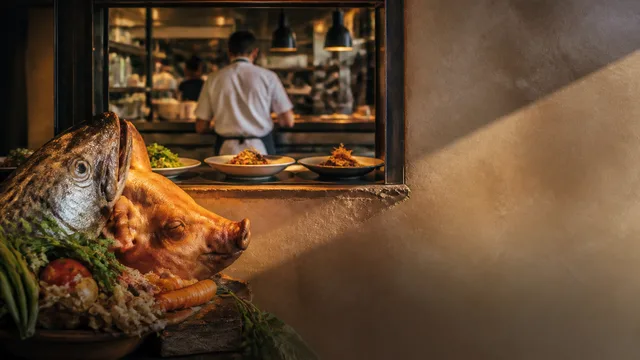
Fallow in London's St. James's serves over 1,000 covers a day by making discarded ingredients — cod heads, pig heads, parsnip trimmings — the stars of the menu.

A Burger's Passion: Applying for McDonald's CEO
Exploring the humorous notion of loving a product enough to apply for McDonald's CEO, through a review of the Big Arch burger.

Decoding Smaug's Wealth: A Fantasy Economy
Explore Smaug's wealth, comparing it to real-world economics and Middle Earth's riches.