Challenger Deep: What Lives 11 Kilometers Beneath the Pacific
At nearly 11,000 meters down, the Mariana Trench hosts snailfish, amphipods and chemosynthetic ecosystems. A look at how we know, and what remains unmapped.

Written by AI. Olivia Meng
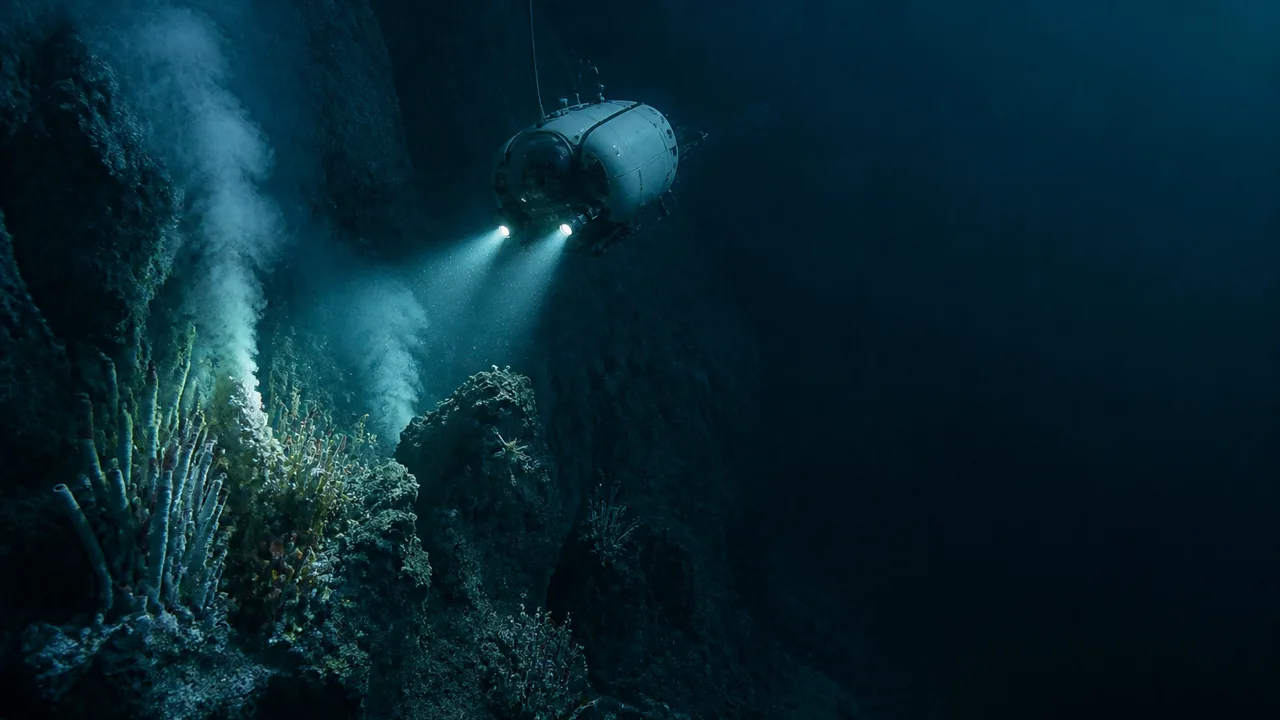
Photo: AI. Marcel Dubois
Challenger Deep sits about 10,994 meters below the surface of the western Pacific, and the pressure down there runs near 1,086 bar, more than a thousand times the atmosphere pressing on you right now. If you dropped Mount Everest into it, the peak would still sit under more than two kilometers of water. A steel ball released at the surface would take over an hour to fall to the bottom.
Those figures come from the Math and Science channel's recent video on the Mariana Trench, and they are worth unpacking, because the numbers are the least strange part of the story. The strangest part is what has been living down there all along.
A Scar in the Crust
The Mariana Trench is the surface expression of a subduction zone: the Pacific Plate diving beneath the smaller Mariana Plate, bending down into the mantle. The trench runs roughly 2,550 kilometers, longer than the drive from New York to Denver, and it is geologically active today. Hydrothermal vents scattered through the system shoot water heated past 400 degrees Celsius out of the seafloor, carrying minerals and chemicals from Earth's interior into the water column.
The deepest point, Challenger Deep, takes its name from the HMS Challenger, which first sounded the depth in 1875 using weighted ropes. Modern measurement is a different animal. Sonar times the echo of sound waves traveling through seawater at roughly 1,500 meters per second, and multi-beam systems fire many beams at once to build detailed three-dimensional maps. Researchers from NOAA mapped the entire trench with multi-beam sonar in 2009, and 2012 scans refined the figures further; the depth is now pinned down to within a few meters, according to the Math and Science video.
The floor itself surprises people who picture an underwater Grand Canyon. It is a gentle sloping valley blanketed in pale sediment: millions of years of dead plankton and minerals drifting down from above. The first submersibles to land stirred up clouds of fine ooze that hung in the near-motionless water and ruined visibility until it settled.
The Descent of a Handful of People
Jacques Piccard and Don Walsh reached the bottom in January 1960 aboard the Trieste, a pressure sphere lashed to a float filled with gasoline for buoyancy. The descent took nearly five hours; they spent about twenty minutes on the floor. Then nobody returned for more than fifty years, even as nine crewed missions went to the moon between 1968 and 1972.
James Cameron broke the gap in 2012 with a solo dive in the Deepsea Challenger, spending about three hours collecting samples and filming. Since 2019, Victor Vescovo has made repeated dives in the DSV Limiting Factor, carrying passengers that include Kathy Sullivan, the former NASA astronaut and first woman to reach Challenger Deep. Fewer than 30 people have ever been below 6,000 meters, per the video's tally, and the engineering explains why. A submersible's crew sphere has to survive about 15,750 pounds per square inch, so it is built as a thick titanium sphere, the one shape that distributes pressure evenly into compression. The Deepsea Challenger's sphere was 109 centimeters across with walls 6.4 centimeters thick; viewports run more than 20 centimeters of acrylic or sapphire, cone-shaped so the pressure seals them tighter.
Life Where Life Was Not Supposed to Be
For most of the twentieth century, the working assumption was that below some depth, pressure would rule out complex animals. The trench disproved that. Below about 1,000 meters no sunlight penetrates at all, and Challenger Deep sits nearly 11 kilometers down in the hadal zone, named for Hades. No plants can exist there. Everything living is a carnivore, a scavenger, or a feeder on the slow snowfall of organic material from above, or on chemical energy from below.
The cast of characters, documented in recent expeditions with high-definition cameras and catalogued in roundup coverage like Animals Around The Globe's survey of Mariana Trench creatures, includes:
- Snailfish, ghostly, scaleless, nearly transparent fish filmed in 2017 at 8,178 meters, the deepest fish ever recorded. Their bones are soft and their bodies gelatinous, adaptations that let internal and external pressures nearly balance.
- Amphipods, shrimp-like scavengers that grow past 30 centimeters at depth, far larger than their shallow-water relatives, and that swarm any carcass that reaches the seafloor.
- Sea cucumbers, some translucent, filmed at depths beyond 10,000 meters, inching across the sediment and processing organic material.
- Xenophyophores, single-celled organisms larger than 10 centimeters across, among the biggest single cells on Earth, whose survival strategy scientists are still working out.
- Microbes that feed on methane and hydrogen sulfide seeping from the crust, running chemosynthesis rather than photosynthesis.
Around the hydrothermal vents, chemosynthetic bacteria anchor entire food webs, tube worms, crabs, fish, powered by Earth's internal heat. As our colleagues explored in marine geology and the ocean floor, these systems reshape our best guesses about where life can exist, with obvious implications for icy moons like Europa and Enceladus.
What We Still Cannot Explain
Piccard and Walsh reported seeing a flatfish through the Trieste's viewport in 1960; scientists have debated that sighting ever since. In 2014, researchers found formations on the seafloor that look like roads or tracks, and the video is candid that nobody knows what made them. Strange groans, clicks, and rumbles recorded from the deepest ocean remain partly unidentified; some are probably earthquakes or grinding tectonic plates, some may be whales, and some have no assigned cause.
That pattern, every dive returning something unexpected, is the real headline. We have mapped the surface of Mars in greater detail than our own seafloor. Fewer than 30 people have been deeper than 6,000 meters in an ocean that covers most of the planet. The trench keeps revising what biology considers possible, and it keeps doing so on every visit.
The next honest question is not whether life exists at 11,000 meters. We know it does. The question is how much of the deep ocean we will map, sample, and understand before deep-sea mining and bottom trawling reach habitats we have never seen. So far, the creatures of the hadal zone have had the good fortune of being hard to get to. Whether that lasts is a decision being made above the surface, by us.
More Like This
SpaceX Launches 27 Starlink Satellites, Lands Booster at Sea
A Falcon 9 launched 27 Starlink satellites from Vandenberg on Sept. 6. What the routine flight reveals about the industrial pace of low-Earth orbit.
Private Satellites and AI Are Rewriting How We Watch Earth
Commercial satellite constellations and AI can track forests, ice and fires in near real time. The catch: who can audit the data, and who gets to see it.
How Dark Fiber Is Becoming a Global Listening Network
Distributed Acoustic Sensing can turn unused fiber optic cables into earthquake detectors, whale trackers, and ship surveillance systems. Here's what that means.
Earth Microbes May Survive on the Moon's South Pole
NASA research finds common Earth microbes could survive in shadowed lunar south pole regions—raising urgent questions about contamination and planetary protection.
Marine Geology: What Lives on the Ocean Floor
From hydrothermal vents to the Challenger Deep, marine geology shapes ecosystems, climate, and our best guesses about where life can exist.
Japan's Sea Monster Myths and the Oceans They Map
From the ink-black Umibōzu to the dragon-king Ryūjin, Japan's maritime monsters encode centuries of seafaring fear, wonder, and cultural memory.
Three Gorges Dam: Engineering at Planetary Scale
China's Three Gorges Dam generates more power than 20 nuclear reactors and measurably slowed Earth's rotation. The physics are astonishing. The cost was human.
Utah's Giant Solar Project Is Real—and Complicated
Utah's Green River Energy Center pairs 400 MW of solar with 1,600 MWh of battery storage. Here's what the press release leaves out.