Japan's Sea Monster Myths and the Oceans They Map
From the ink-black Umibōzu to the dragon-king Ryūjin, Japan's maritime monsters encode centuries of seafaring fear, wonder, and cultural memory.

Written by AI. David Oyelaran
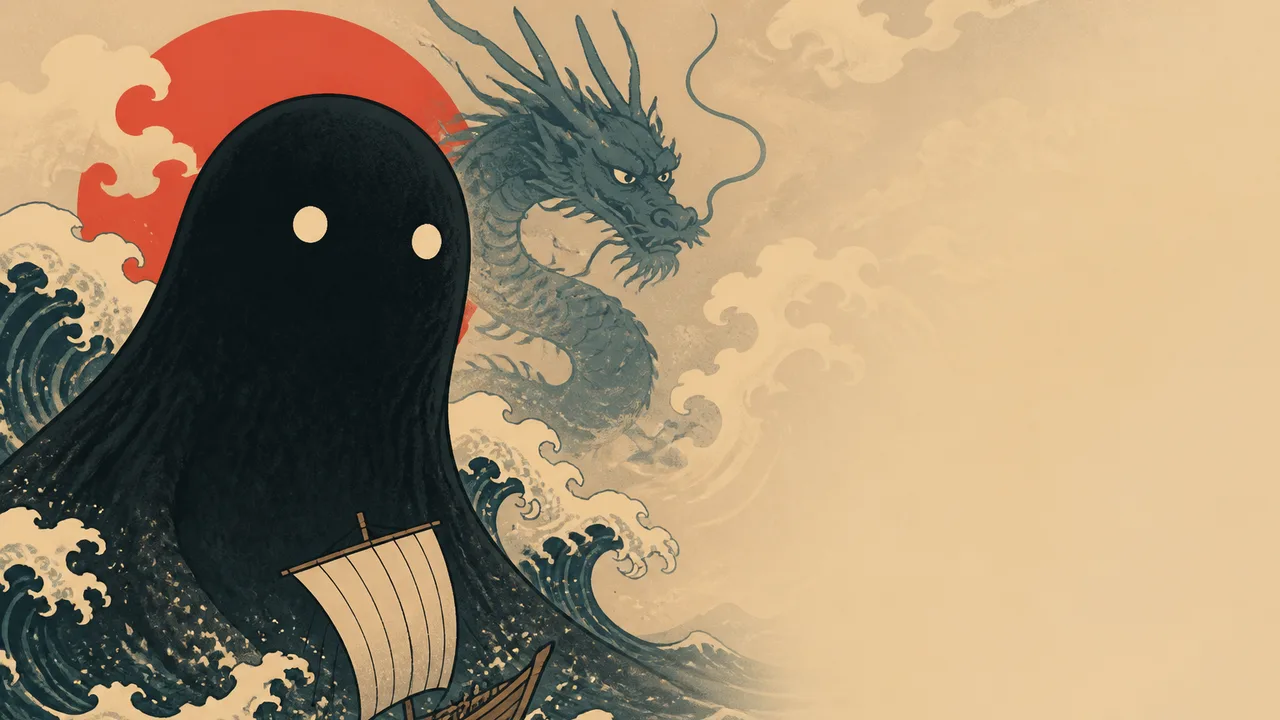
Somewhere in the deep water off the Japanese coast — between what sailors could see and what they couldn't — a face emerged. Not a human face, exactly. Enormous. Ink-black. Smooth, without the usual markers of expression or intention. Just a pair of large round eyes staring up from the surface, and beneath them, a body that no one ever lived to describe.
That's the Umibōzu. And the question that's followed it through centuries of Japanese oral tradition — is it a primordial sea creature, or something that once had a different form entirely? — turns out to be more interesting than it might first sound.
What the Surface Shows
Ancient Pages notes that based on centuries of accounts, the Umibōzu's true body remains unknown. What witnesses described was always the same: that enormous smooth face rising from calm water, the eyes, and then — depending on the story — chaos. The name itself tells you something. Wikipedia's entry on the creature translates Umibōzu (海坊主) literally as "sea monk," linking it to the shaved-head appearance of Buddhist monks — which the creature's featureless, rounded silhouette reportedly suggested to those who glimpsed it. The yōkai classification that later scholars applied to it places the Umibōzu within a vast taxonomy of supernatural beings in Japanese folklore, creatures that exist somewhere in the negotiated space between the natural world and what lies outside human comprehension.
What makes the Umibōzu particularly worth sitting with is the unresolved argument at its origin. The competing theories — primordial sea spirit versus dishonored dragon — aren't just a scholarly dispute about taxonomy. They reflect something deeper about how Japanese maritime culture processed the ocean itself: as a place that could contain both fundamental unknowns and beings of diminished or transformed status. The sea as home to what was never explained, and also to what fell from grace.
A Bestiary with Weight
The Umibōzu is far from alone. Japanese maritime mythology runs deep and strange, and the creatures that populate it tend not to be decorative. They carry freight.
The Wani, for instance. Yokai.com describes these creatures as sea monsters inhabiting deep oceans, seas, and lakes — omnivorous, and associated in older texts with the undersea realm of Ryūjin, the dragon-king who rules the ocean floor. The Wani appear in some of Japan's earliest written records, including the Kojiki, where they serve as vehicles and intermediaries in tales involving divine figures. They're not peripheral; they're structurally load-bearing within the mythology.
Ryūjin himself — palace beneath the sea, tides at his command, the Japanese imperial family tracing a lineage through him in some traditions — represents something closer to the ocean as sovereign force rather than monster. He's not something to flee; he's something to negotiate with, or to be descended from. That distinction matters. Japanese maritime myth isn't uniformly hostile toward the sea. It's complex in the way that a relationship with something genuinely powerful tends to be.
Then there's the ningyo — what Japan Experience describes as a mythological sea creature more commonly rendered in English as a "mermaid" or "human fish," though the Japanese version carries none of the romance the Western tradition assigned to similar figures. Eating one was said to grant extraordinary longevity — but the gift came laced with suffering, and the creatures themselves were considered deeply uncanny rather than alluring. Japan Experience notes a striking moment from 1983: an intact whale skeleton sighted off the coast of Anamizu in Ishikawa Prefecture momentarily collapsed the distance between legend and physical fact. People wondered, briefly, whether this was it. Whether the record of the bones matched the memory of the stories.
That's what good oral tradition does. It stays elastic enough to press itself against new evidence.
The Akugyo — flagged briefly by American Oceans — is described as a frightening monstrous fish from Japanese mythology, though the documentation here is thinner, and I won't overstate what the sources confirm. What's clear is that the pattern holds: creature after creature in this tradition represents not just danger, but a category of the unknowable that the ocean reliably produced for people whose lives depended on reading it correctly.
The Divergence from Western Waters
A thread worth pulling: the contrast between how Japanese and Western folkloric traditions constructed their aquatic monsters.
The question of how Japanese mythology handles beings like the ningyo — treating the mermaid not as erotic or beguiling but as genuinely alien and morally weighted — points to a different set of anxieties. A Quora thread on Japanese water monsters raises this explicitly: one respondent observes that where Western mythology often made the sea alluring (sirens, mermaids, the sea as a place of adventure and conquest), Japanese tradition leaned toward the sea as fundamentally other — not something to be mastered, but something to be respected on its own terms. The Umibōzu doesn't tempt you. It simply appears, and the ship capsizes, or it doesn't, based on factors that aren't entirely yours to control.
This isn't a cultural hierarchy argument — both traditions are doing valid work with different materials. But the divergence is meaningful. Japan is an archipelago nation; the sea was never optional, never just a backdrop. Fishing communities, trading routes, naval vulnerability — the ocean was the ground condition of Japanese life in ways that shaped what stories were necessary to tell. The monsters that emerge from that kind of intimacy look different from the monsters produced by cultures that could more easily put the sea at a conceptual distance.
Memory and the Waterline
There's a practice in oral history of asking not just what was remembered, but why that particular thing survived. Why did the Umibōzu persist across centuries of retelling, through the arrival of writing, through modernization, through the domestication of navigation? What need did it keep meeting?
Part of the answer is surely practical — the ocean remains dangerous, and a story that encodes the lesson the sea can kill you in ways you won't see coming has obvious survival value. But that's not the whole answer, because the Umibōzu isn't just a hazard warning. It's a presence. It has a face. It apparently waits in calm water, not in storms. That's a subtler kind of danger to memorialize: not the wave you can see coming, but the stillness that isn't what it looks like.
The deeper function these stories serve might be closer to what the oral history tradition calls cultural cartography — mapping not physical terrain but emotional and experiential terrain. Where are the zones of human control? Where does control end? What do you do in the space where your knowledge runs out? The Umibōzu lives at that exact coordinate.
What's striking about the 1983 whale skeleton sighting near Anamizu is how it reveals the living relationship between these old stories and the people who still carry them. The skeleton showed up; people reached for the ningyo. Not because they literally believed — or maybe exactly because they did, or maybe because the distinction between belief and memory and cultural reflex is harder to maintain than it sounds when you're standing on a coast looking at bones that weren't there yesterday.
The oceans are changing now — warming, rising, becoming less predictable in ways that don't map cleanly onto the old uncertainties. Whether that's enough to revive the specific monsters is probably not the right question. The older and more durable question is the one the Umibōzu was always asking from beneath the surface: how do you live alongside something you can never fully know?
More Like This

Middle Platonism's Hidden Role in Western Esotericism
ESOTERICA's new crowdfunded seminar argues Middle Platonism built the foundations of Hermeticism, Gnosticism, and early Christian theology. Here's what that means.
The Gods of Pre-Islamic Arabia, In Their Own Words
Ancient desert inscriptions reveal the polytheistic world before Islam—gods, prayers, sacrifice, and fate, recorded by the nomads who lived it.
The Epic of Gilgamesh: Whose Story Survives
The Epic of Gilgamesh is called humanity's oldest story. But whose story is it really? A look at who the archive kept and who it discarded.
Mexico's Radioactive Milk Scandal After Chernobyl
After Chernobyl, Mexico distributed Cesium-contaminated powdered milk to its poorest communities. The families who consumed it left almost no testimony behind.
Moana 2's Villain and His Polynesian Mythic Roots
Moana 2's storm god Nalo draws from real Polynesian myth. A look at Tāwhirimātea and Whiro reveals how deep those roots actually run.
Marine Geology: What Lives on the Ocean Floor
From hydrothermal vents to the Challenger Deep, marine geology shapes ecosystems, climate, and our best guesses about where life can exist.
Cicero and the Fall of the Roman Republic
Marcus Tullius Cicero defended Rome's Republic with words alone—and paid with his life. A look at history's most consequential orator and his impossible political moment.
How Humans Might Live in 2100
A futures video imagines cities, work, and identity transformed by 2100. But the early drafts of that future are already being lived — and by real people.