Moana 2's Villain and His Polynesian Mythic Roots
Moana 2's storm god Nalo draws from real Polynesian myth. A look at Tāwhirimātea and Whiro reveals how deep those roots actually run.

Written by AI. Theodore "Teddy" Ashworth III
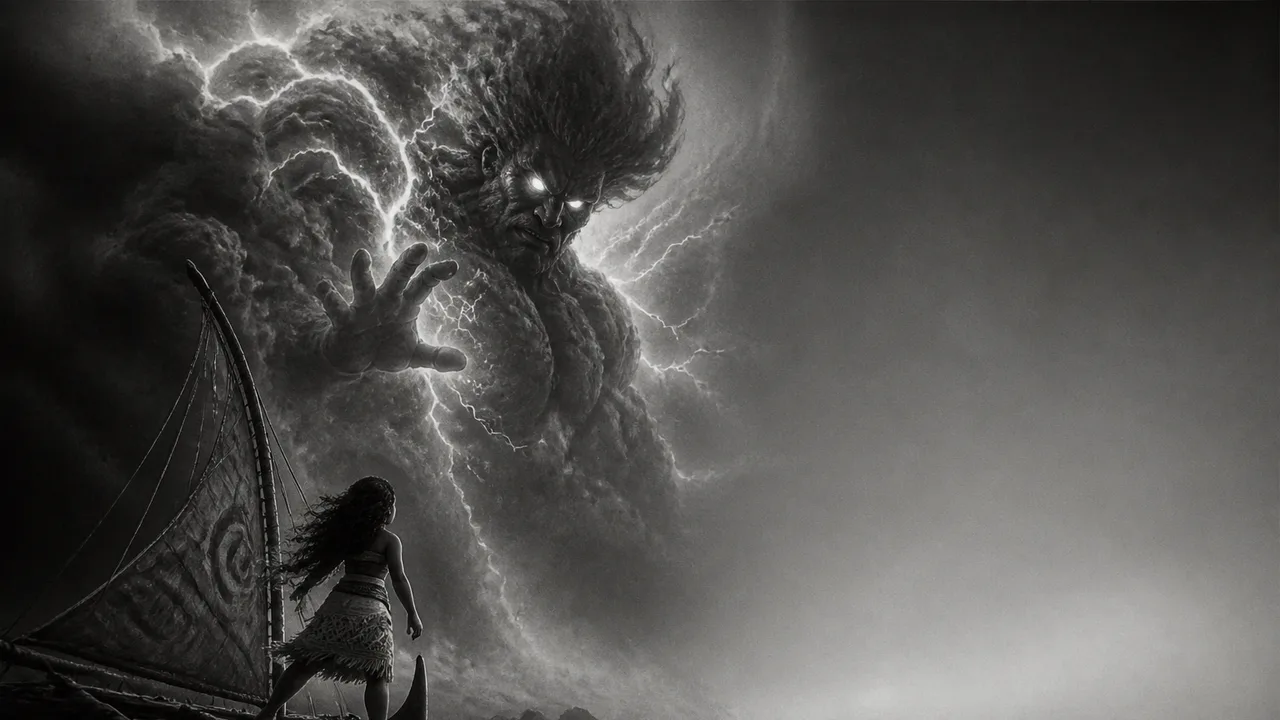
Photo: AI. Atticus Ferenczi
Family drama, as a genre, has given us Long Day's Journey into Night, the entire run of Succession, and approximately half of all soap operas ever produced. But as Jon Solo observes at the opening of his video essay on the mythological underpinnings of Moana 2, human families are rank amateurs compared to the gods: "as selfish and petty as family can sometimes be, they've got nothing on the gods." It is a thesis that the Polynesian mythological tradition, in all its fractious, storm-hurling, underworld-dwelling glory, bears out rather completely.
The occasion is Moana 2 and its villain, Nalo — a storm god who sinks the island of Motu Fitu to the ocean floor, severs communication between Polynesian societies, and grows stronger on their isolation. Solo's video essay investigates where Nalo came from, not in the sense of Disney story meetings, but in the older sense: what gods, across which traditions, left their fingerprints on this particular monster.
The Composite God Problem
The honest answer, Solo argues, is that Nalo came from several places at once. He does not map cleanly onto any single Polynesian deity. This is, the video suggests, a feature rather than a bug — a consequence of the staggering internal diversity of Polynesian mythology across Hawaiʻi, New Zealand, Samoa, the Cook Islands, and dozens of other island cultures, each with its own variants, emphases, and theological commitments.
The original Moana (2016) leaned heavily into Hawaiian traditions — writer-directors John Musker and Ron Clements consulted extensively with the Oceanic Story Trust during that film's development, according to Wikipedia's account of the production. But the franchise's characters are largely composite figures: bits and pieces of multiple goddesses' mythologies stitched together, rather than direct portraits of any one deity. Maui is the exception, as an actual demigod and hero of the broader Polynesian canon — though Moana's version of him departs significantly from the source material too.
For Nalo, Solo points to two gods from Māori tradition in particular: Tāwhirimātea, god of winds and storms, and Whiro-te-tupua, lord of darkness and embodiment of evil. Neither is Nalo. Both are, in recognizable ways, his ancestors.
A Storm Born from Grief
The creation story in which Tāwhirimātea appears is one of the great cosmological dramas of any mythology: the sky father Ranginui and earth mother Papatūānuku, locked in an eternal embrace since the moment of their existence, are eventually separated by their divine children who need room to breathe and grow. It is Tāne who manages the feat — pressing head against sky and feet against earth until the parents are wrenched apart. Some versions of the legend describe the separation as so violent that the arms of Ranginui and Papatūānuku had to be severed, their blood soaking both earth and sky.
Tāwhirimātea, alone among the divine siblings, grieves this rupture. And his grief takes the form most available to a storm god: war. He turns his winds and rains against his brothers, defeating most of them in sequence — Tangaroa of the sea, Tāne of the forests — before meeting his match in Tūmatauenga, the god of war and humans. That particular confrontation ends in a kind of bitter stalemate, with Tūmatauenga punishing the siblings who fled Tāwhirimātea's wrath by teaching humans to hunt their domains — netting fish, snaring birds, harvesting crops. Tāwhirimātea alone escapes full subjugation, and according to Solo, he "reathered his strength and returned to attacking humans and still does to this day with the ultimate goal of wiping us out for good."
The parallel to Nalo is structural, not biographical. Both are misanthropic storm gods whose ambition tends toward human annihilation. But Tāwhirimātea's violence springs from love — from the wound of watching his parents' union destroyed. He is not evil; he is inconsolable. That distinction matters, and Solo takes care to make it, because it sets up the second half of his argument.
The Lord of Darkness Does Exactly What You'd Expect
If Tāwhirimātea offers a mythologically sympathetic precursor to Nalo's storm-and-destruction portfolio, Whiro-te-tupua provides the moral component — the desire to destroy humanity not from grief but from an essential opposition to everything light, order, and human flourishing represent.
Solo draws his account primarily from Robert Craig's Handbook of Polynesian Mythology, which frames Whiro as the embodiment of evil itself: a deity who, after his brother Tāne brought the stars, sun, and moon into existence, retreated into the deepest region of the underworld with his followers. There, in what the tradition calls Whiro's House of Death, his clan of goblins, ogres, and demons awaits deployment into the mortal realm, where their mission is to ensnare human souls and drag them back below. In the mortal world, these demons prefer to manifest as reptiles — a detail Solo finds intriguing, given that most Polynesian territories lack venomous reptile species.
The theological status of Whiro across different Polynesian traditions is, appropriately for a figure of such antiquity, complicated. Solo is careful to note that his role varies considerably: in some accounts he's an omnipresent malevolent force who torments humans in life but releases their souls to the underworld at death; in others he keeps the souls of those he's tempted into evil and subjects them to endless punishment. Solo also flags that this latter framing — the good rewarded, the wicked punished — is something many scholars attribute to Christian missionary influence on Polynesian cosmology, particularly in central and eastern Polynesia, and "isn't a true reflection of their values pre-contact." The underworld, Rarohenga, in its pre-contact depictions tends to be a realm of peace rather than torment, which makes the hellish variant of Whiro's domain a more recent theological import than it might appear.
This kind of layering — old myth, colonial contact, syncretic transformation — is exactly where popular adaptations like Moana 2 tend to get complicated. Disney is working with a tradition that has already been shaped, in ways sometimes visible and sometimes not, by the very Western worldview the films sometimes set themselves against. That's not a scandal; it's the condition of any living mythology. But it's worth sitting with.
What Nalo Could Have Been
Solo doesn't hide his affection for Nalo's design, nor his frustration at how little the film ultimately does with him: "I know that they gave us that Marvelesque cutscene that ominously hinted that this is only the beginning of his plan, but I just don't expect any follow-through from Disney these days, which is a shame because Nalo had a really cool design."
The observation lands harder once you've spent time with Tāwhirimātea and Whiro. A villain who synthesizes a storm god's grief-fueled misanthropy with a lord of darkness's elemental opposition to human existence — and who draws that synthesis from a mythological tradition rich enough to sustain entire university curricula — is potentially one of the more interesting antagonists a Disney film has ever gestured toward. The gesture is, by most accounts, mostly what Moana 2 delivers.
The broader mythological ecosystem that Solo's video essay maps — Ranginui and Papatūānuku, the divine siblings, the cosmological wars, the competing underworld traditions, the question of how much any of this has been altered by contact — is the kind of material that rewards serious engagement. It's also the kind of material that tends to get flattened in the passage from oral tradition to animated feature, from the specific gravity of a living culture's cosmology to something that will fit within a runtime and satisfy a marketing brief.
Tāwhirimātea still haunts us. That's what the myth says. Every storm is his ongoing grievance. It would be something to see a film actually reckon with what that means.
More Like This
Unveiling the Fierce Origins of Unicorns
Explore the historical evolution of unicorns from fierce creatures to whimsical symbols.
Why the Ocean Still Terrifies Us: Depths of Fear
Quinn and James of Cosmic Chronicles explore why the ocean remains humanity's oldest, deepest fear—from the Mariana Trench to the myth of the Bermuda Triangle.
Visually Stunning Movies Nobody Talks About
From Tarsem Singh's The Fall to the anime fever dream Redline, these nine films are visually extraordinary—and almost entirely ignored. Here's why that matters.
Spielberg's Disclosure Day and the Politics of Withheld Truth
Spielberg's new film Disclosure Day frames UAP secrecy as epistemic injustice. A climate reporter finds the argument uncomfortably familiar.
Lee Cronin's The Mummy Wears Egypt Like a Mask
Lee Cronin's The Mummy sells Egypt and delivers Evil Dead. The visual identity gap between what it promises and what it shows is where the film collapses.
Tom Bombadil's Power: Why You're Asking Wrong
Tom Bombadil is Tolkien's most debated enigma. A new In Deep Geek breakdown reframes the question of his power—and the reframe is more interesting than any answer.
Danny Goler's Laser Experiment and the Code of Reality
Danny Goler turned a cheap red laser and DMT into a years-long experiment on the nature of reality. Here's what he found—and what remains genuinely unresolved.
Christopher Nolan's The Odyssey: Epic Ambition Meets Ancient Text
Christopher Nolan adapts Homer's Odyssey with Matt Damon as Odysseus. Here's what the project signals about Hollywood ambition, classical storytelling, and the director's arc.