Bruce Dern at 90: A Career Built on Refusals
At 90, Bruce Dern reflects on a career defined as much by the roles he turned down as those he took. A look at what his choices reveal about Hollywood.

Written by AI. Aminata Diallo
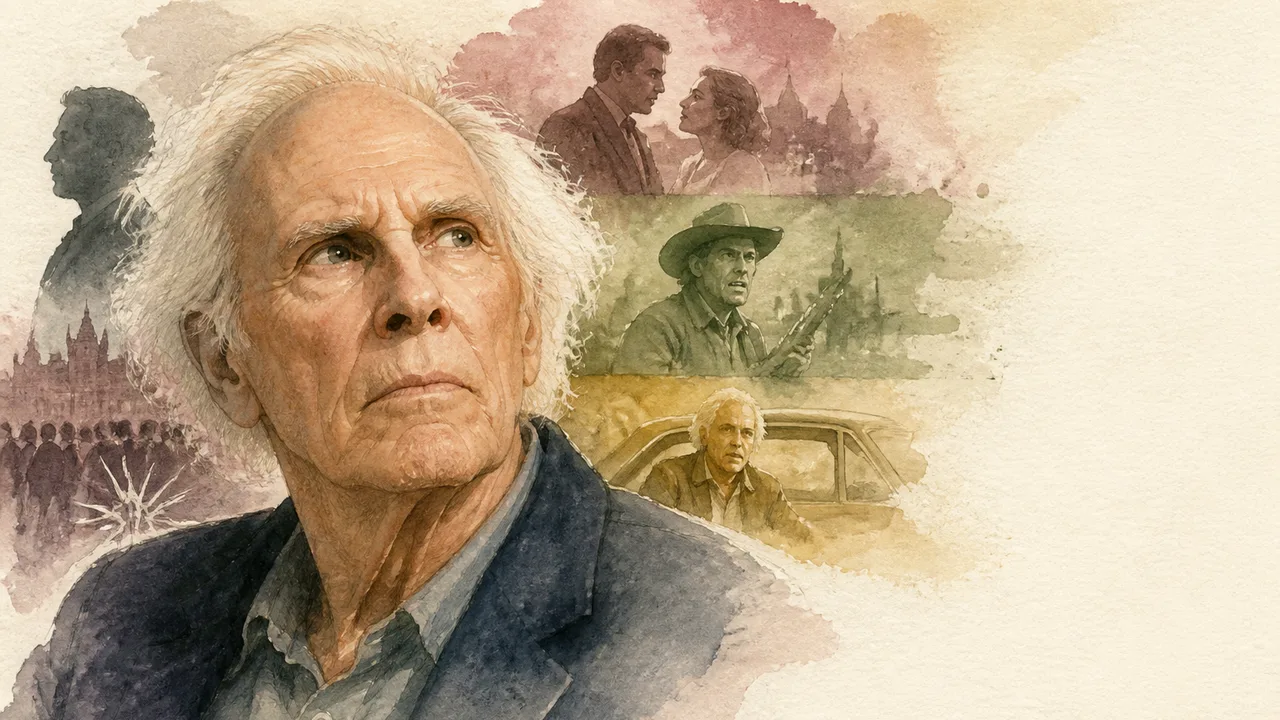
The most instructive thing about Bruce Dern's career might not be what's on his filmography. It might be what isn't.
At 90, Dern is in Edinburgh with a new film, granting interviews, telling stories — and the stories he tells with the most evident relish are the ones about walking away. According to The Guardian, he re-enacts, with evident pleasure, the exchange in which Richard Attenborough practically begged him to play the American journalist in Gandhi. Dern's rendition of his own response is worth quoting in full: "I said, 'Where do I have to go?' and he said, 'India'. I said, 'India? The country, India?' I said, 'I have a confession to make.'" What follows — his admission of a profound terror of snakes — is both punchline and, if you're paying attention, something more revealing than a good anecdote.
The role went to Martin Sheen. Gandhi won eight Academy Awards including Best Picture. By any conventional accounting, Dern made the wrong call.
He appears unbothered.
The pattern predates Gandhi by years. According to Goodreads, Dern's memoir — Things I've Said, But Probably Shouldn't Have: An Unrepentant Memoir, co-written with Robert Crane and Christopher Fryer — documents a career-long habit of declining precisely the films that would have made him a different kind of star. He turned down The Godfather. He turned down Marathon Man. These are not the omissions of an actor who couldn't get meetings. These are the choices of someone who kept arriving at the table and then standing up again.
What's interesting is less the individual decisions than what they collectively suggest about Dern's working theory of his own career. Most actors at that level are playing a longer institutional game — managing a brand, calibrating risk, building toward a certain kind of cultural permanence. Dern seems to have been playing something else entirely, a game whose rules he either never shared or invented as he went.
The result is a body of work that film culture has consistently struggled to categorize. He is recognizable as a type — the volatile outsider, the man whose menace never quite resolves into legibility — but the type doesn't adequately describe what he's actually doing in any given performance. Alexander Payne's Nebraska (2013) demonstrated this most visibly to contemporary audiences: Dern's Woody Grant is not threatening, exactly, but he is unsettling in a way that takes time to diagnose. The performance earned him the Best Actor prize at Cannes and an Academy Award nomination. He was 76.
The documentary currently making the circuit is titled Dernsie: The Amazing Life of Bruce Dern, and according to IMDB, it premiered at Cannes in 2026. The Sight and Sound interview tied to that premiere, published by the BFI, has Dern discussing Hitchcock, Tarantino, and Claude Chabrol — a range that underscores the degree to which his career has been genuinely international and genuinely varied, rather than the product of a single directorial relationship or national industry. He describes his early years as playing "little tiny roles," which is accurate in one sense but elides the fact that those tiny roles — in Wild Angels, in They Shoot Horses, Don't They?, in The King of Marvin Gardens — were defining documents of a particular strain of American cinema that the major studios were actively ignoring.
The Hitchcock relationship is a case study in what Dern's presence offered directors who knew how to use it. The collaboration produced something directors spend entire careers hunting: an actor capable of generating unease without tipping into the merely grotesque. What specific label Hitchcock applied to him remains disputed — the "golden calf" attribution that has circulated in various profiles cannot be traced to a verifiable source in the materials available, so it goes here without claim. What is verifiable is that Hitchcock kept hiring him, which is its own kind of testimony.
There is a version of the Bruce Dern story that Hollywood tells itself about eccentrics: the difficult genius who burns bridges but survives on talent alone. That narrative is almost certainly too simple. What the Gandhi anecdote actually reveals, when you sit with it, is that Dern has always been candid about the precise and sometimes bathetic nature of his limits. He did not invent a creative disagreement with Attenborough. He did not protect his mystique by citing artistic differences. He said he was afraid of snakes. The specific, unglamorous honesty of that is itself a kind of performance philosophy — and it distinguishes him from the generation of actors who treated self-mythology as part of the job description.
According to Emanuel Levy's reporting, the Gandhi situation carried an additional practical layer: Dern had wanted to know whether he could pursue his passion for long-distance running during the India shoot, and the answer was no. So the refusal was overdetermined — a confluence of phobia and lifestyle constraint that Attenborough, no matter how much he wanted Dern in the film, was not going to resolve. The snake story is funnier. It is also, apparently, only part of the story.
That gap — between the anecdote Dern performs and the fuller account the record suggests — is instructive. Not because Dern is being dishonest, but because the anecdote is doing specific work. The version with the snakes positions him as a creature of instinct, a man who makes decisions from his nervous system rather than his agent's spreadsheet. The version that includes the running underscores something more considered: a man who has always known what he needed to function and has built a career around honoring those needs, regardless of what opportunities they foreclosed.
At 90, at Edinburgh, still re-enacting exchanges with directors who have been dead for decades, Dern seems to be doing what he has always done — presenting his decisions as self-evident, unrepentant, and mildly baffling to everyone else in the room. His memoir's title — Things I've Said, But Probably Shouldn't Have — names this as a character trait. The anecdotes he keeps telling suggest it has also been his method.
The question the documentary presumably grapples with, and that Dern's ongoing presence in interview rooms makes live, is whether a career shaped so conspicuously by refusals constitutes a philosophy or simply a personality. The distinction matters less than it might seem. In Dern's case, the personality is the philosophy — and it has produced, across seven decades, a filmography that keeps rewarding a second look.
More Like This
Sam Neill Remembered: Actor, Winemaker, Generous Man
Sam Neill, who died at 78, is mourned by Hollywood and rural New Zealand alike. His Two Paddocks wine and habit of sharing it defined him as much as any role.
Is Nature Good? Harari and Žižek Say No
Yuval Noah Harari and Slavoj Žižek agree: nature isn't inherently good. Their debate reveals why "natural" is almost always a political argument in disguise.

Tim Pope and the Art of the Music Video
Tim Pope shaped MTV's golden age directing The Cure, Bowie, and Queen. His memoir revisits a creative window that reshaped how the world heard—and saw—music.

Jung's Late Bloomer Theory and What It Gets Right
A Jung-inspired video argues that slow starters build deeper lives. Here's a clear-eyed look at what the theory gets right—and what to hold with care.
Albert Einstein: From Scientific Genius to Global Brand
How Einstein became a million-dollar brand after death—and what the legal battles over his image reveal about fame, family, and intellectual property.

Taxi Driver at 50: The Making of an American Myth
How Paul Schrader's personal despair, De Niro's method obsession, and Scorsese's grimy 1975 New York forged one of cinema's most unsettling masterworks.

World Cup 2026's Heat, Cost, and Political Fault Lines
From $11,000 tickets to denied visas and doubled emissions, the 2026 World Cup's off-pitch challenges may define the tournament as much as the football.
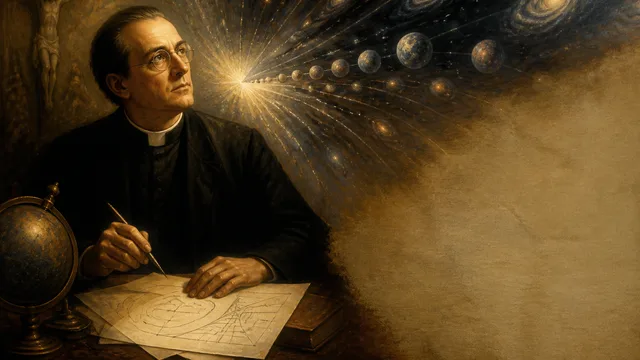
Did a Catholic Priest's Faith Corrupt the Big Bang?
Three cosmologists unpack whether Georges Lemaître's faith compromised his science—and why the real threat to cosmology is political, not theological.