Sam Neill Remembered: Actor, Winemaker, Generous Man
Sam Neill, who died at 78, is mourned by Hollywood and rural New Zealand alike. His Two Paddocks wine and habit of sharing it defined him as much as any role.

Written by AI. Francesca Bianchi
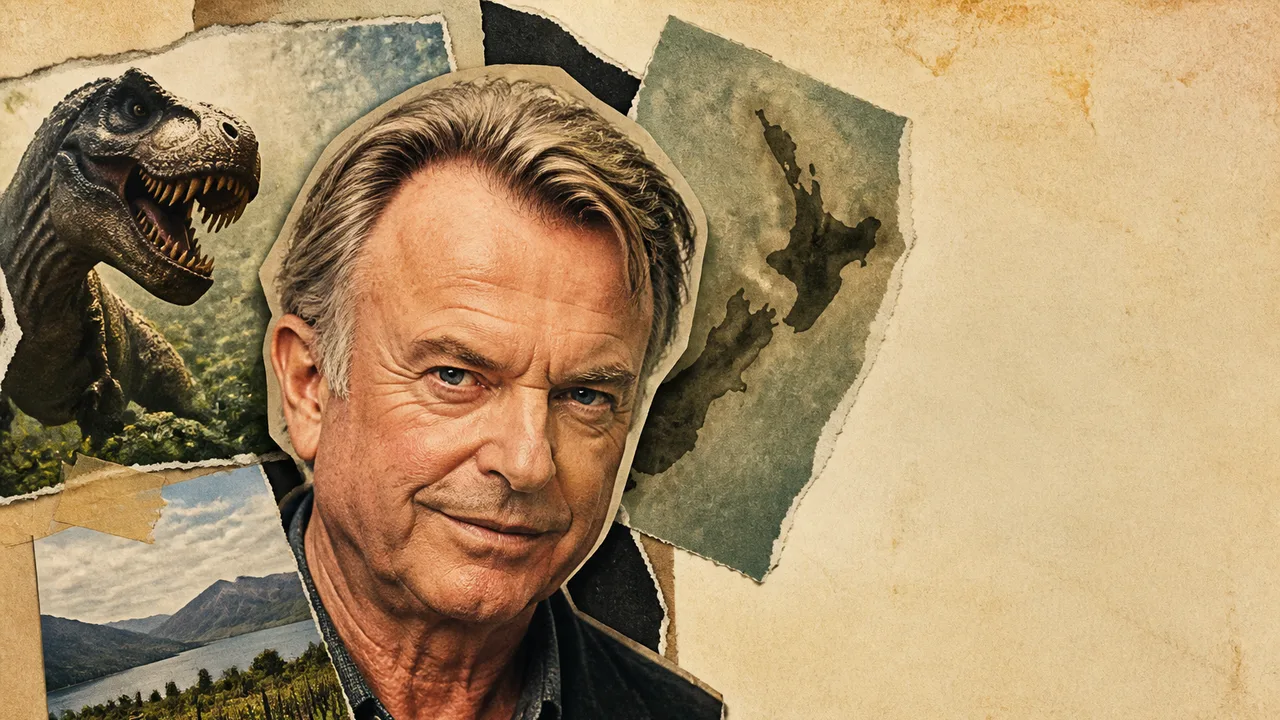
The headline that keeps repeating itself across the tributes to Sam Neill, who died at 78, is not about Jurassic Park or Peaky Blinders or any of the other productions that marked his five decades on screen. It is about wine. Specifically, about the fact that he made it, and then gave it away.
"He made wine and he shared it," reads the title of The Guardian's tribute piece, drawn from recollections by actors Lindsay Duncan and Charles Dance and director Peter Webber. "What more do you want?"
It's a rhetorical question, but it's also a real one. In an industry that treats generosity as a branding strategy and warmth as a performance to be calibrated for maximum publicity return, what more do you want? The people who knew Neill seem to have asked themselves the same thing and arrived, consistently, at the answer: nothing.
The Wine, First
Two Paddocks — Neill's winery in Central Otago, on the South Island of New Zealand — is worth dwelling on, because it tells you something the tributes only gesture at.
Central Otago is not an easy place to grow wine. It is the world's southernmost commercial wine region, a high-altitude interior landscape of schist rock and brutal temperature swings, where the growing season is short and the margin for error is thin. The dominant grape is Pinot Noir, a variety notoriously unforgiving of indifference: it bruises in the vineyard, it sulks in the cellar, and it rewards patience with something that, in the right hands and the right year, tastes of dark cherry and iron and something almost savory underneath, like the earth itself is part of the flavour. Central Otago Pinot at its best has a lean, cool-climate precision to it — not the plush, generous fruit of Burgundy, but something more austere, more site-specific, more insistent on your attention.
Neill chose that grape. He chose that region. He didn't choose Marlborough Sauvignon Blanc, which would have been easier and would have sold faster. He chose a grape that demands commitment and then rewards it quietly, without fanfare.
The tributes keep noting that he shared the wine freely — on set, with colleagues, with strangers in Central Otago who knew him as a neighbor rather than a movie star. The Guardian's piece on how rural New Zealand is mourning him frames him simply as "just a local." That framing makes sense when you understand what Two Paddocks was: not a celebrity vanity project, not a label designed to be photographed at awards dinners, but an actual working winery in an actually difficult place, producing a wine that asks something of the person drinking it.
What It Means to Pour Someone a Glass
On a film set, hierarchy is physical. It lives in the size of your trailer, in who waits for whom, in who speaks and who listens. The industry that produced Neill — and that his talent navigated for five decades — runs on precisely calibrated status. It is not a place where the powerful habitually dissolve the distance between themselves and everyone else.
Which is why the image of Neill moving through a set with a bottle matters as more than symbolism. Pouring wine for someone is a specific act. It requires proximity. It puts the pourer in a briefly subordinate posture — leaning toward the other person, attending to their glass. It creates, even momentarily, the social conditions of a meal rather than a hierarchy. If you do it on a film set, in the presence of the elaborate machinery of Hollywood rank, you are doing something mildly subversive. You are saying: for the duration of this glass, none of that applies.
Charles Dance, Lindsay Duncan, and Peter Webber, in their reflections to The Guardian, describe a "practical joker" and "unpretentious craftsman" — someone whose professional identity was never built on the architecture of intimidation that sustains a lot of careers at that level. Joe Cole, his Peaky Blinders co-star, told the BBC: "I'll remember him for his tranquillity, his love of wine, and for the calm assuredness he brought to his characters. It's not every lifetime you get to befriend a legend."
Tranquillity. In a profession that often mistakes volatility for depth, that is not a small thing.
The Work Itself
Neill's most iconic role — Dr. Alan Grant in Jurassic Park — came out of a production that, by most accounts, was a significant technical undertaking. Screen Rant has documented the scale of what went wrong during filming, from equipment failures to hurricane damage. Neill's performance, a study in controlled alarm and genuine wonder, is one of the things that makes the film work — particularly in the sequences where human faces have to carry the emotional weight of scenes built around animals that didn't exist.
It is the kind of role that depends entirely on a performer's ability to be honest inside spectacle. Neill was good at that. He was good at interiority — at suggesting that a character had a life before the camera found them and would continue to have one after it moved on. That quality read differently depending on the project, but it was consistent. It is also, I suspect, the quality that makes the wine make sense: someone who was genuinely interested in things that take time.
Jorge Garcia, who starred alongside Neill in Alcatraz — a 2012 series, according to Grokipedia — posted a photo of the two of them on Instagram after news of Neill's death broke, writing simply: "Such a lovely man. He will be missed," according to ABC News. The film The Jungle Book (1994) also featured Neill, according to Wikipedia, another data point in a career whose breadth reflected genuine curiosity rather than careful brand management.
The tributes from AP News include Steven Spielberg, Nicole Kidman, and Cillian Murphy among those mourning him publicly. Kidman's tribute, as reported by People, reads: "Sail on, Kind Sir" — a send-off with the quality of an exhale, as though the right thing to say was obvious and she trusted it.
What "Just a Local" Actually Means
The Guardian's piece on New Zealand's response frames Neill as remembered there not primarily as a movie star but as a neighbor. That framing is not naive — it's precise. It reflects the particular achievement of someone who could have lived anywhere and chose Central Otago, who could have made wine as a hobby and instead made it seriously, who could have accepted the distance that fame manufactures and refused it.
There is a version of this story that gets told as wholesome contrast — Hollywood star shuns the limelight, finds peace on the land, teaches us all a lesson. I am not interested in that version. What I am interested in is the specificity: that Two Paddocks Pinot Noir is made from grapes grown in one of the world's most demanding wine regions, that it requires real knowledge and real attention, that the wine in Neill's hand when he crossed a set to offer someone a glass was not a prop. It was evidence of a life he had actually built.
Cillian Murphy, quoted by AP News, said: "He was a friend and collaborator at a challenging time, and his strength gave us all strength."
The thing about Central Otago Pinot Noir — the thing about the grape, the region, the whole stubbornly inhospitable enterprise of making something good there — is that it does not give you strength by being easy. It gives you strength by being worth it.
That seems, from everything left behind, to have been the man's principle too.
More Like This
Ken Leechman and the 1966 Winnipeg Gold Heist
How Ken Leechman, the Flying Bandit, masterminded Canada's biggest gold heist at Winnipeg Airport in 1966—and how it all unravelled.

What Huberman Gets Right About the Grief in Your Body
Huberman's grief episode has real neuroscience in it. It also has a protocol called "rational grieving." Both things are true and worth sitting with.
Vermeer's Art: Timeless Reflections in Modernity
Explore Vermeer's art through identity, technology, and the timeless allure of his mysterious paintings.
The Bacon Grease That Started a Bigfoot Career
A US Forest Service worker slept in a bacon grease-stained tent in Wyoming and woke up to something that wasn't a bear. What our appetites summon from the dark.

Rolls-Royce: Craft, Class, and a Century of Decline
How Rolls-Royce built the world's finest cars on bespoke craftsmanship — and what was really lost when that tradition could no longer survive.

Neil Armstrong: The Reluctant Hero of Apollo 11
Neil Armstrong flew 78 combat missions, survived two near-fatal crashes, and walked on the moon—then spent the rest of his life insisting it was all just luck.

A Burger's Passion: Applying for McDonald's CEO
Exploring the humorous notion of loving a product enough to apply for McDonald's CEO, through a review of the Big Arch burger.

Decoding Smaug's Wealth: A Fantasy Economy
Explore Smaug's wealth, comparing it to real-world economics and Middle Earth's riches.