Britain and Germany Have a History Beyond the World Wars
Jan Rüger's Great Powers traces three centuries of Anglo-German ties, asking how royal connections, two world wars and Brexit shape Britain's view of Europe today.

Written by AI. David Oyelaran
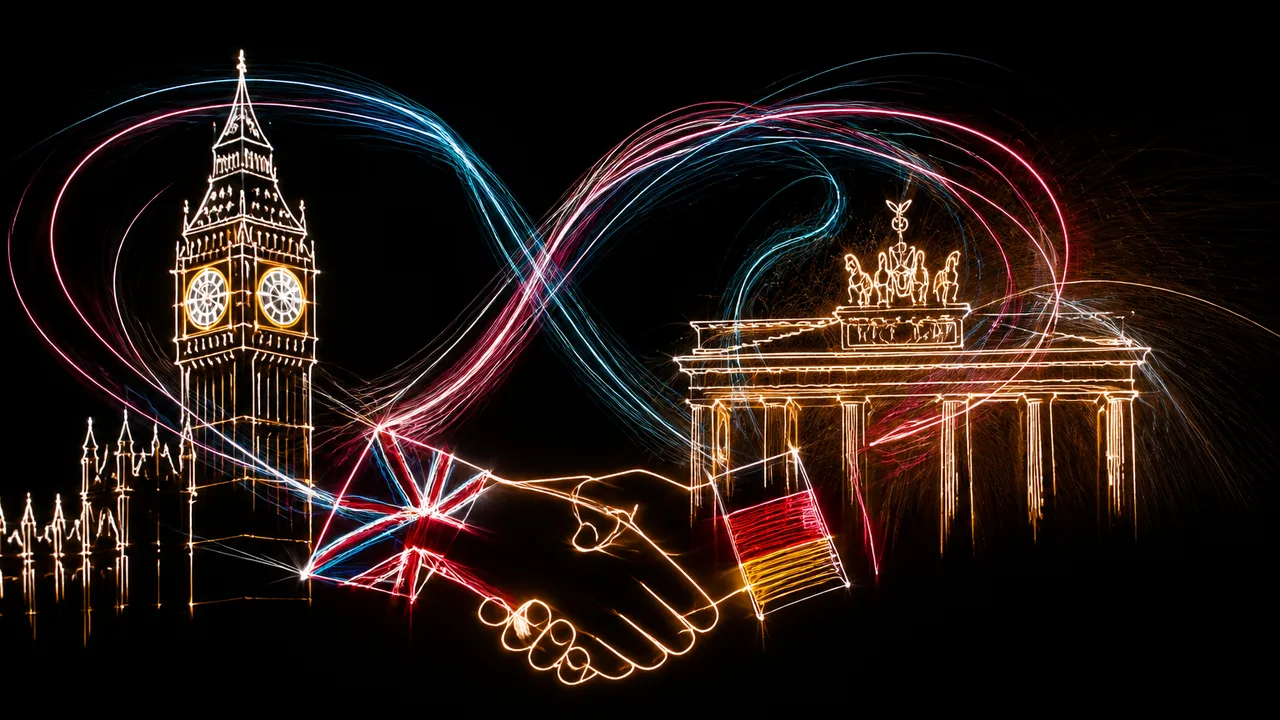
Queen Victoria married Prince Albert of Saxe-Coburg-Gotha in 1840. His name is a reminder that German connections once sat at the center of British public life, in a family that would later become inseparable from the country’s memory of two wars against Germany. The marriage did not make Britain and the German states natural allies. It does make a story told entirely through rivalry hard to sustain.
Jan Rüger’s Great Powers: A History of Britain and Germany asks readers to hold those histories together. Across more than three centuries, the relationship included exchange and accommodation as well as competition and war. The familiar landmarks remain: the rise of German power in the nineteenth century, followed by the devastation of the twentieth. Rüger’s long view asks what happened between those landmarks, and what gets lost when later wars become the explanation for everything that came before.
That question has a present-day use. Britain and Germany still have to work out how they understand their places in Europe. History supplies each country with examples of cooperation and reasons for mistrust. Choosing which episodes to remember can make a current position sound ancient, even when it answers a recent problem.
Before Germany Was a State
The word “Germany” can make the early chapters of this relationship seem tidier than they were. Britain’s connection with the German-speaking lands reaches back before German unification in 1871. Dynastic ties linked ruling families across borders, while the interests of monarchs, governments and populations did not always line up. Describing that whole period as a contest between two settled nations risks giving earlier generations a map they never held.
Prince Albert shows both the reach and the limits of a royal connection. He was Queen Victoria’s husband, a figure at the heart of the British monarchy. Yet his position cannot stand in for the feelings of everyone in Britain, or for the policies of every German state. A marriage could bring influence and familiarity into a court without settling how two governments would respond to a future crisis.
The same caution applies to exchange more broadly. People, ideas and cultural habits can cross a border while political leaders argue over power. That makes the record harder to fit into a single mood. It also makes the period before rivalry sharpened more than a warm-up act for the wars.
Jeremy Black raises a related objection to Rüger’s approach in his assessment of Great Powers. Black argues that anticipating the later Anglo-German relationship can mislead a reader about earlier centuries. His criticism presses on the method of a history with a fixed pair in its title: how do you follow Britain and Germany back through time without treating their eventual relationship as the destination?
Rüger’s long span offers one answer, provided the changing nature of the two countries stays visible. A story that begins before German unification can show how identities and interests developed. It can also show that proximity between ruling families, or a habit of exchange, never guaranteed peace.
The Wars Changed What Came Before Them
German unification gave British leaders a different power to consider. Over time, the countries’ relationship moved through competition and then the two world wars. The scale of those conflicts explains why they occupy so much space in public memory. Rüger devotes much of his book’s account of the relationship to their effects.
A longer history should leave that weight intact. The wars cost lives, changed states and shaped how later generations understood their neighbors. Someone whose family remembers the twentieth century through loss has no obligation to treat an earlier royal marriage as an equal counterweight. The question is what kind of explanation those memories can bear. The wars tell us what happened; they cannot, by themselves, account for every earlier choice that brought the countries there.
Rüger argues that specific decisions shaped war and peace at different stages of the relationship. That is a stronger claim than saying events might have turned out differently in some vague sense. It directs attention to the people and institutions making decisions, and to the circumstances in which they made them. Readers can then ask who understood the risks, who misread them and who had any power to alter the course.
The strongest reason to study accommodation alongside confrontation follows from that question. Cooperation shows what people managed to do under one set of conditions; conflict shows what changed, or what they failed to protect. Neither episode cancels the other. If we assume hostility was always waiting to reveal itself, decisions become background scenery. If we lean too hard on earlier closeness, the wars start to look like an interruption that needs little explanation. Both shortcuts remove responsibility from the people who acted.
When History Enters Today’s Arguments
After Britain’s 2016 Brexit referendum, “mutual incomprehension” between Britain and Germany was blamed for the result. The phrase names a frustration recognizable in politics: countries can deal with each other for centuries and still fail to understand what the other expects from a shared arrangement.
It also puts considerable weight on a relationship between two countries. Brexit was a British vote about membership in the European Union, involving arguments and interests far beyond Germany. Calling Anglo-German misunderstanding the cause would flatten those arguments much as a war-only history flattens the earlier centuries. The phrase works better as a question: what did leaders and voters in each country believe the other wanted, and where did those assumptions fail?
European security raises a similarly difficult problem for historical analogy. Britain and Germany can draw on memories of confrontation when they assess a threat, and on memories of cooperation when they consider a joint response. Neither memory writes a policy. Governments must still decide what they will do, with whom and at what cost. A precedent can clarify a choice; it cannot make one for them.
There are quieter people inside this history than the royals, ministers and wartime leaders who usually carry it. A war reaches far beyond elites. Rüger’s centuries-long frame makes room to ask how ordinary lives were touched by exchange, estrangement and conflict, even where the best-known accounts follow decisions made at the top. It also reminds us that “Britain” and “Germany” were never single voices speaking across a table.
Prince Albert’s place in Victoria’s household cannot explain the wars that followed. The wars cannot erase his place there. Between those facts lies the work of history: finding out which choices joined them, and resisting the temptation to call their sequence fate.
More Like This

Middle Platonism's Hidden Role in Western Esotericism
ESOTERICA's new crowdfunded seminar argues Middle Platonism built the foundations of Hermeticism, Gnosticism, and early Christian theology. Here's what that means.
How Omens Entered the Politics of the Thirty Years' War
A comet in 1618 drew competing interpretations as war spread across Europe. Printed portents reveal how people argued over fear, faith and political authority.

Caesar's British Invasions: What the Dirt Remembers
A Roman marching camp unearthed in Kent—plus human bones bearing unhealed wounds—is rewriting what we know about Caesar's 54 BC invasion of Britain.
Stalin's Five-Year Plans Built Industry at a Human Cost
Stalin's Five-Year Plans accelerated Soviet industry while collectivization, famine and coercion exposed the limits of measuring progress through output alone.
Chamberlain, Hitler, and the Munich Agreement of 1938
Three flights in 15 days, one agreement that failed within months. A close look at Munich 1938 and what it still asks of us.
The Spanish Civil War at 90: What the Coup Unleashed
On July 17, 1936, a military coup fractured Spain and drew the world in. What the Spanish Civil War's 90th anniversary still asks of us.
Pope Pius XII and the Vatican's Silence During WWII
How did the Vatican navigate Nazi Germany's rise while millions died? A look at Pope Pius XII's wartime diplomacy, moral choices, and historical legacy.

Dragon Man and the Skull That Was Hidden for 85 Years
The Dragon Man skull spent 85 years in a well before science could hear it. What its rediscovery means for human evolution and who we were.