Arminius and the Betrayal That Broke Rome's Empire
How a Germanic prince trained by Rome destroyed three legions in the Teutoburg Forest in 9 AD — and fixed the Rhine as Europe's dividing line forever.

Written by AI. James Morrison
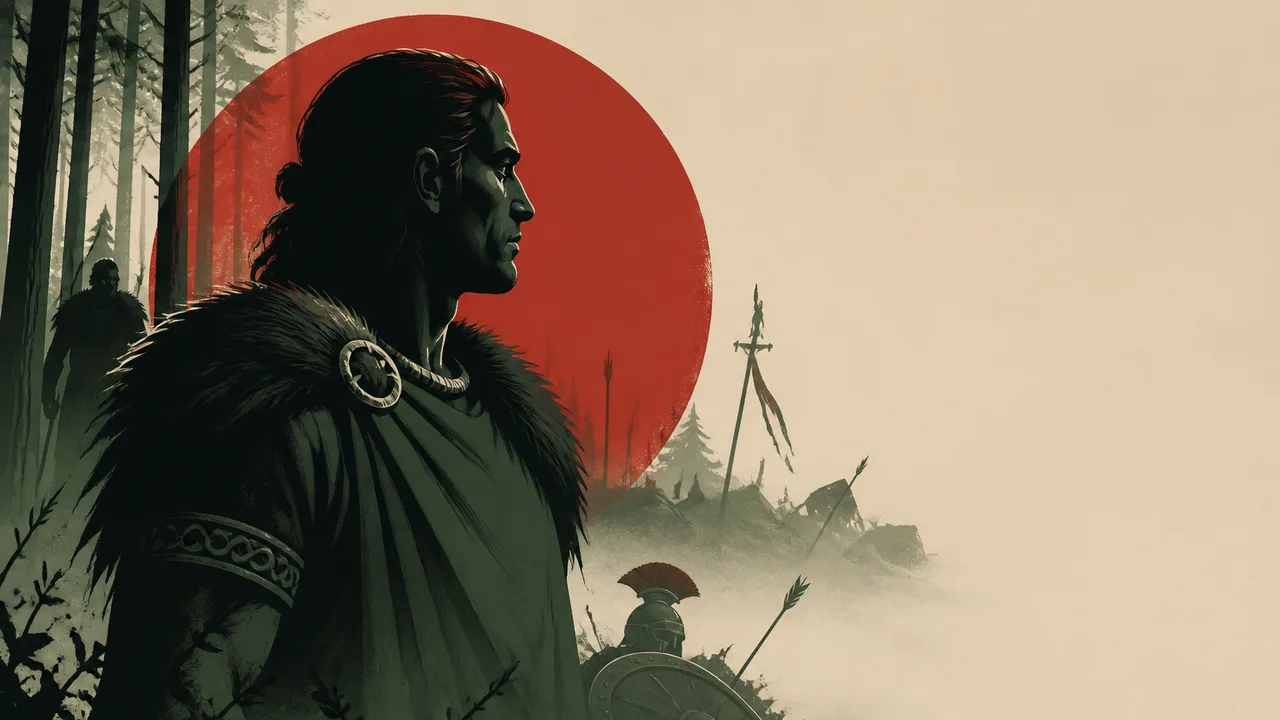
Photo: AI. Mika Sørensen
The program made perfect sense on paper. Take the sons of tribal chieftains — potential enemies, future leaders — bring them to Rome young, educate them alongside the children of senators, give them Latin, law, military science, citizenship, rank. Send them home as Rome's men. The logic had worked before. Juba of Numidia went through the same system, grew up to be a scholar-king of considerable sophistication, and never once raised a hand against the empire that had raised him. Augustus expected the same return on every such investment.
He was catastrophically wrong about one of them.
The Program and Its Flaw
Arminius and his brother Flavus, sons of the Cheruscan chieftain Segimer, arrived in Rome as boys — hostages by function, students by Roman euphemism. They absorbed everything the city offered: rhetoric, philosophy, Roman law, and above all the science of war as Rome practiced it. Logistics. Siege craft. The geometry of a disciplined infantry line. Velleius Paterculus, who served on the German frontier and knew these men firsthand, described Arminius as "a young man of noble birth, brave in action, quick in mind" — and recorded it as praise, apparently without registering what it foretold.
Rome gave Arminius citizenship, then raised him to the equestrian rank — a Roman knight, not a barbarian auxiliary. They handed him command of German cavalry, the flanking units that scouted ahead of every marching column. He bled for the eagle. Between AD 6 and 9, he rode alongside the legions grinding down the Pannonian revolt, sitting in Roman strategy tents, eating Roman food, learning not just how the machine worked but precisely where it was vulnerable.
He was hunting for the seams. He found them.
The legion on a flat plain was, as the Ancestral documentary puts it, essentially unconquerable — a wall of locked shields and short stabbing swords that could grind through opposition like a mill through grain. In dense forest, in a tight ravine, it became something else entirely: a long, helpless snake of men waiting to be chopped apart. Arminius filed that observation away alongside everything else. He was the program's prize product. He was also, simultaneously, its executioner.
What Rome's foreign military education programs have historically failed to account for — and the International Military Education and Training program, which has brought tens of thousands of foreign officers through American institutions since the Cold War, has not fully resolved this either — is that education transfers knowledge without transferring allegiance. You can teach a man to think like a Roman. You cannot teach him to want what Rome wants.
The Governor and the Trap
Publius Quinctilius Varus was not a stupid man. He was the wrong man. Velleius Paterculus wrote of him with barely concealed contempt: a man more accustomed to the quiet of a camp than to the demands of actual war, who had governed Africa, then Syria, and arrived in Germania expecting to find the same pliable population — people who could be taxed, litigated, and administered into submission.
Cassius Dio, writing two centuries after the fact, put the problem plainly: Varus tried to change the tribes faster than they could bear, "giving them orders as if they were slaves and demanding money as if from subjects." He dragged chieftains into Roman courts to argue over land under laws they had never heard of and would never accept. He was not pacifying Germania. He was loading it.
Arminius watched this from Varus's own table. Dio records that the governor came to treat him as a friend, dining with him, sharing counsel, trusting him above his own Roman staff. By day, Arminius advised Varus on managing the restless locals, painting his own people as a fractured rabble too consumed by old blood debts to ever unite. By night, he rode into the forest to do exactly the opposite — meeting with the chiefs of the Cherusci, the Marsi, the Bructeri, the Chauci, the Sugambri, using the rhetoric Rome had drilled into him to forge a coalition from their mutual grievances.
The key to the trap was not the ambush. It was the prior architecture of trust. Arminius had spent years making himself indispensable, making the governor's confidence in him feel like his own good judgment. When a rival Cheruscan chief named Segestes walked into Varus's tent in the late summer of AD 9, named Arminius as a traitor, and offered to be chained alongside the conspirators as proof of his sincerity, Varus looked at the desperate, sweating older man and saw only a bitter father-in-law. Arminius had carried off Segestes's daughter Thusnelda against her father's wishes. Obviously, this was a domestic quarrel dressed as an alarm.
Varus waved Segestes off like a fly. That dismissal killed three legions.
Three Days in the Rain
The lure was a fabricated uprising — a small tribe to the north had stirred, Arminius reported, and an unpunished revolt spreads. He drew the route with a finger on the campaign map. A short detour through the Teutoburg Forest, a show of force, back on the road within days.
What the three legions — the 17th, 18th, and 19th — marched into was a killing corridor. Between the wooded slope of the Kalkriese hill and a great bog to the north ran a strip of firm ground only a few hundred paces wide. Arminius had built a turf rampart along the base of the slope that blended into the hillside from the path below. He had chosen the terrain because it annihilated everything a Roman formation could do. No room to deploy a battle line. No clear sight lines for ranged weapons. Nine miles of column stretched thin as thread through a forest that had been arranged, in every meaningful sense, as a machine for killing them.
The storm came with them. Cassius Dio describes violent wind and driving rain that snapped treetops down onto the column — and reading Dio's account closely, as documented at Livius.org, the pattern of the weather seems almost designed: conditions that disabled Roman bowstrings and swelled their wooden shields to useless weight broke hardest at the moments Rome most needed to respond. Whether that pattern was as systematic as it appears in Dio's telling, or whether Arminius simply chose a season and terrain where such weather was predictable, the effect was the same. The rain was an ally.
The rampart erupted. Javelins came from the left — from high ground, thrown by men no Roman could see. There was no room to charge the slope, no room to form a line, no room to do anything that Roman training prepared a man to do. Cassius Dio described it: men, horses, and carts crushed together on ground already broken by storm, unable to keep footing to fight or even to run.
It went on for three days. By the end, Varus had taken a wound and understood, at last, what had been done to him. He fell on his own sword rather than be taken alive. His senior officers followed him into death. The 17th, the 18th, and the 19th were struck from the army rolls. No later Roman legion ever carried those numbers again. Augustus, by Suetonius's account, beat his head against the doorposts of his palace for months, crying the same words into the empty corridor: Quinctilius Varus, give me back my legions.
What Survives
Six years later, Germanicus led a Roman army back into the forest and found the clearing. What his soldiers saw there, Tacitus recorded from men who had stood in that place: bones scattered where men had run, heaped where they had made a last stand. Skulls nailed to tree trunks. Altars where captured tribunes and centurions had been killed before the German gods. The soldiers of Germanicus began to bury the dead, unable after six years of weather to tell stranger from kinsman. Germanicus set the first turf on the grave himself.
Tiberius, back in Rome, disapproved. An emperor's heir and an augur, he thought, should not have touched the dead. Even in grief, the living kept scoring points.
Rome never made another serious attempt to provincialize Germania. The Rhine became the border — a line drawn in a single autumn that would, in one form or another, divide Latin Europe from Germanic Europe for two thousand years. Modern archaeology at Kalkriese has confirmed the battlefield, the rampart, the trap. The physical evidence matches Dio's account with uncomfortable precision.
Arminius did not live to see what he had built become permanent. His own kinsmen killed him around the year AD 21, fearing he meant to make himself a king. He was thirty-seven. Tacitus, a Roman with every reason to write him small, gave him the epitaph the man's own people were still singing generations later: beyond doubt the liberator of Germania.
His wife Thusnelda — the daughter he had stolen from Segestes, the man who tried to save Varus — was captured by the Romans while pregnant with Arminius's son. Segestes himself watched her led through the streets of Rome in Germanicus's triumph from a seat of honor in the stands. Her son, born in Roman captivity and named Thumelicus, grew up on Roman soil and then vanished entirely from the historical record. Arminius never saw the boy.
The program produced exactly what it promised: a man who understood Rome completely. What it could not guarantee — what no such program has ever been able to guarantee — is what that understanding would be used for. School of the Americas graduates ran the death squads in El Salvador in the 1980s. The assumption that training equals loyalty collapsed there the same way it collapsed in the Teutoburg Forest, for the same reason: education without allegiance is just capability in someone else's hands.
More Like This

Ray Dalio's Framework for Tracking Empire Decline
Ray Dalio argues empires follow measurable, repeating cycles of rise and fall. His framework deserves scrutiny—and raises questions relevant to today's geopolitics.
Sun Tzu's Brutal First Lesson and the Real Art of War
A new documentary examines the palace courtyard execution that launched Sun Tzu's career—and asks whether we've been misreading The Art of War for 2,000 years.
FBI's Struggle Against Omega 7: A Tale of Terrorism and Intrigue
Explore the FBI's complex investigation of Omega 7, a Cuban exile terrorist group, amid community challenges and evolving tactics.
The Spanish Civil War at 90: What the Coup Unleashed
On July 17, 1936, a military coup fractured Spain and drew the world in. What the Spanish Civil War's 90th anniversary still asks of us.
How Roman Soldiers Survived Winter in Germania
Roman legionaries in Germania weren't built for the cold—but they survived it anyway. Here's what that survival actually looked like, and what it cost them.
McClellan's Civil War Failure and the Cost of Hesitation
George McClellan built the finest army America had seen — then refused to use it. What his hesitation cost the Union, and what it still costs us today.
April 1865: How the Civil War's End Was Decided
The History Channel's documentary on April 1865 examines how decisions made in a single month determined whether the Civil War's end would bring peace or prolonged guerrilla conflict.
The Nine Days of Bismarck: A Battle That Changed Naval War
How nine days in May 1941 destroyed Germany's mightiest battleship, sank the Royal Navy's iconic HMS Hood, and ended the battleship era for good.