Angola Prison's Plantation Past Still Shapes Its Story
Angola prison sits on former plantation land. Its history of convict leasing and harsh conditions raises questions about labor, punishment and state power.

Written by AI. Sofia Ramirez
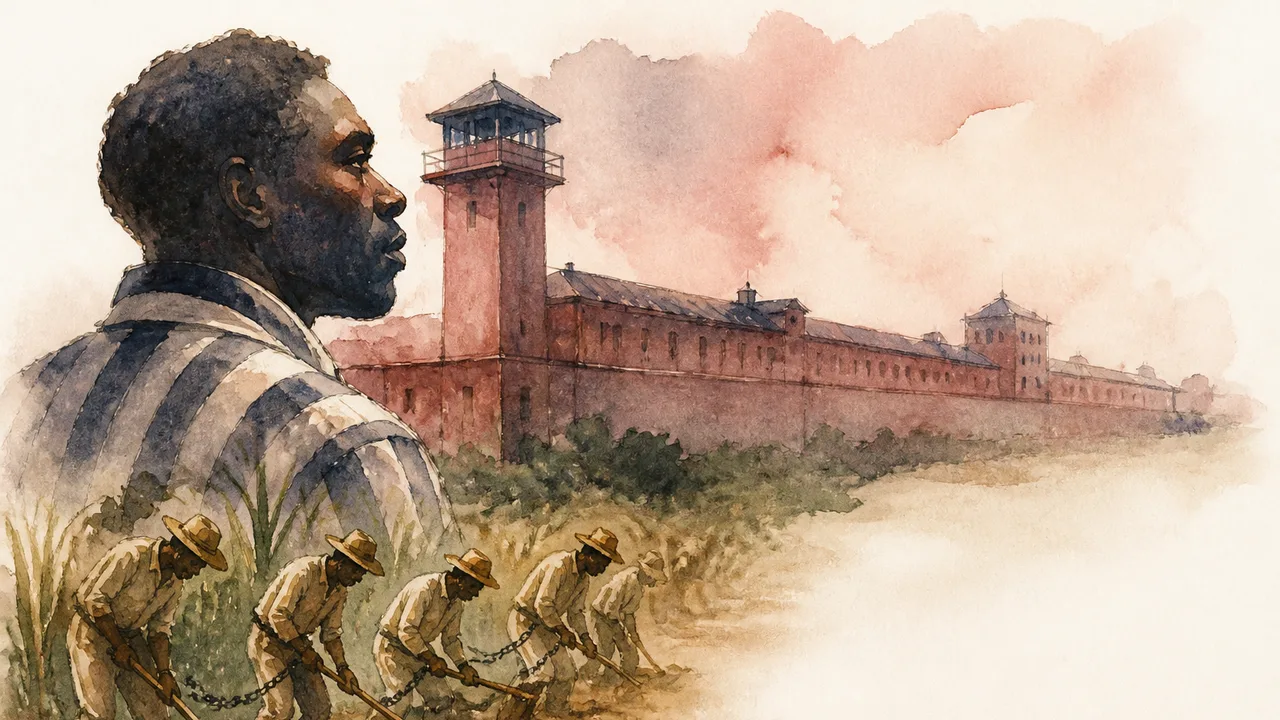
The land beneath Louisiana’s Angola prison once belonged to Isaac Franklin, a partner in one of the country’s largest slave-trading firms. Before the Civil War, the property was known as the Angola Plantations. Today it holds the Louisiana State Penitentiary. Those two facts belong in the same sentence because the institution’s history asks what happened to labor and power on that land after emancipation.
Angola is often called “the Alcatraz of the South.” The nickname points toward its reputation for harsh conditions, but it gives readers an island-prison image when the more revealing geography is underfoot: a former plantation operated as a prison by the state. Geography alone cannot explain every decision made there since. It does tell us which history a description of Angola must account for.
The Dates Do Different Work
Louisiana’s prison history at Angola stretches across several dates that can be easy to collapse into one origin story. Convict leasing began in Louisiana in 1844, before the Civil War, and continued into the 1900s. Under leasing, governments put incarcerated people to work for outside interests. Emancipation later made that arrangement part of a larger Southern struggle over who could control Black labor and on what terms.
The penitentiary opened on the former plantation site in 1901. That date marks a change in institutional arrangement, not the first time people had been compelled to work there. Franklin’s plantation, Louisiana’s convict-leasing system and the state prison belong to different periods. The connection among them is the recurring use of confinement and compelled labor within a regional economy long organized around plantations.
The Thirteenth Amendment abolished slavery and involuntary servitude while allowing involuntary servitude “as a punishment for crime whereof the party shall have been duly convicted.” That exception did not dictate every Southern labor practice. It did leave governments with legal power to compel work from people convicted of crimes. After emancipation, officials could exercise that power in a society where racial hierarchy still shaped policing, punishment and access to freedom.
That sequence calls for precision. Enslaved people on Franklin’s property, people leased out under Louisiana’s penal system and people incarcerated at the penitentiary lived under different laws and institutions. Treating them as interchangeable would erase the choices governments made at each stage. Treating 1901 as a clean beginning would erase the labor system the prison inherited.
What a Prison Nickname Can Hide
Angola’s reputation for brutality has a history of its own. Riots and assaults were commonplace inside the prison, and its harsh conditions helped give it the Alcatraz nickname. Violence deserves direct attention. But a nickname built around danger can turn every person inside into scenery for a story about a frightening place.
That shorthand also narrows the questions people ask. How was work assigned? Who decided what punishment followed a refusal? How did a family maintain contact with someone held there? What did staff understand their responsibilities to be? These questions put decisions and relationships back into a story that can otherwise sound as though the land itself ran the prison.
The scale makes those relationships impossible to dismiss. Angola is operated by the Louisiana Department of Public Safety and Corrections and is identified as the largest maximum-security correctional facility in the United States. A prison described in terms of thousands of incarcerated people and staff also reaches outward to families and communities. Isolation affects more than the person serving a sentence; it affects the people trying to stay in that person’s life.
Scale can obscure differences among incarcerated people, too. They entered under different circumstances, faced different lengths of confinement and experienced the institution differently. Staff members had different jobs and degrees of authority. A history that makes everyone at Angola stand for one unchanging idea loses the people whose lives give that history its stakes.
The Questions Labor History Puts to Angola
The plantation connection often enters public discussion as a visual comparison: a prison on land where enslaved people once worked. The harder inquiry concerns rules. Who held the authority to demand labor at each point in the property’s history? Who benefited from the work? What options did the workers have, and what happened if they resisted? Those questions make it possible to trace change without pretending that a change of name settled the underlying struggle over power.
Convict leasing makes the inquiry especially sharp. Louisiana used it before emancipation, then continued it through the era when Southern governments and employers sought ways to command labor after slavery. The institution changed; the demand for workers remained. The timing does not mean every person convicted of a crime was innocent, or that every sentence served an employer’s interests. It means the history of punishment cannot be separated from the economic uses to which punished people were put.
There is a contemporary question inside that history. When a government requires incarcerated people to work, how should the public judge the work? The answer may depend on its purpose, the conditions, the compensation, the ability to refuse and who receives the benefit. Security and the daily operation of a large institution are also part of the terrain. A serious account of prison labor has to examine those details rather than rely on the former plantation setting to answer every question in advance.
Reform requires the same care with dates and consequences. A change in prison management, a new rule or an improvement in conditions may alter daily life for people inside. It cannot undo what earlier prisoners experienced. Nor does the persistence of a painful history prove that nothing inside an institution can change. Readers need to know which conditions changed, for whom and when before either claim carries much weight.
Angola’s past is unusually visible because the former plantation and the penitentiary share a place. Its present is harder to understand through a single image. The nickname directs attention to walls and violence; the land directs attention to slavery and labor. Neither tells a family how a visit went, or an incarcerated person what tomorrow’s work will require. A history adequate to Angola has to keep those lives in view while asking who, across generations, has had the power to decide what happens on that ground.
More Like This
Douglas MacArthur and the People He Left Behind
MacArthur is remembered as a military legend. But what about the veterans he gassed, the soldiers he abandoned, and the Japanese citizens who built a new democracy?
California's Hidden Underground: Caves, Tunnels, and Buried History
From a buried Gold Rush city to survival tunnels built by Chinese immigrants, California's underground holds layers of geology, history, and forgotten infrastructure.
Medieval England: How Peasants and Guilds Shaped Society
A new documentary traces medieval England's social divide through two real families—one peasant, one guild merchant—and the starkly different worlds they inhabited.
How the Continental Congress Named the United States in 1776
On September 9, 1776, Congress swapped 'United Colonies' for 'United States.' The name left the country's whole structure deliberately unresolved. Here's how.

Roosevelt's 1936 Peace Promise: What He Really Meant
In 1936, FDR ran on "peace" — but he meant three different things by it. Unpacking that word reveals a political strategy still worth examining today.

The Anaconda Plan Was Right. People Paid for It.
Winfield Scott's Anaconda Plan was strategically vindicated — but the years it took to work were paid for in hunger, death, and bondage by ordinary people.