Alpine Glaciers Are Melting at a Record Pace in 2026
ETH Zurich scientists are measuring record ice loss on the Rhône glacier this summer. What the melt stakes, pink dye, and one researcher's surprise tell us.

Written by AI. Nadia Marchetti
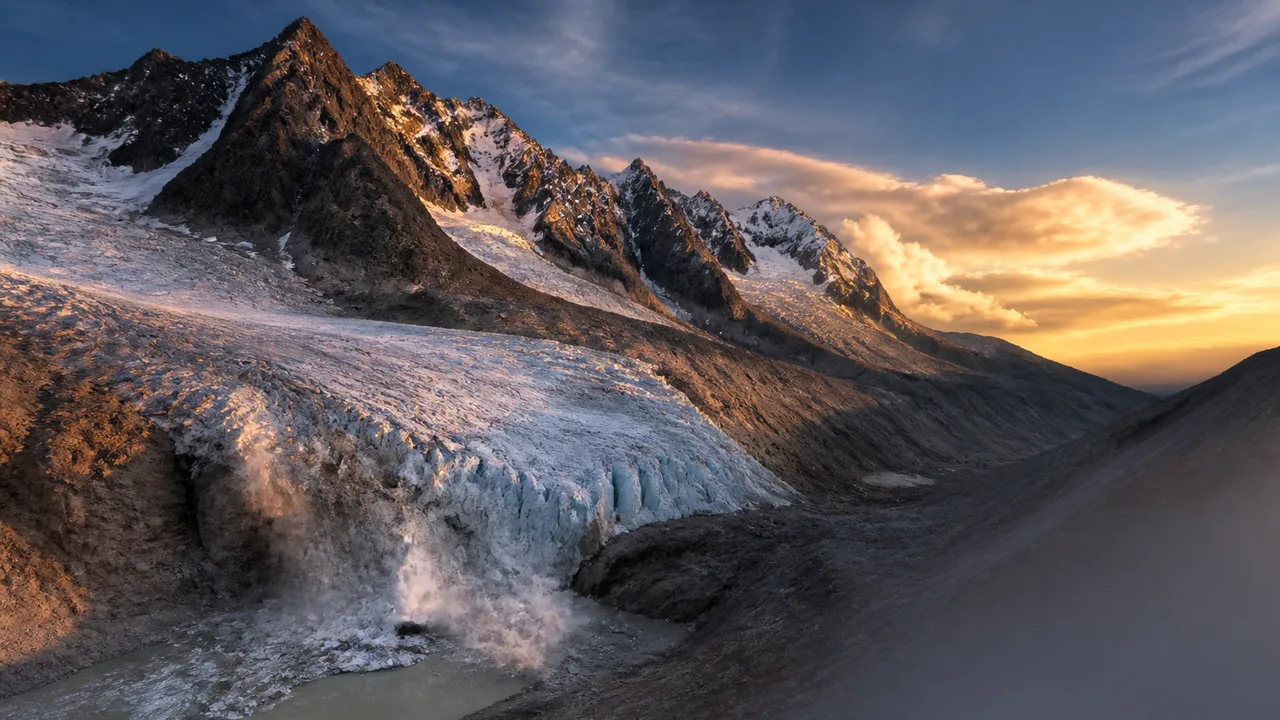
Photo: AI. Castor Belov
Andreas Bauder has spent decades drilling melt stakes into the Rhône glacier. He knows what a bad summer looks like. So when he told the camera, "I did not expect it," that deserves to register as something more than a throwaway line.
Bauder, a glaciologist with ETH Zurich, was explaining what he found when he returned to a stake he had drilled in at the end of July: two meters of ice had vanished in four weeks. The stake was about to melt out entirely, which would have ended its usefulness, so he re-drilled it two meters deeper into the glacier surface. Six meters of ice had gone since the previous fall. For someone whose professional life is the careful, systematic expectation of ice behavior, that admission carries weight. These are scientists whose job is building predictions about ice over time, and Bauder's prediction was wrong. He said so, plainly, on camera.
The Rhône glacier monitoring is part of ETH Zurich's long-term program tracking more than 100 Alpine glaciers, and what the team found this summer fits a pattern that prior reporting on the 2026 melt season has been tracking: extreme melt years are arriving more often, and this one may exceed them all. According to New Scientist, more than 9 meters of ice have already melted off the Rhône glacier's surface this season, and forecasters warn that above-average temperatures could persist through autumn.
The altitude numbers are stark on their own. Bauder's team was filming at 2,800 meters, which he described as historically the upper limit of summer melt on the glacier. This summer the melt line had pushed past 3,100 meters, and he thought it might reach 3,200. That is not a statistical abstraction. It is a physical boundary that glaciologists have used for decades as a reference point, and it moved.
What the pink dye can and cannot tell us
Bauder's colleagues have been injecting pink dye into meltwater streams running off the Rhône, and I find myself wanting to press gently on what that experiment currently shows versus what the researchers are hoping to learn from it.
Tracking dye through glacier hydrology is a standard method for mapping subglacial drainage, figuring out how fast meltwater moves, which channels it uses, and where it surfaces. What the footage shows is the dye going in. What we do not yet know from the video or the accompanying reporting is where it came out, how fast, and what that means for the volume calculations the team is building. The experiment is ongoing. The hydrological picture is still being assembled, and the dramatic image of pink water pouring off a melting glacier is the beginning of a dataset, not the conclusion.
A stake re-drilled mid-season
I keep returning to that re-drilling. Bauder did not describe it as routine. The practical reason was clear: a stake that melts out cannot measure anything, so if you want continuous data through September you have to go back up and reset it. But the act of re-drilling a monitoring stake mid-season because the ice has already consumed your margin, that has not been a normal part of the workflow. The fact that Bauder had to do it, and that he framed it as a surprise, speaks to the pace of change that a graph cannot.
According to Phys.org, Swiss glaciers are already facing what experts describe as drastic loss from this season's heat. The New Scientist video puts that in physical terms: the melt is moving into elevations that were previously safe, and the researchers monitoring the glacier in real time did not anticipate the speed.
What runs dry when the glacier shrinks
Glaciers in the Alps function as a buffer for river systems throughout the summer. When seasonal snowpack is gone, meltwater from glaciers keeps rivers like the Rhine and the Rhône running at levels that hydropower stations, irrigation networks, and municipal water systems have been engineered around for generations.
Picture a hydropower operator in Switzerland running turbines calibrated to a summer flow rate that has been reliable for 40 years. Or a farmer in Italy's Po Valley, whose irrigation schedule assumes the river will carry a certain volume in August, drawing from Alpine meltwater contributions upstream. This summer, river levels across the region have been running at record lows, according to the New Scientist reporting. That is the current consequence. The longer-term one is that as glaciers shrink, the buffer shrinks with them, and there is no replacement mechanism. Rain does not fill the same seasonal role; snowpack does not last as long; the timing of water availability shifts in ways that existing infrastructure was not built to accommodate.
This is not a distant risk being modeled in a spreadsheet. Bauder's team is watching it happen in the ground beneath their feet, in a glacier that is losing ice at elevations and rates outside the range his experience led him to expect.
What comes next, and what stays uncertain
Forecasters, as reported by New Scientist, have flagged the possibility of another heatwave before the season ends. If that materializes, the cumulative melt this year could set a new record for Alpine glaciers. That record would join 2022, currently one of the worst melt years on record, in a sequence that is no longer easily dismissed as a run of bad luck.
Bauder will go back up. He will re-measure. If the stake he re-drilled in midsummer has melted out again, he will drill it deeper still, assuming there is enough glacier left to anchor it. That image, a scientist chasing the ice surface downward through the summer, trying to keep his instruments inside a glacier that is retreating faster than his instruments were designed to track, is where I land when I try to hold the full picture.
The pink dye will eventually surface somewhere downstream and give the team data about flow rates and drainage paths. Bauder's measurements will be compiled alongside readings from the other hundred-plus glaciers ETH Zurich monitors. The forecasters will see whether the autumn heatwave materializes. And then the numbers will tell us whether this summer was an outlier or, as the trend line suggests, a preview.
More Like This

The Simplest Question Mathematics Still Can't Answer
Fields Medal winner James Maynard explains why prime numbers—the atoms of arithmetic—remain deeply mysterious despite centuries of study.
Arctic Sediment Flows Are Rewriting Climate Science
NASA imagery of Russia's Severny Island reveals how Arctic sediment flows are becoming one of science's most precise—and alarming—climate change indicators.

Unknown Humans Are Hidden Inside Your DNA
New genetics research reveals only 1.5–7% of our DNA is uniquely human. The rest? Ancient relatives—including species we haven't even named yet.
Is the Autism Spectrum Broken? One Pioneer Says Yes
Uta Frith, who shaped modern autism science, now argues the spectrum has been stretched so far it no longer holds. Here's what she means—and why it matters.
Are We Completely Wrong About Black Holes?
Black holes expose a crack running through all of modern physics. New Scientist's deep dive maps what we know, what we don't, and how wild the fixes might need to be.
Total Solar Eclipse August 12, 2026: Science and Access
The Aug. 12, 2026 total solar eclipse crosses Spain, Iceland, and Greenland. Here's what scientists are doing with it — and who actually gets to watch.

Do DMT Entities Point to Alien Consciousness?
Cognitive scientist Donald Hoffman claims DMT entities may be real alien minds. The math is real. Whether it proves anything about consciousness is a different question.
Viking Landers and the Unsolved Mars Life Debate
Fifty years after Viking landed on Mars, one experiment's positive result remains unexplained. Here's what the science actually shows—and what we've learned since.