Aliens, Belief, and What the Silence Means
Adam Kirsch's new book argues UFO culture reveals more about human longing than extraterrestrial reality. Teddy Ashworth examines what the silence means.

Written by AI. Theodore "Teddy" Ashworth III
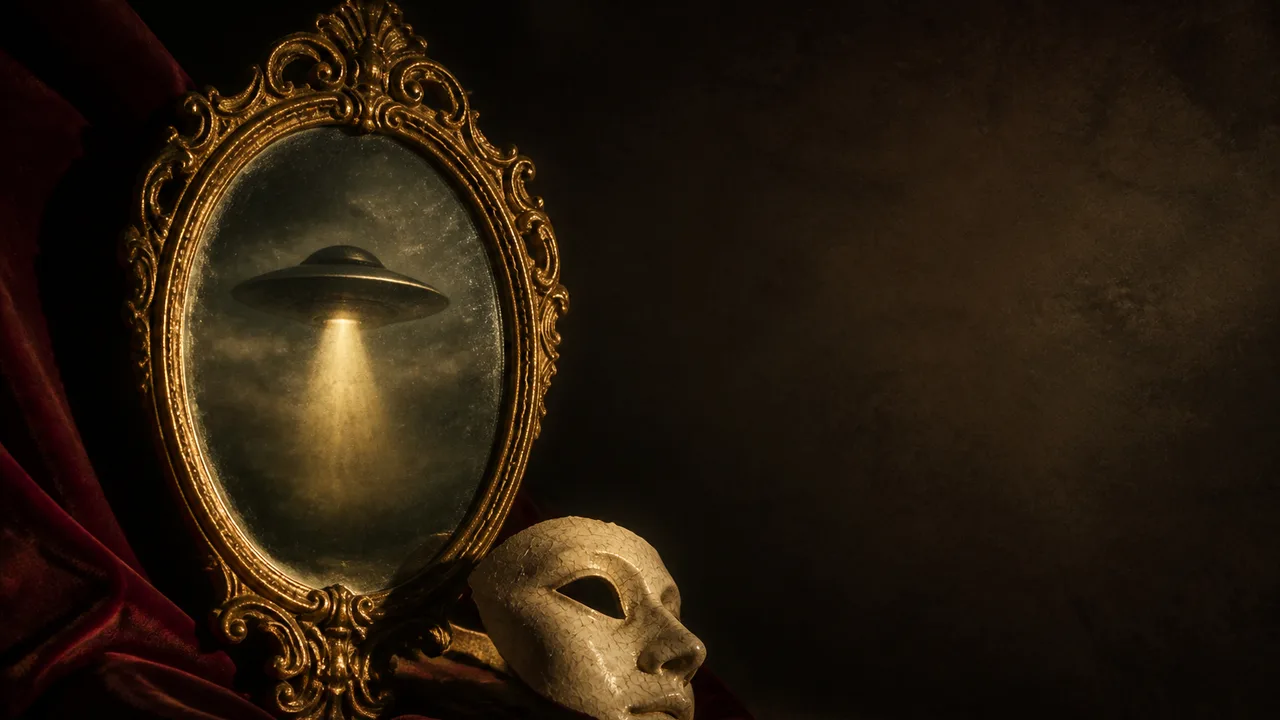
Photo: AI. Soraya Hadid
Adam Kirsch, senior editor at The Atlantic, has written a book called We Want to Believe: How Aliens Went Mainstream and Why It Matters, and the title does the honest work of announcing his thesis. Speaking with Jonquilyn Hill on Vox's The Gray Area, Kirsch makes a case that UFO culture is not primarily about UFOs. It is about what a society reaches for when its institutions have stopped seeming reliable and the universe has started seeming indifferent.
The book dates the current cycle of mainstream UFO interest to December 2017, when the New York Times and the Washington Post both ran stories about the Advanced Aerospace Threat Identification Program, a Defense Department initiative that had spent roughly $22 million collecting reports of aerial phenomena from military personnel. For decades, the Pentagon had maintained it kept no such records. The AATIP reporting proved that was false, and simultaneously the department acknowledged a set of infrared videos taken from military aircraft showing objects that moved unlike any known aircraft. Kirsch's point is not that these videos proved anything supernatural. His point is that the Pentagon's admission that it had been paying attention was enough to legitimize the conversation. Once serious institutions started hedging, everyone else felt licensed to wonder.
What followed was a textbook "flap," Kirsch's term for the periodic surges that have characterized UFO interest since the postwar period. He traces the pattern carefully: a claim gets made, media amplifies it, people who have been sitting on their own ambiguous sky-sightings suddenly have a category to put them in, and then, within weeks or months, an official non-explanation arrives and the energy disperses. The 2024 New Jersey drone panic followed this script with almost comic fidelity. The flap that began in 2017, Kirsch argues, has now run its course for the same reason they all do: nothing concrete materialized.
The government disclosure angle has added a strange layer to the current moment. Kirsch notes that when the Trump administration posted UAP footage to Defense Department servers, the videos were indistinguishable from every other video in this genre: blurry, ambiguous, and notably free of spacecraft. What Kirsch finds revealing is the political structure of the gesture. Trump, he observes, ran the same move with UAP that he ran with vaccines: position yourself against elite knowledge-keepers while simultaneously being the person who would, if anyone would, possess that knowledge. "He's a master of saying, I'm on your side, the ordinary person against the elites, even though he is the most elite person there is." The UFO file becomes, in this reading, another instrument for producing the experience of skepticism toward authority without ever having to pay out the promised revelation.
Kirsch is careful here, and the carefulness matters. He is not dismissing the distrust itself. Roswell is instructive: the Air Force spent decades insisting that what crashed in New Mexico in 1947 was a weather balloon, and this was, in a narrow technical sense, a lie. What they recovered was surveillance equipment using high-altitude balloons to monitor Soviet nuclear tests, and Area 51, officially known as Groom Lake, was in fact used during the Cold War to test aircraft including the U-2 spy plane. The conspiracy theorists who said the government was hiding something were correct. They were wrong only about what was being hidden. The history of UFO belief is full of cases where institutional deception occurred and the specific conclusion drawn from it was not.
Kirsch spends considerable time on the difference between testimony and evidence, and it is one of the more clarifying passages in the conversation. Military pilots who report objects moving in ways that violate known physics are not unreliable witnesses in any ordinary sense. They are observant professionals with incentives against embarrassment. But Kirsch invokes David Hume's argument about biblical miracles: when assessing a claimed violation of natural law, you must always ask whether it is more probable that the laws were violated or that the witness was mistaken. The pilots' credibility does not change this calculus. A radar software upgrade that produces anomalous readings is a far more probable explanation for a blurry infrared smudge than an interstellar craft.
Faith is the substance of things hoped for, the evidence of things not seen. That line is from the Epistle to the Hebrews, and Kirsch reaches for it when Hill pushes him on why rational people maintain UFO belief in the face of absent evidence. His argument is that UFO belief activates the same cognitive and emotional architecture as religious faith, with one crucial difference: a UFO is a physical object. If alien spacecraft exist, they occupy space and time, obey or violate the laws of physics, and came from somewhere specific. You cannot say "I have faith in UFOs" the way you can say "I have faith in God," because the former is an empirical claim masquerading as a metaphysical one. And yet, he says, the longing that drives UFO belief is the same longing that drives religious belief: for the transcendent, for the miraculous, for something that exceeds the ordinary terms of existence.
This is where Kirsch's argument turns, and where it starts to press on something harder.
The search for artificial radio signals from other civilizations, which began in earnest around 1960 with Project Ozma, has returned decades of silence. Not ambiguous data, not faint candidates requiring reanalysis. Silence. As astronomers have confirmed thousands of exoplanets, many in the so-called Goldilocks zone where liquid water could theoretically exist, the denominator of possible life-hosting worlds has expanded enormously. The numerator has not moved. It remains one. Earth.
I watched the SETI program run with genuine institutional seriousness, with Carl Sagan's advocacy and public funding and the cultural confidence of Contact, the 1997 Jodie Foster film in which the first signal from another civilization arrives and changes everything. Sagan died in 1996, before the film came out. The signal never came. What Kirsch is describing when he calls the silence "disturbing" is not a failure to find one thing among many possibilities. It is the slow accumulation of negative results across an expanding search space, which at some point stops being an absence of data and starts being data. Either life is extraordinarily rarer than the Copernican intuition suggested, or something about the development of technological civilization is self-terminating. We built nuclear weapons and spacecraft in the same decade, from the same physics. Maybe everyone does.
Sitting with that possibility is not like sitting with a puzzle. It is like sitting with a verdict.
Kirsch's conclusion is that UFO belief has flourished in precisely the historical moment when this verdict became, for the first time, the most probable position most people occupy. Premodern religious cosmology guaranteed other minds in the universe; God and angels and the whole populated supernatural order ensured you were not cosmically alone. The scientific displacement of that cosmology left the question open but the universe untenanted. Now even the optimistic scientific hypothesis, that life must be common given the scale of the universe, is being eroded by the data. "We can't tolerate the idea that it's just us," Kirsch tells Hill. The UFO is what you get when a civilization decides to manufacture the other minds it cannot find.
A YouGov and CBS poll cited in the conversation found that 63 percent of Americans believe in aliens or UAPs, a figure that Scientific American has reported alongside persistent majorities believing the government withholds relevant information. Variety has noted how this shift has moved alien conspiracy thinking from the cultural margins to Steven Spielberg's production schedule. Kirsch's book, in this context, is doing something slightly different from most commentary on the phenomenon: it is treating the belief as a symptom worth diagnosing rather than a mistake worth correcting.
The diagnosis is not flattering, but it is also not contemptuous. We want to believe because the alternative, that the universe is vast and silent and we are its only experiment in self-awareness, requires a kind of composure that most of us cannot hold for long. The flying saucer is, in the end, a night-light.
More Like This
Why the Ocean Still Terrifies Us: Depths of Fear
Quinn and James of Cosmic Chronicles explore why the ocean remains humanity's oldest, deepest fear—from the Mariana Trench to the myth of the Bermuda Triangle.
Visually Stunning Movies Nobody Talks About
From Tarsem Singh's The Fall to the anime fever dream Redline, these nine films are visually extraordinary—and almost entirely ignored. Here's why that matters.
Moana 2's Villain and His Polynesian Mythic Roots
Moana 2's storm god Nalo draws from real Polynesian myth. A look at Tāwhirimātea and Whiro reveals how deep those roots actually run.

Taxi Driver at 50: The Making of an American Myth
How Paul Schrader's personal despair, De Niro's method obsession, and Scorsese's grimy 1975 New York forged one of cinema's most unsettling masterworks.
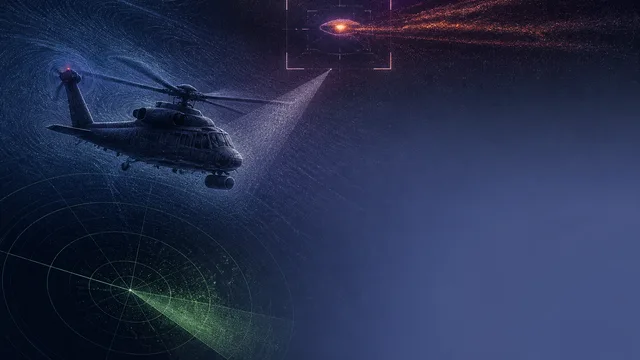
Chile's Navy UFO Sighting and the Limits of Radar
A Chilean Navy helicopter filmed an unidentified object in 2014 that defied radar detection. Here's what investigators found—and what remains genuinely unsettled.
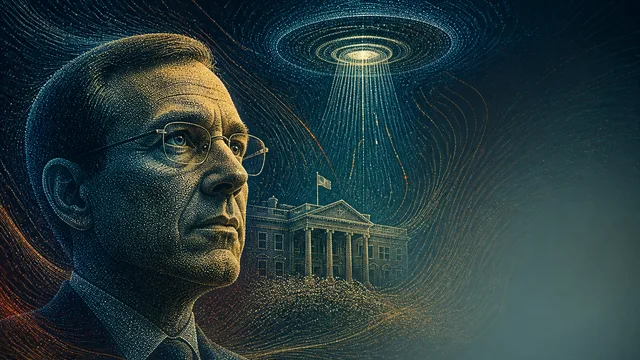
Avi Loeb to Lead White House UAP Council
Harvard astronomer Avi Loeb will lead a new White House UAP council. What the council's structure reveals about whether it's built for science or optics.

Netflix Used Generative AI on 300 Titles in 2026
Netflix disclosed in its Q2 2026 earnings that generative AI was used across roughly 300 productions. Here's what we know—and what's still murky.
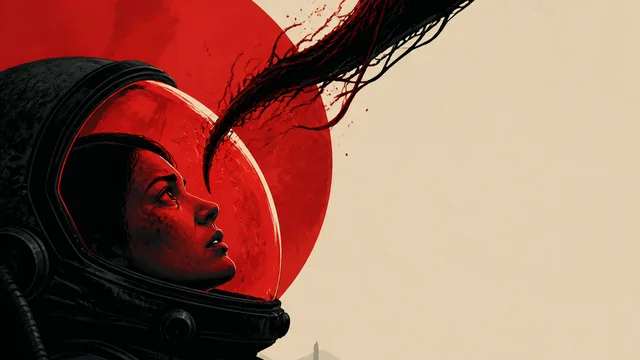
Flying Lotus's Ash: Dazzling Sci-Fi Horror Adrift
Flying Lotus's Ash is a visually stunning sci-fi horror film with a genuinely unnerving premise — and the frustrating habit of flinching from its own best ideas.