Airport Procedures in 2026: What Has Actually Changed
Facial recognition, carry-on crackdowns, battery rules, digital boarding locks — here's what's genuinely different at airports in 2026 and why it catches travelers off guard.

Written by AI. Tomas Reyes-Kim
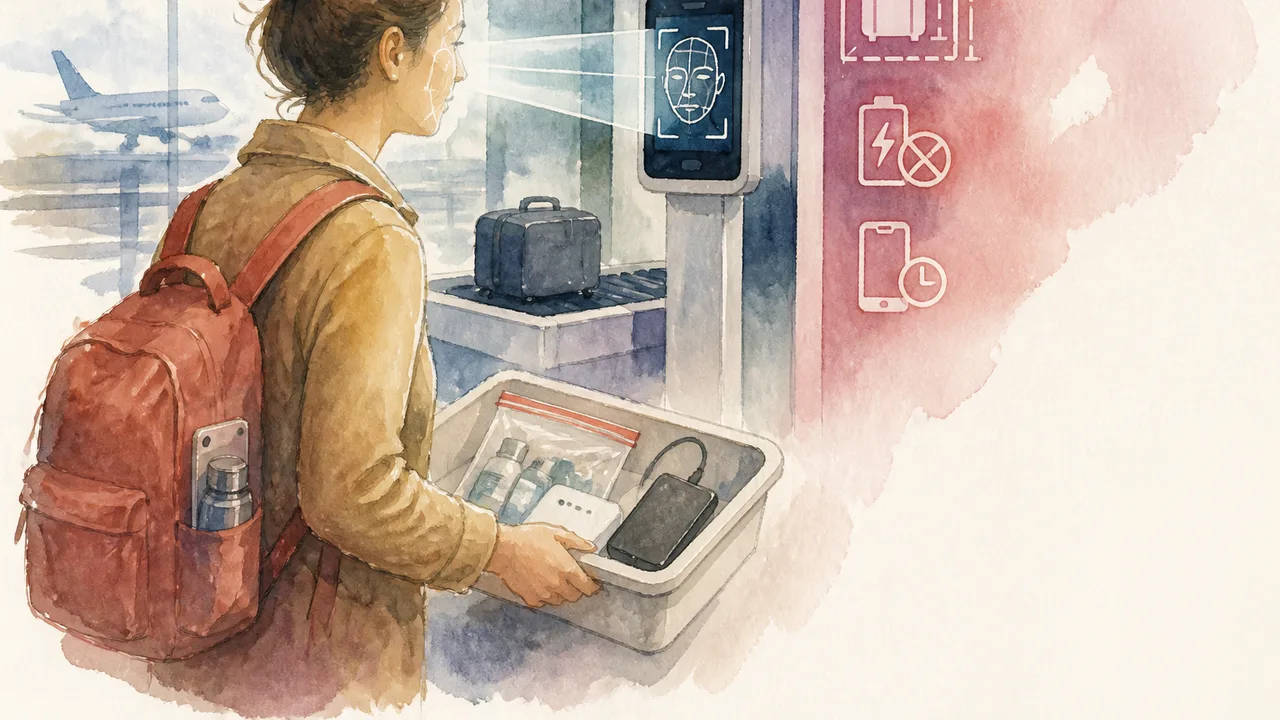
Photo: AI. Júlia Almeida
The airport hasn't changed in the way a renovation changes a building. It's changed in the way a relationship changes when someone stops letting things slide — same structure, different enforcement, and you find out at the worst possible moment.
A recent video from Airport Tips and Tricks maps out six of the seven changes it identifies as genuinely catching travelers off guard in 2026. (The seventh — security scanner "false alarms" from cluttered bags — is covered in the video but folded into the broader automation picture here, since the fix is essentially the same as everything else: slow down, be legible to the machine.) The video's framing is useful: "Most of the people getting stopped did nothing wrong. They just didn't know the rules changed." That's worth sitting with, because it reframes the whole thing. This isn't about catching bad actors. It's about systems that have quietly gotten more exacting while travelers were still operating on 2019 assumptions.
The face you show the camera matters more than it used to
Biometric gates are now the first checkpoint at a lot of airports, not the secondary one. Which means the first entity deciding whether you move forward isn't a person — it's an algorithm running a match between your current face and a passport photo that might be eight or nine years old.
A survey of facial recognition techniques published on arXiv confirms what the video describes: these systems have documented consistency issues with lighting, aging, and appearance variation. Glasses, a different hairstyle, significant weight change, heavy makeup, a hat that left a tan line — none of that makes you suspicious. But it can make you unreadable, which routes you to manual screening.
The video's practical advice is almost comically simple: take off your hat, remove your sunglasses, pull your hair back, stand still for a beat longer than feels natural. The reason it needs saying is that most people rush these gates, especially experienced travelers who've built speed into their whole airport routine. The system doesn't reward speed. It rewards stillness and clarity.
What's worth noting is what the video doesn't say: this routing to manual screening isn't a flag, it's a fallback. Understanding that it's procedural rather than accusatory is the difference between a five-minute detour and a spiral of anxiety that ruins the first hour of your trip.
Airlines enforcing what they always technically could
I'll be honest — the carry-on crackdown is the change that produces the most complicated feelings in me. I've watched someone argue with a gate agent over a bag that was obviously too big, acting like enforcement was a personal affront, and it's hard not to think: the rule was always there. Airlines just finally decided to mean it.
Full flights, carry-on-only travel becoming the default, digital bag tracking — the economics shifted, and now the gate is where it gets real. The video describes bags being weighed and sized at the gate, not at check-in, which is the part that catches people: you make it all the way to boarding thinking you're fine, and that's where you find out you're not.
The personal item math is where it gets genuinely murky. As the video puts it: "A backpack plus a handbag plus a duty-free bag plus a neck pillow clipped on. Individually, normal. Together, sometimes too many items." That's not an unreasonable observation — it's the accumulated-carry-on problem that anyone who flies regularly has watched evolve over the past decade. And according to PIRG's airline bag fee research, gate check fees are often higher than check-in fees — so the gamble of bringing a borderline bag to the gate has a real financial downside, not just a logistical one.
The video's position is that consistent enforcement actually speeds up boarding overall. I think that's probably true, and I also think it's worth acknowledging that "consistent enforcement" tends to hit budget travelers harder — people who bought the cheapest ticket and are now navigating carry-on rules that vary by airline, route, and fare class in ways that are genuinely difficult to track. The rule is the rule, but the rule isn't always clearly communicated.
Batteries are the new liquids
This one doesn't get enough attention relative to how consequential it can be. Lithium batteries — your power bank, your spare camera batteries, your CPAP backup pack — are now among the top security concerns in aviation. The reason is straightforward: a battery fire in the cargo hold is catastrophic in a way a battery fire in the cabin is not, because crew can respond to one and can't respond to the other.
The current rule is that loose lithium batteries must travel in carry-on, not checked luggage. What's shifting is how strictly airports are enforcing the details: terminals covered, no damaged or swollen batteries, and — critically — if staff can't confirm a power bank's watt-hour rating, they can confiscate it on the spot. Travel Sentry confirms what the video states plainly: no argument, no appeal at the gate.
The practical fix is annoying but not complicated — keep batteries in original packaging or small cases, cover terminals on loose cells, and don't travel with anything that looks damaged. The video's broader point is that this enforcement direction is one-way. It's not getting looser.
Digital boarding locks and the end of "I made it"
This is the change that feels most like a structural shift rather than a tightened rule. Airlines have increasingly tied boarding management to automated systems, meaning the gate can be "closed in the system" while passengers are still physically walking down the jetway.
The video is explicit about what this produces: your boarding pass stops working, your seat gets released, your checked bag gets pulled — and staff may have no ability to override it even if they want to. Arriving at the gate at boarding time is no longer the safe play. The video argues the gate arrival should happen before boarding even begins, especially on international flights, connections, and full flights where automated seat reallocation runs fastest.
I think automated boarding locks are genuinely bad for travelers who cut it close for reasons outside their control — a long security line, a delayed connection, a gate that moved. The efficiency gain for the airline is real. The experience of being told your seat is gone while you're still in the terminal is awful in a way that a missed flight used to at least involve some agency. Now you can do everything "right" by old standards and still lose.
Kiosks and the consistency test
Self-service immigration kiosks are now the first stop at arrivals in a growing number of airports. The video describes them accurately: "The kiosk is basically a little consistency test machine. It's not trying to trick you, but it does expect you to follow the prompts exactly."
Face scans fail when people move. Fingerprints don't register on rushed placements. Answers that don't match entry form data — even minor variations — can trigger a referral to manual processing. Jet-lagged, moving fast, squinting at a screen in a second language: these are exactly the conditions under which people make small errors that cascade.
The fix the video recommends is genuinely unglamorous: slow down, stand still, answer consistently. It works. The harder question it doesn't fully address is what happens to travelers who have legitimate reasons for inconsistency — people who changed plans mid-trip, who are traveling on complex itineraries, or who simply don't have the documentation that kiosks expect in the format they expect it.
Proof of exit: the question that sounds casual and isn't
More countries and airlines are asking for proof of departure — a return ticket or onward booking — before allowing entry or boarding. The video frames this as something that hits hardest when travelers say things like "I'll book my return later" or "I'm not sure when I'm leaving." Those are perfectly reasonable answers for flexible travelers, and they're also answers that can trigger extended questioning or boarding denial.
The practical response is to have your return or onward ticket saved offline — screenshot, PDF, somewhere accessible without WiFi. Same for travel insurance documentation if you're going somewhere that wants to see it. The point isn't to have a rigid itinerary. It's to have evidence of a plan when someone asks for one.
The through-line in all of this is the same: airports have gotten better at moving people quickly when everyone fits the expected pattern, and less forgiving when they don't. The systems don't let things slide — they route you. Whether you experience that as efficiency or as friction depends almost entirely on how prepared you are for a process that now assumes you've done your homework.
More Like This
EU Entry/Exit System: Border Delays and What They Mean
The EU's new EES biometric border system is causing summer travel delays. Here's what it asks of travelers, workers, and the institutions behind both.
Airport Behavior That Makes Flying Worse for Everyone
From gate lice to baggage claim crowding, Mark Wolters of Wolters World maps the airport habits that slow everyone down—and why they persist.

Uber Wants to Book Your Hotel Now, Too
Uber is teaming up with Expedia to add hotel booking inside its app. Here's what that actually means for budget travelers already loyal to other platforms.
Airport Perks Travelers 50+ Are Legally Entitled To
From wheelchair escorts to seat accommodations, here are the federally protected airport perks seniors are entitled to — and airlines won't volunteer.
What Smart Travelers Do Right After Boarding a Plane
From seat checks to jet lag tricks, here's what experienced flyers actually do in the first few minutes after boarding—and why it matters.

Travel Spending Is Rebounding—But Read the Fine Print
Travel spending rebounded in June and agents are booking again—but the data tells a messier, more interesting story than the headlines suggest.

Mass Media Doesn't Change Your Accent. Your Friends Do.
A linguist breaks down why Netflix won't flatten your vowels, what the Peppa Pig effect actually proves, and why teenage girls lead every major sound change.
American Airlines Ends 24-Hour Refunds on Last-Minute Tickets
American Airlines has quietly removed the 24-hour refund window for tickets booked within seven days of departure. Here's what that means for last-minute travelers.