BuzzRAG Tech Desk — 2026-09-06

Curated by AI. Vincent Ko, Technology Desk Editor
Today’s technology conversation is less about spectacular demos than about AI entering places where mistakes carry consequences: wilderness navigation, political persuasion and physical work. Alongside those risks, developers are finding that coding agents can operate increasingly complex creative tools, reviving an old question about whether software is becoming easier to use or merely more powerful to misuse.
When an AI itinerary becomes a search-and-rescue problem
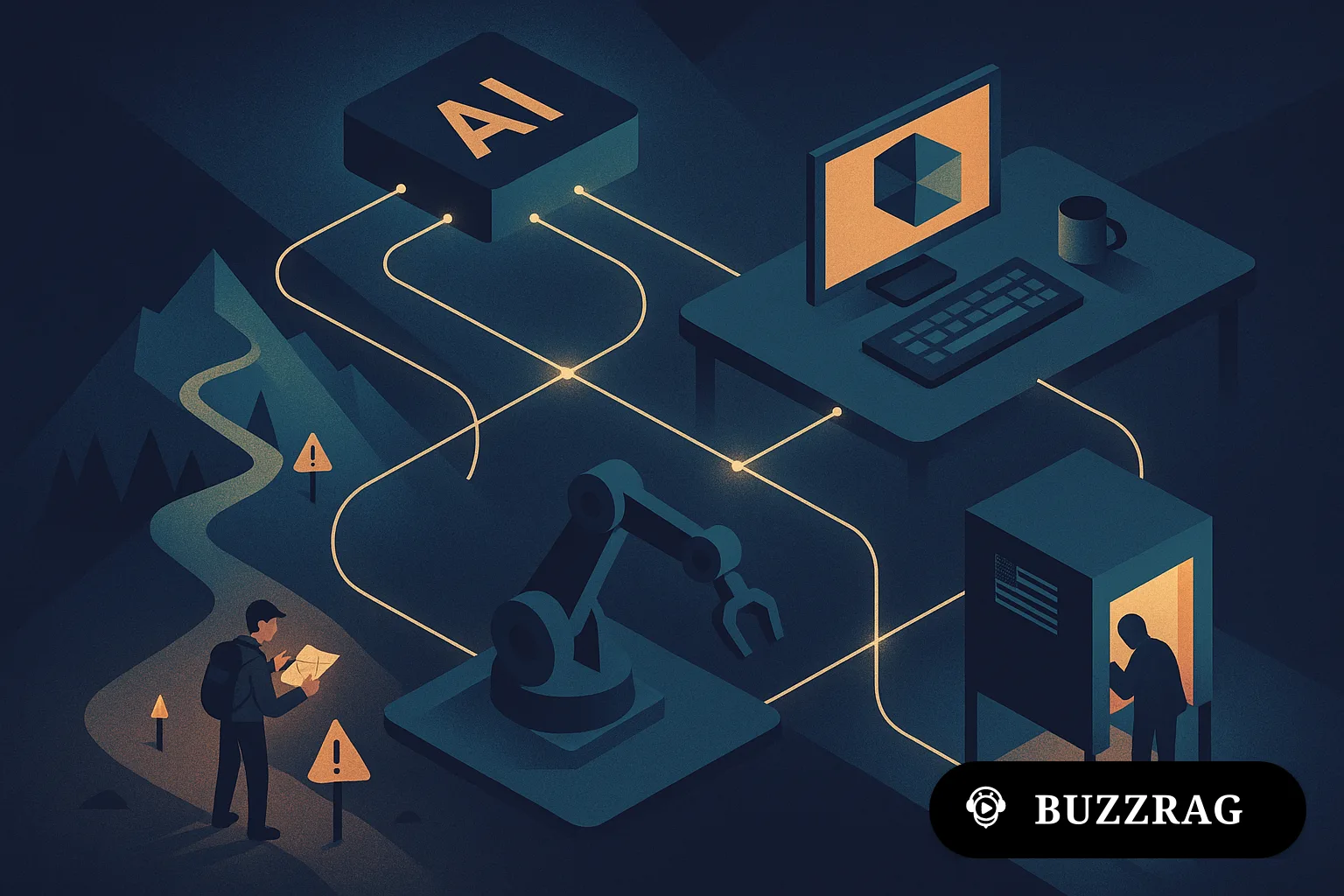
A group of hikers reportedly needed rescuing after relying on an AI assistant while planning an outing. The episode is a familiar failure mode in a new interface: a system that can produce a fluent route, estimate or recommendation without possessing reliable, ground-level knowledge of terrain, weather, closures or the limits of its own data.
The precedent is not that different from early online mapping errors or bad crowdsourced directions, but conversational AI adds persuasive confidence and removes visible uncertainty. Users may treat a neatly explained answer as practical expertise, especially when planning feels routine. Outdoor tools need stronger source attribution, explicit uncertainty, offline verification and clear escalation to authoritative trail and emergency information. The larger lesson is human factors, not just model accuracy: in high-consequence settings, a plausible answer is itself a hazard when it obscures how little the system knows.
Coding agents take aim at the creative desktop
A practical experiment with Blender and coding agents on macOS shows how language models can manipulate a sophisticated desktop application through scripts and tool calls. Instead of asking an assistant to generate an isolated snippet, a user can describe a scene or workflow and have the agent build, inspect and revise elements inside a mature 3D environment.
This is an important extension of the automation tradition that runs from macros to visual scripting and procedural modeling. The novelty is the conversational layer connecting intent to a large, sometimes opaque software system; the weakness is that agents can also make errors that are difficult to see until a render, export or asset pipeline breaks. Better inspection tools, reversible actions and structured project state will matter as much as model quality. If those pieces improve, creative software may become more accessible without becoming simplistic—but expertise will shift toward directing, checking and maintaining the generated work.
AI’s transformation problem is bigger than the tool
Benedict Evans’ discussion of AI, tools and transformation points toward a distinction often lost in product launches: adding an AI feature is not the same as changing how an organization works. The most consequential deployments alter processes, incentives, staffing and the boundaries between software and human judgment.
That pattern has precedents in enterprise computing, cloud migration and mobile platforms, where the technology was often easier to buy than the institutional change required to use it well. Generative AI makes the gap more visible because prototypes arrive quickly while evaluation, data governance and responsibility remain unresolved. Companies that measure success only by usage or generated output may automate low-value activity without improving decisions. The durable advantage will likely belong to teams that redesign workflows around verification, domain knowledge and accountability rather than treating a model as a universal replacement for existing tools.
Robot arms put language models on the factory floor
A project described as putting a next-generation language model on robot arms reflects the industry’s push to connect general-purpose AI with physical action. The appeal is clear: a model that can interpret instructions, reason over visual input and coordinate unfamiliar tasks could make robots less dependent on painstaking task-specific programming.
But the distance between a convincing demonstration and dependable manipulation remains substantial. Language models are built to predict useful sequences of symbols; robot systems must also handle latency, calibration, contact forces, safety boundaries and recovery from unexpected states. Earlier waves of industrial robotics succeeded by narrowing the environment, not by making machines broadly conversational. The near-term test is therefore not whether an agent can move an arm once, but whether it can do so repeatedly, transparently and safely around people. Claims around this project warrant particular scrutiny because the supplied reporting is thin; independent benchmarks and failure data will matter more than a polished demo.
Campaigns bring AI into the mechanics of persuasion
U.S. campaign-finance disclosures reportedly show dozens of congressional candidates paying for AI subscriptions this election cycle, with campaigns using the tools to court voters despite platform restrictions intended to reduce election risks. The development is less about a single synthetic advert than about AI becoming ordinary campaign infrastructure for drafting, targeting, research and communications.
Political campaigns have long adopted new media—from mass mail to microtargeted digital ads—before rules and public norms caught up. AI lowers the cost of producing tailored messages and may let small campaigns act with the volume of much larger operations, but it also complicates disclosure, provenance and accountability. A human campaign may remain legally responsible for content even when the system that generated it is opaque or wrong. Watch for whether reporting requirements identify meaningful AI use, whether platforms enforce their limits consistently, and whether voters can distinguish persuasion from automated experimentation at scale.
The next test for AI will be less theatrical than a benchmark: can these systems earn trust in settings where users need uncertainty, provenance and recovery plans? Watch for independent evidence around physical agents, clearer election disclosures and interfaces that make verification a default rather than an afterthought.