Yayoi Kusama Dies at 97: What Her Legacy Reveals
Yayoi Kusama died at 97. Beyond the obituaries, her legacy raises real questions about who art is actually built for—and who gets left outside.

Written by AI. Ryan Kowalski
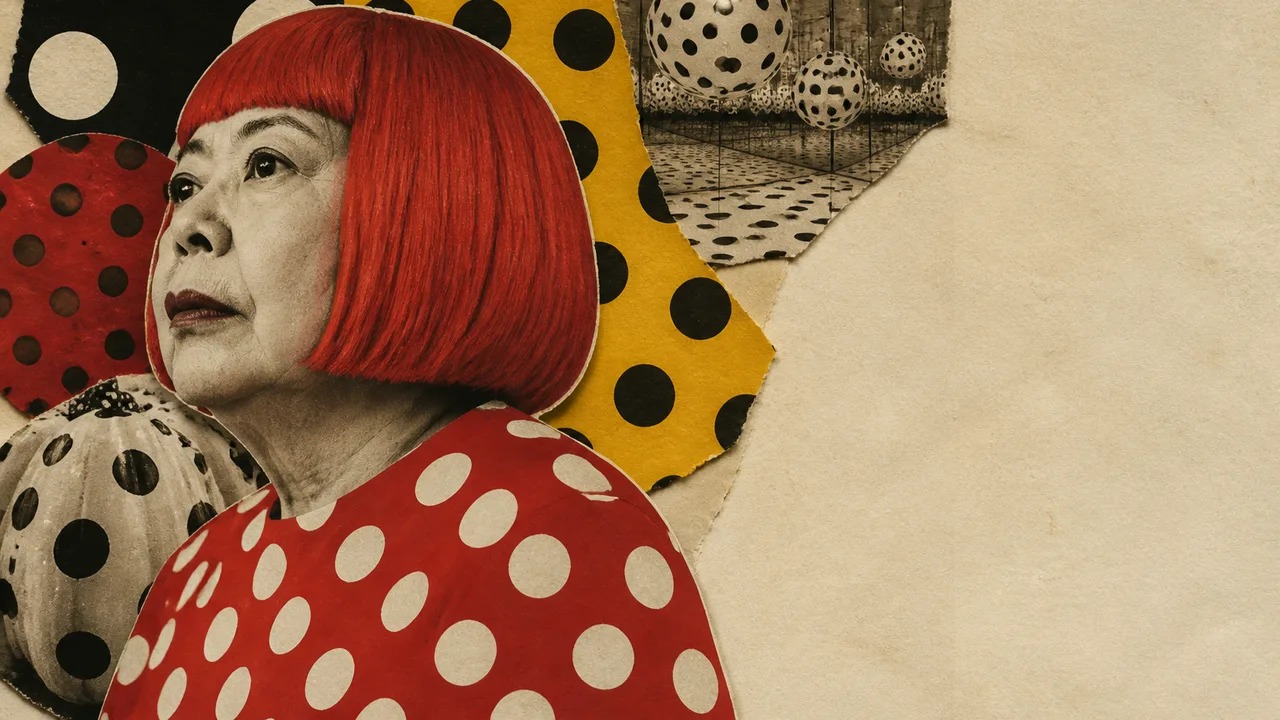
People stood in lines for her. Long ones. Hours-in-the-sun, check-the-app-every-morning, timed-entry-ticket kind of lines. That's not nothing. That's actually the most concrete thing you can say about what Yayoi Kusama built over the course of her life, and it tells you more about her than most of the obituary prose that's been published since her death was confirmed this week.
Kusama died at 97, according to NPR, the BBC, The Guardian, and essentially every major outlet covering arts and culture. She was Japanese. She made dots. She made rooms that looked like the universe folded in on itself. She lived, voluntarily, in a psychiatric facility in Tokyo for decades while continuing to work. She became, by any reasonable measure, one of the most widely recognized visual artists of the 20th and 21st centuries.
That last part is worth sitting with for a minute, because it's genuinely strange. The contemporary art world is not generally organized around mass accessibility. It has gatekeepers and price tags and a social grammar that takes years to learn. And yet here was Kusama — avant-garde in her origins, as ARTnews documents — pulling in people who had never set foot in a gallery and probably still wouldn't, unless you put dots on the walls and made everything shimmer.
How did that happen? And what does it mean that it happened the way it did?
Start with the work itself, because the mythology around Kusama is so thick at this point that it's easy to lose the actual objects underneath it.
The Infinity Mirror Rooms are the obvious entry point. You walk into a mirrored chamber, usually with hanging lights or sculptural elements, and the reflections multiply until the room appears to go on forever. That's the experience — not complicated, not demanding, not requiring any background in art history. You get it immediately, or you feel it immediately, which is maybe more accurate. Hyperallergic describes Kusama as an "artist of infinities," and the Infinity Rooms are where that phrase makes the most literal sense.
The polka dots are older and stranger. Kusama talked openly about experiencing hallucinations — seeing dots proliferating across surfaces, including her own body — from childhood. She described her art-making as a way of externalizing that experience, of putting the dots on the canvas so they didn't consume her. That's the origin story you'll find in virtually every profile written about her, including those from Far Out Magazine, and it's compelling, and it's also worth noting that it's a story Kusama told about herself, refined and repeated over decades.
That's not a dismissal. It's just an observation about how artist narratives work. The psychiatric-hospital-as-studio, the compulsive repetition as survival, the self-obliteration philosophy she called "infinity nets" — this is a fully formed, deeply consistent personal mythology. It holds together. It's also been enormously useful, commercially and culturally, in framing Kusama as something more than a successful contemporary artist: as a figure who made her suffering into something universal.
Maybe she did. But the line between authentic self-expression and carefully maintained brand is harder to locate than the obituaries suggest, and I don't think acknowledging that is cynicism. It's just the same question you'd ask about any public figure who controlled their own narrative that effectively for that long.
Here's what's less ambiguous: the access problem.
When the Infinity Mirror Rooms toured major institutions — and the details of specific venues and attendance figures are territory I won't invent where the sources don't supply them — they became cultural events that looked, from the outside, a lot like the ticketing situation for a popular concert. Timed entry. Sold out weeks in advance. Thirty seconds inside the room, then you're ushered out so the next group can come through.
Thirty seconds.
There's something worth examining in the gap between what the work promises — immersion, dissolution of self, genuine encounter with something larger — and what the institutional delivery system actually provides. Kusama's philosophy, as reported by NPR, was about the integration of art and life, about pulling viewers into her world rather than keeping them at a respectful critical distance. The timed-entry queue is about as far from that vision as you can get while still being technically inside the building.
Who designed that experience? Not Kusama. Museums did. Institutions did. The same institutions that, in other contexts, set ticket prices and membership tiers and manage the physical flow of bodies through cultural space. Kusama's work became a vehicle for a particular kind of museum programming — blockbuster immersive experience, heavy on the social-media moment, optimized for throughput — and the gap between what the artist intended and what the system delivered is a gap worth naming.
That's not a knock on Kusama. It's a structural observation about how even the most democratically legible art gets processed by institutions that have their own priorities.
What Kusama actually did manage — and this is documented across her career without needing to overstate it — was reach people who don't normally think of themselves as art audiences. That's harder than it sounds, and rarer. The Guardian frames her as an artist who became a "global superstar," which is true, and also a little odd as a descriptor for someone who spent most of her adult life living voluntarily in a mental health facility and painting dots in her studio every day.
The superstardom was partly the work, partly the timing — the Infinity Rooms arrived at the exact moment that museums realized Instagram was either a threat or an opportunity, and Kusama's installations were, whatever else they were, extraordinarily photogenic — and partly the coherence of the brand she'd built. The red wig. The polka-dotted everything. The single-minded repetition across decades of output. By the time the queues started forming around the block, Kusama had been doing this work long enough that there was no question of the authenticity of the core.
ARTnews describes her as an "avant-garde artist who pursued infinity," which is accurate and also undersells the discipline involved. Whatever you think about the mythology, the record of sustained production across a very long life is real. The body of work exists. The paintings, the sculptures, the installations — these are physical objects in the world, created by a person who kept showing up to her studio.
The question her death surfaces, and that I don't think the art world has fully worked out, is what happens to the work now.
Kusama's Infinity Rooms exist as discrete physical installations that have to be licensed, assembled, maintained, insured. The museums that want them have to negotiate with an estate. The estate will have priorities. Pricing structures will be set. Decisions will be made about which institutions get access and which don't, which communities get to stand in the line and which communities are priced out before the question even comes up.
Those are the decisions that will actually determine whether Kusama's stated ambition — art as life, accessible, dissolving the distance between the work and the person standing in front of it — survives her. And those decisions won't be made by an artist. They'll be made by administrators and lawyers and board members, the same category of people I cover every week in a completely different context.
The dots will remain. What they're worth, and to whom, is still being decided.
More Like This

Mastering Film's Silent Language: Visual Storytelling
Explore how filmmakers use visual storytelling to convey complex narratives without dialogue.
Kane Parsons on the Backrooms Film and YouTube Filmmaking
Kane Parsons, described as 20 years old in his BBC Newsbeat interview, made a Backrooms feature film from a YouTube series. Here's what that path actually required.

2026 Booker Prize Longlist: What 13 Novels Reveal
The 2026 Booker Prize longlist names 13 novels from 163 submissions, including two past winners and three debuts. Here's what the selection actually signals.

Dolly Parton Is Exploring Avatar Performances
Dolly Parton is in early talks to create avatar performances amid health challenges. Here's why she might be the most avatar-ready artist in music history.

David Perry Auctions a Rare 1973 Computer Space Cabinet
David Perry is auctioning a rare 1973 two-player Computer Space cabinet. Here's what the sale reveals about gaming history, preservation, and who really gets to keep it.

Dolly Parton Dies at 80: A Legacy Beyond Country Music
Dolly Parton has died at 80. From Appalachian poverty to global icon, her legacy in music, film, philanthropy, and culture was without parallel.

Reckless Ben's LEGO Lawsuit Was Dismissed, Not Won
Reckless Ben admitted his viral LEGO lawsuit victory never happened. Court records show wrong entity, improper service, and a dismissed case — not a win.

Gamers Are Fighting the EU Over Digital Ownership
The Stop Killing Games movement reached 1.25M signatures and an EU hearing. Here's what's actually at stake—and why it's bigger than gaming.