Dolly Parton Dies at 80: A Legacy Beyond Country Music
Dolly Parton has died at 80. From Appalachian poverty to global icon, her legacy in music, film, philanthropy, and culture was without parallel.

Written by AI. Aminata Diallo
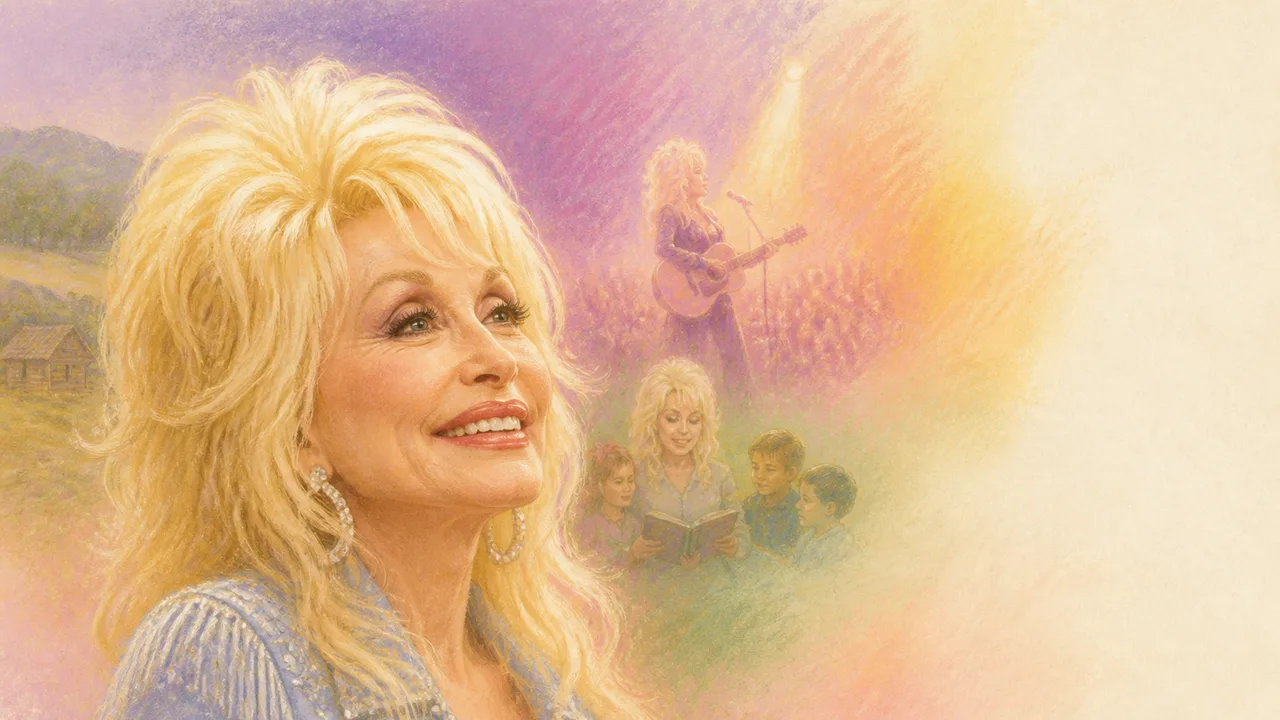
She grew up in a one-room cabin in Locust Ridge, Tennessee, one of twelve children, in a family that — by her own description — was so poor they couldn't afford a doctor when she was born. Her father paid the delivering physician with a sack of cornmeal. She died on August 25, 2026, at the age of 80, as one of the most beloved entertainers the United States has ever produced, and the distance between those two facts is the whole story.
According to NPR, Dolly Parton was one of country music's most singular performers. That description is accurate and also barely scratches the surface. Singular implies she was unusual within a tradition. What she actually became was something the tradition couldn't fully contain — a songwriter of genuine literary instinct, a film actress of warmth and comic precision, a philanthropist who changed childhood literacy rates in ways that most government programs couldn't manage, and a cultural touchstone who somehow held together a fractured American public long after most shared touchstones had dissolved.
From the Smokies to Every Living Room
The arc of her career, traced across decades by Mental Floss and revisited by The AV Club, moves from the Grand Ole Opry circuit of the 1960s through the crossover pop success of the late 1970s and into a film career that, at its peak with 9 to 5 and Steel Magnolias, proved she could carry a scene against Lily Tomlin, Jane Fonda, and Shirley MacLaine without flinching.
The Hollywood Reporter called her a Hollywood treasure who lit up the screen with her authentic self — and there's something worth sitting with in that phrase. "Authentic self" gets deployed so routinely in celebrity coverage that it has lost most of its meaning. In Parton's case it pointed to something specific: she was camp and earnest simultaneously, elaborately constructed in presentation and utterly undefended in emotional expression. She made no apology for either. That combination is rarer than it sounds.
Her songwriting catalog — "I Will Always Love You," "Jolene," "Coat of Many Colors," "9 to 5" — holds up not because those songs are nostalgically comfortable but because they are structurally sound. "Jolene" is built around an unsettling chromatic descent and a protagonist who is not triumphant; she is pleading. It is a song about female precarity written decades before that framing existed in mainstream discourse. "Coat of Many Colors" is a poverty memoir set to melody. These are not pop confections. They are documents.
The Breadth of the Mourning
What the volume and range of tributes this week reveals is something that public grief usually distorts but occasionally, briefly, clarifies. This is one of those occasions.
Rolling Stone reported that Jelly Roll, appearing on Jimmy Kimmel Live, called Parton "the last American that everyone liked." The line is glib and also forensically accurate. In a media environment where cultural consensus has fragmented to the point that shared reference points are vanishingly rare, Parton occupied a position that was genuinely anomalous: she was embraced across lines of region, generation, race, class, and political identity with an enthusiasm that bordered on the unanimous.
Taylor Swift, in a tribute reported by both Billboard and Variety, described Parton as "true grace and true grit, all in one dazzling person." Swift, who has spent the past decade navigating the same country-to-crossover terrain Parton pioneered, is not an incidental voice here. She is a direct inheritor.
Pitchfork compiled responses from Reba McEntire, Kacey Musgraves, and others across the country and Americana world. Far Out Magazine reported that Jane Fonda — who co-starred with Parton in 9 to 5 — delivered what the outlet described as a deeply emotional tribute, calling herself "devastated." Fonda and Parton had a friendship that stretched across nearly five decades; the loss was personal and it read that way.
And then there is the tribute that arguably says the most about the strange width of Parton's cultural reach: Consequence reported that Eminem issued a written tribute calling her "a superstar in every sense." Eminem and Dolly Parton share almost no musical DNA, no overlapping fanbase on paper, no obvious point of cultural contact. That he felt moved to respond publicly is its own kind of data point.
What She Meant That Went Unsaid
The Los Angeles Times published what may be the most analytically precise piece of the immediate coverage. Its appreciation, focused on Parton's relationship with the LGBTQ+ community, argued that she showed queer Americans that their country loved them. That framing deserves more than passing acknowledgment.
Parton never made her allyship a political brand. She did not announce it with press releases or leverage it for favorable coverage. What she did, consistently and over decades, was treat queer fans as fans — with the same warmth, the same humor, the same absence of condescension she extended to everyone else. In a cultural landscape where allyship often functions as performance, that quieter form of acceptance carried weight precisely because it was not performed. She was not demonstrating a position. She was just being Dolly.
This is worth naming because it explains something about why the grief this week has cut so deep for so many different communities simultaneously. Parton did not require you to belong to a particular tribe before she acknowledged your humanity. In a country that has spent the better part of two decades intensifying its sorting mechanisms, that was not a small thing.
The Philanthropy and What It Actually Did
The Quietus noted that Parton's influence extended beyond music into philanthropy and social causes. The specific initiative worth naming here, because it is the one with the most measurable reach, is the Imagination Library — a program she founded in 1995 in Sevier County, Tennessee, that mailed free books monthly to children from birth through age five. What began as a local effort eventually expanded across the United States, Canada, the United Kingdom, Australia, and beyond, distributing hundreds of millions of books. Longitudinal research on early childhood literacy programs of this design consistently shows gains in school readiness. The Imagination Library is not a celebrity vanity project. It is a functional public good that has outlasted several federal literacy initiatives.
She reportedly declined a Presidential Medal of Freedom twice before accepting it, and turned down a statue in her honor in Nashville, suggesting instead that the funds be directed elsewhere. These are not the gestures of someone managing an image. They are the gestures of someone who understood the difference between recognition and utility.
NME and Treble both covered the immediate news of her passing; The Guardian has been running live updates as tributes accumulate. The coverage is global and it is dense, which is itself a measure of something.
What Comes After an Irreplaceable Thing
There is a version of this piece that ends with a pronouncement about what Parton's death means for American culture, for country music, for the possibility of cross-partisan shared feeling. I am not sure that pronouncement is available yet. What is observable is this: the figure who held a kind of informal office — the one American celebrity that people across otherwise unbridgeable divides could agree to love — has died, and no obvious successor exists.
That office was never formally defined. It was earned, slowly, through decades of consistency, through never being cruel, through being genuinely funny rather than performing humor, through writing songs that told the truth about poverty and longing and survival without aestheticizing suffering. It was earned through treating the Imagination Library like a job, not a photo opportunity.
Whoever fills that space next — if anyone does — will not fill it the same way. The cabin in Locust Ridge, the cornmeal, the twelve children in one room: that particular origin story, and what Dolly Parton made of it, belongs to her alone.
More Like This

2026 Booker Prize Longlist: What 13 Novels Reveal
The 2026 Booker Prize longlist names 13 novels from 163 submissions, including two past winners and three debuts. Here's what the selection actually signals.
Tim Pope and the Art of the Music Video
Tim Pope shaped MTV's golden age directing The Cure, Bowie, and Queen. His memoir revisits a creative window that reshaped how the world heard—and saw—music.
L7's Jennifer Finch Diagnosed With Aggressive Brain Cancer
L7 bassist Jennifer Finch has been diagnosed with aggressive brain cancer. What her diagnosis means for the instrument, the band, and musician healthcare.
Dolly Parton Is Exploring Avatar Performances
Dolly Parton is in early talks to create avatar performances amid health challenges. Here's why she might be the most avatar-ready artist in music history.
Rick Beato on Acoustic Guitar and Music's Lost Commons
Rick Beato argues algorithm-driven listening killed communal music culture. The real picture is messier — and more interesting — than that.
Legally Blonde at 25: How Elle Woods Shaped Women in Law
Twenty-five years on, Legally Blonde's Elle Woods has inspired real women to enter law. Here's how a comedy's sound and craft made that possible.

World Cup 2026's Heat, Cost, and Political Fault Lines
From $11,000 tickets to denied visas and doubled emissions, the 2026 World Cup's off-pitch challenges may define the tournament as much as the football.
Did a Catholic Priest's Faith Corrupt the Big Bang?
Three cosmologists unpack whether Georges Lemaître's faith compromised his science—and why the real threat to cosmology is political, not theological.