Rick Beato on Acoustic Guitar and Music's Lost Commons
Rick Beato argues algorithm-driven listening killed communal music culture. The real picture is messier — and more interesting — than that.

Written by AI. Zoe Kim
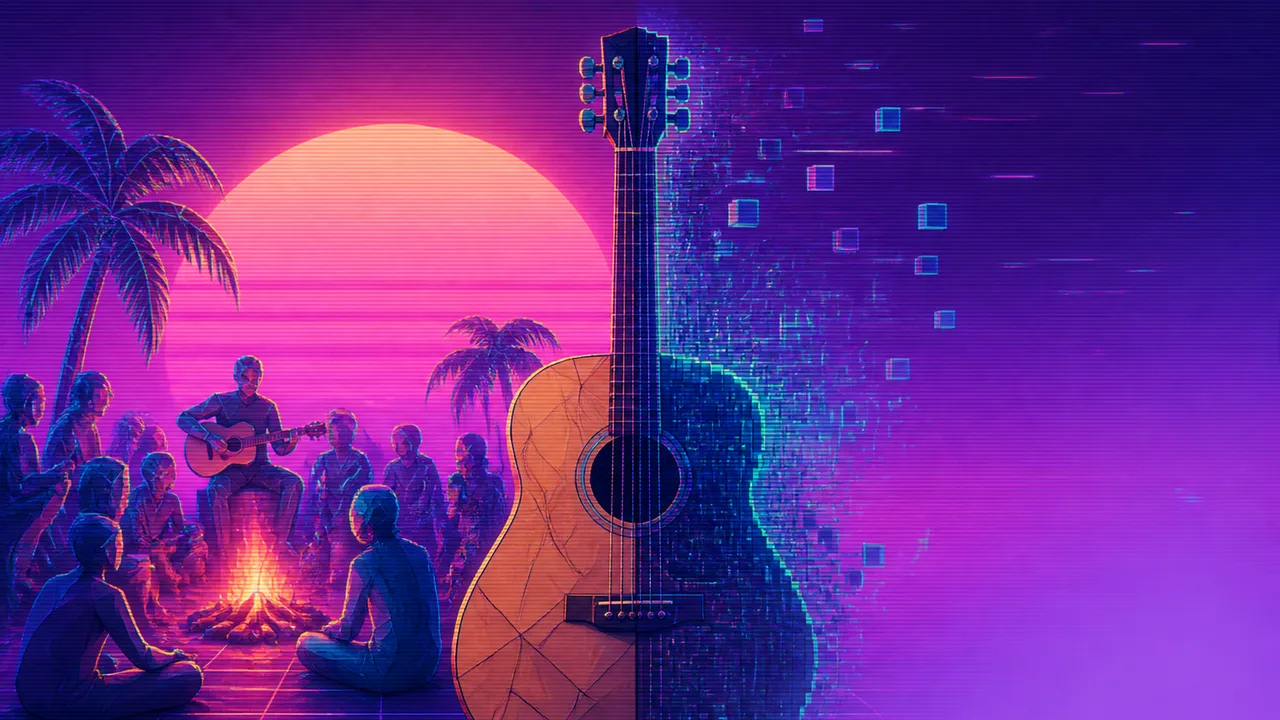
Photo: AI. Roxanne Vex
Rick Beato is sitting on a hill in Salzburg — Mozart's birthplace, he notes, then immediately clocks the absurdity of using that as an acoustic guitar argument — and nobody around him is playing music. Not in Salzburg. Not, he says, in Atlanta's Piedmont Park either. Just people, phones, earbuds, their own separate sonic universes scrolling past them.
It's a genuinely evocative image. And Beato, who has built one of the most-watched music education channels on YouTube, is clearly not performing nostalgia for the bit. He grew up in the '70s walking to the park with a guitar case, strangers wandering over to request songs, harmony breaking out spontaneously. That world feels gone to him. He's trying to figure out why.
I'm the generation he's describing on those benches. Earbuds, algorithm-sorted playlist, parallel musical universes. And here's what's strange: he's not entirely wrong about the fragmentation. But the picture he's drawing from Salzburg has some significant blind spots, and they matter for what he's actually arguing.
The argument has two layers, and they're not the same thing
Beato threads two different claims together, and it's worth pulling them apart — not to be pedantic, but because one of them is much stronger than the other.
Claim one: the songs that dominate popular music now are harder to play on acoustic guitar than the songs that dominated in the '70s and early '90s, which means fewer people spontaneously jam with strangers. This is the guitar-as-infrastructure argument. It's specific, it's teachable, and it's pretty defensible. When Beato taught guitar lessons in Atlanta from 1994 to 1999, he says, "every one of them had a riff. They started out with cool riffs. Come As You Are, Smells Like Teen Spirit, Something in the Way, 1979, Bullet with Butterfly Wings." Grunge and early alternative rock, he argues, was written on acoustic guitars and played like it — which meant a beginner could approximate it, which meant it spread through parks and bedrooms and impromptu jams.
John Mayer, Dave Matthews, Joni Mitchell with her labyrinthine alternate tunings — these are artists with devoted followings whose music is genuinely harder to replicate with six chords and enthusiasm. Beato's not wrong that playability affects virality in a pre-internet, physical, embodied sense.
Claim two: algorithms killed shared musical knowledge, and that's why communal music is dead. This is the bigger, sweeping version of the argument. "No two teenagers are living in the same universe," he says. "They literally could be sitting on benches next to each other with their earbuds on, and they're hearing completely different music." The phone is a mirror, he says — "It's who you are" — before admitting he doesn't quite know what he means by that.
That uncertainty is doing a lot of work here, and it's actually the most honest moment in the video. Because claim two is much harder to substantiate than claim one, and it obscures the places where his framing breaks down entirely.
What the framing misses
Here's what I keep thinking about: Beato's model of communal music culture is specifically a rock guitar monoculture model. A stranger hears you playing and recognizes the song because you're both listening to the same radio. The shared language is Top 40 rock, the medium is acoustic guitar, the space is a public park in suburban upstate New York in 1975.
That's real. It's also extremely specific to who was in that park.
The communal music culture that Beato is eulogizing never fully included everyone. It included people whose music happened to be built around acoustic guitar, in a radio era where those songs got the most airplay. The monoculture that made spontaneous sing-alongs possible in Piedmont Park was also the monoculture that shunted enormous amounts of music — reggaeton, Afrobeats, cumbia, hip-hop's entire early architecture — to the margins of "what everyone knows."
What does communal music actually look like for the people his frame excludes? Think about what K-pop fan communities have built: synchronized listening events, fandom spaces that require everyone to know the words, elaborate choreography that functions as collective participation. Or Afrobeats listening parties — not nostalgic recreations of 1970s park culture, but living, dense, socially generative spaces where shared musical knowledge is absolutely the currency. The communal music impulse didn't die. It moved, and it diversified, and some of it looks nothing like a dude with a guitar on a hill.
The algorithm did fragment shared mainstream knowledge. That part is real. But it also gave those other communities room to breathe. Both things are true simultaneously, which makes "algorithms killed community" a cleaner story than the actual situation warrants.
And then there's what's happening on the platforms
Here's the tension I can't stop sitting with: Beato is mourning the death of acoustic guitar culture on a YouTube channel with millions of subscribers, many of whom are learning guitar right now, today, because of him. His own platform is part of a massive ecosystem of guitar education and guitar culture that exists entirely online.
The TikTok acoustic guitar trend is enormous and coexists without apparent contradiction next to hyperpop, bedroom pop, and whatever SoundCloud corner you fell into last week. People are learning songs from r/guitarlessons and Ultimate Guitar tabs at a scale that would have been unimaginable in 1975. The "playable songs" problem Beato identifies — the fact that John Mayer is harder to teach than "Come As You Are" — hasn't stopped the internet from generating an entire infrastructure of tutorials, chord breakdowns, cover videos, and reaction content around exactly the songs he thinks are unreachable.
Which is to say: the park jam session didn't die, exactly. It migrated. It's asynchronous now. Someone learns a riff from a YouTube tutorial, posts a cover, gets comments from strangers who know the song, learns a new song from the algorithm that surfaces in their recommended. Is that less communal? It's differently communal. I genuinely don't know how to weigh those against each other, and I don't think Beato does either — though he's filmed his uncertainty in a beautiful Austrian park, which is at least a charming way to not know something.
The playability thing, though
I don't want to dismiss the guitar hypothesis just because the monoculture hypothesis has problems. The observation that great rock songs of the '70s and early '90s were written on acoustic guitars and therefore sound complete on acoustic guitars is doing real analytical work. "Black Hole Sun" on a drop-D acoustic is recognizable from the first two notes. That's not a coincidence — it's a compositional property. Songs built around guitar-native riffs carry differently than songs built around production, texture, or vocal runs that don't translate down to six strings.
"The riffs were not too hard that people couldn't play and sing," Beato says of the grunge era — and that's a legitimate thing to notice about that moment's cultural stickiness. It might even be worth asking whether the decline of guitar-centric songwriting in mainstream pop is part of why digital virality replaced physical transmission as the engine of how songs spread. The campfire sing-along requires singable, playable songs. The FYP does not.
But that's a narrow, specific claim — about one mechanism of music transmission, not about whether music culture is dying. Music culture is not dying. It is, as it has always been, reorganizing around new tools, new communities, and new definitions of participation. Beato's Salzburg hill is quiet. The Discord servers are not.
What I find myself genuinely curious about, watching this video, is whether the thing Beato is mourning — that specific texture of strangers harmonizing around a shared song in a public space — is something new tools could reconstruct, or whether it requires a monoculture that we're not getting back and maybe shouldn't want back unchanged. I don't have an answer. But I think that's a better question than "is music culture dying?"
It almost certainly isn't. It might just be somewhere Beato isn't looking. 🎸
More Like This

Rice Theory and What Streaming Did to Musicians
The rice theory says your job reshapes your personality. Streaming-era music is the most uncomfortable proof of that idea alive right now.
The Self-Loathing Monologue Playing on Loop
Alain de Botton's School of Life video on loneliness gets the diagnosis right — but who's actually providing the antidote? A music critic weighs in.
Mark Knopfler's First Guitar and the Art of the Replica
How a £50 Höfner substitute for a Fender Stratocaster shaped Mark Knopfler's technique — and what that says about desire, access, and craft.
Geddy Lee on Relearning Rush for the Road
Geddy Lee talks to Rick Beato about relearning Rush songs, tone, the space bass, and the emotional weight of making Vapor Trails without Neil Peart nearby.
Music Shapes Your Daydreams More Than You Know
Princeton researcher Elizabeth Margulis explains how music hijacks your spontaneous thoughts—and what that means for your mental and emotional life.
Metallica Close the M72 World Tour in London
Metallica wrapped a three-year world tour at London Stadium in July 2026. Here's what the shows revealed about the band's enduring live power.

William Blake and the Art World That Couldn't File Him
William Blake's genre-defying illuminated books found almost no buyers in his lifetime. A new Nerdwriter1 video explains exactly why — and why the machine still works the same way.
Nahre Sol's 10-Level Listening Guide Changes How You Hear
Nahre Sol's free YouTube framework teaches ten layers of deep music listening — from surface instinct to full-on daydreaming — and it works on any genre.