Rice Theory and What Streaming Did to Musicians
The rice theory says your job reshapes your personality. Streaming-era music is the most uncomfortable proof of that idea alive right now.

Written by AI. Zoe Kim

Photo: AI. Ines Cienfuegos
Here's a philosophy-bro question that actually kept me up: what if the reason so many artists in the streaming era sound anxious, attention-fractured, and weirdly genre-allergic isn't a vibe shift or a generational thing — but a logical response to their economic environment? Like, what if Spotify made them that way?
That's the uncomfortable corner Alain de Botton backs you into with a new School of Life video on the rice theory of the Japanese character. It's a short one — under four minutes — but it lands somewhere that I genuinely haven't stopped thinking about since I watched it.
The theory, quickly
The rice theory holds that the particular demands of rice cultivation — painstaking, cooperative, hydraulically complex — shaped the cultures that depended on it. De Botton describes the logistics of Japanese rice farming in a way that makes wheat look like a weekend hobby: seeds need to germinate in pooled water (de Botton puts the depth at roughly 5cm, though paddy cultivation specifics vary by variety and region), then be drained and dried before harvest. You can't do any of this alone. The whole community has to agree on when each terrace receives water and when it gets cut off. De Botton describes how the community requires "a firm grasp of hydrodynamics, a law-abiding nature, and a highly punctual and disciplined outlook." If a single farmer jumped the queue, the entire system could fail. The crop demands your ego stay small.
The rice-wheat contrast — rice cultures tending toward collectivism, wheat cultures toward individualism — got traction as a formal empirical hypothesis through psychologist Thomas Talhelm's 2014 study published in Science, which found measurable psychological differences between rice-growing and wheat-growing regions within China, isolating the agricultural variable from ethnicity, climate, or other confounders. That research is real and peer-reviewed, though the interpretation of what it means remains genuinely contested among scholars.
De Botton's move — and this is where the video gets interesting — is to detach the theory from ancient agriculture and aim it at contemporary work life. "Our jobs don't just occupy our energies," he says, "they shape our personalities." He gestures toward TV industry workers as his example of an environment that breeds disloyalty and paranoia, then offers the generous counterfactual: drop those same people into a rice field south of Osaka, give them some water sluices and neighbors who depend on them, and "they might, in time, grow exceptionally calm, collaborative, and forbearing." The argument isn't that people are bad. It's that certain fields of work cultivate certain people, the way rice cultivation cultivated Japan.
Here's where I stop being a neutral party
I cover music. I'm inside the industry this theory fits most uncomfortably.
Think about what the streaming economy actually asks of a musician on a practical, daily, survival level. Spotify's per-stream payout rate is somewhere around $0.003 to $0.005, depending on who's counting and where. To make minimum wage from streaming alone, you need roughly 3 to 4 million streams a month. Most artists aren't there. So what do you do? You release more, faster. You chase playlists. You optimize for the first 30 seconds of a song because that's when the stream counts. You build a TikTok presence because the algorithm surfaces you there before your music even gets a chance to get heard, which means you need to become a content creator first and a musician second.
That's not an artistic decision. That's rice farming, except the water never arrives and your neighbors are all competing for the same sluice.
De Botton's thesis says the field shapes the farmer. So what does this particular field grow? I'd argue it grows artists who are hypervigilant about trends, allergic to patience, instinctively skeptical of their own creative instincts if those instincts don't hook fast enough, and constitutionally incapable of staying in one genre long enough for it to define them — because genre identity is a liability when algorithmic recommendation can strand you inside a box you can't escape. The music industry is producing a specific type of personality right now: smart, adaptable, slightly haunted, always watching the dashboard. And the rice theory asks whether that's a character flaw or just a rational response to the sluice system.
I find this genuinely difficult to sit with, because the easy narrative is that streaming killed artistic integrity. But if de Botton is right, that framing is too simple and too cruel. Asking why a generation of musicians sounds anxious is like asking why 18th century rice farmers in Niigata were punctual. Because the system required it. The crop demanded it. The alternative was starvation.
The compassion move, and why it matters here
De Botton's pivot toward compassion is the part of the video that deserves more attention than it usually gets in these pop-philosophy short takes. He's making a structurally significant argument: that moral judgment directed at individuals — "this artist is a sellout," "this creator is a clout-chaser" — may be systematically misdirected. "The regrettable awfulness of many people won't necessarily always be their fault," he says. "It may be a function of the work they found themselves having to do."
Apply that to any musician who has shapeshifted into their streaming numbers' demands and it reframes almost everything. The sadder version of this argument — the one de Botton doesn't quite say but definitely implies — is that we might not fully know what these conditions are making us into until we've been in them long enough. The rice farmers of Maruyama Senmaida weren't sitting around in 1200 CE noticing that they were becoming collaborative and precise. They were just trying not to drown their terraces.
Which raises the question I can't quite resolve: is self-awareness about the field you're in enough to resist its shaping? Does knowing that the hook-first TikTok pipeline is rewiring your creative process give you any real protection against it? Or does recognizing the sluice system just mean you're a more articulate participant in it?
What the theory can't tell you
The rice theory is a provocation, not a verdict. There's a version of this argument that slides dangerously close to determinism — your job is your destiny, your industry is your character, reform is a pipe dream. De Botton doesn't go there, and you shouldn't let him get dragged there either. He closes with the suggestion that this framework might allow us not just to "explain" but "perhaps one day reform our characters by looking in an unfamiliar and often painful place, at who our jobs ask us to be every working day." The reform possibility matters. The theory isn't a closed loop.
And there are real limits to the rice-wheat binary, even in the empirical literature. Talhelm's 2014 study is careful — it controls for obvious confounders and finds real effects — but it's a study of regional differences in China, not a unified theory of civilization. The causal arrow is genuinely hard to establish at the scale de Botton is gesturing toward, and applying it across history and across industries involves interpretive leaps that serious scholars would flag. I'm flagging them too. De Botton's video is philosophy as thought experiment, not sociology as methodology, and that's fine as long as you hold the frame loosely.
But the core provocation? That one sticks. The question of what the streaming economy's sluice system is quietly growing — which personality types it selects for, which creative instincts it drowns out, which ones it rewards — is the most important question in music right now. It's not being asked nearly enough, and certainly not with this much structural clarity.
The rice terraces of Maruyama Senmaida took centuries to shape a national character. The streaming economy has had about fifteen years. Whatever it's making, we're still inside the field.
More Like This
Tech Influencer Rap Video Satirizes Startup Culture's Illusions
A former Netflix engineer turned streamer releases a rap video mocking startup hustle culture, failed side projects, and the gap between tech ambition and reality.
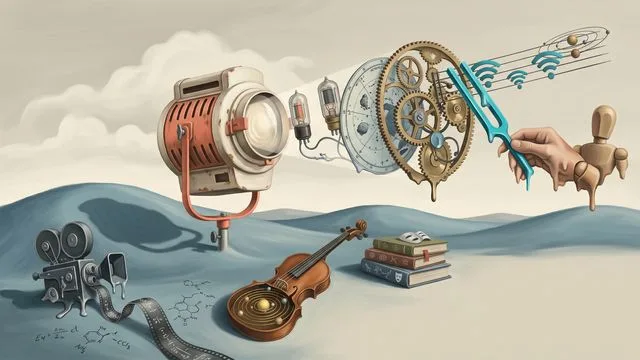
When Celebrities Actually Do Real Science
From Hedy Lamarr's frequency-hopping patent to Brian May's astronomy thesis, these celebrity scientists made contributions that still hold up under scrutiny.

Why You Keep Falling Off (It's Not Discipline)
Dan Koe's viral framework says your identity is built from survival-coded "memes"—and that's why self-improvement keeps failing. Here's what the argument actually claims.
When AI Makes Everything Free, What Are You Worth?
AI tools have broken the old chain of value: production, effort, expertise. Here's what tech workers need to prove instead—and why it's harder than it looks.
Remakes That Outshine the Originals
Exploring movie remakes that have surpassed their originals, offering fresh takes and captivating storytelling across genres.
Joni Mitchell's Timeless Influence in Music
Explore Joni Mitchell's journey from Canadian roots to global icon, shaping music and culture with authenticity and activism.

William Blake and the Art World That Couldn't File Him
William Blake's genre-defying illuminated books found almost no buyers in his lifetime. A new Nerdwriter1 video explains exactly why — and why the machine still works the same way.
Nahre Sol's 10-Level Listening Guide Changes How You Hear
Nahre Sol's free YouTube framework teaches ten layers of deep music listening — from surface instinct to full-on daydreaming — and it works on any genre.