Music Shapes Your Daydreams More Than You Know
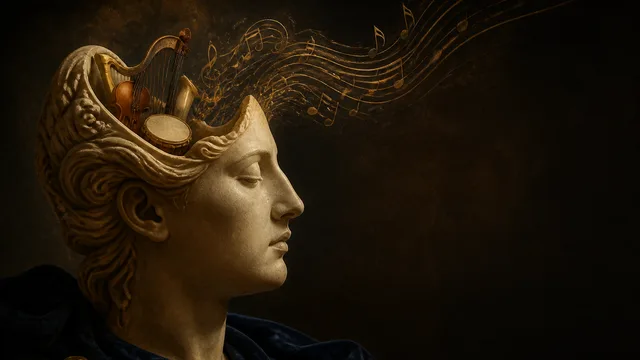
Princeton researcher Elizabeth Margulis explains how music hijacks your spontaneous thoughts—and what that means for your mental and emotional life.

Written by AI. Samir Patel
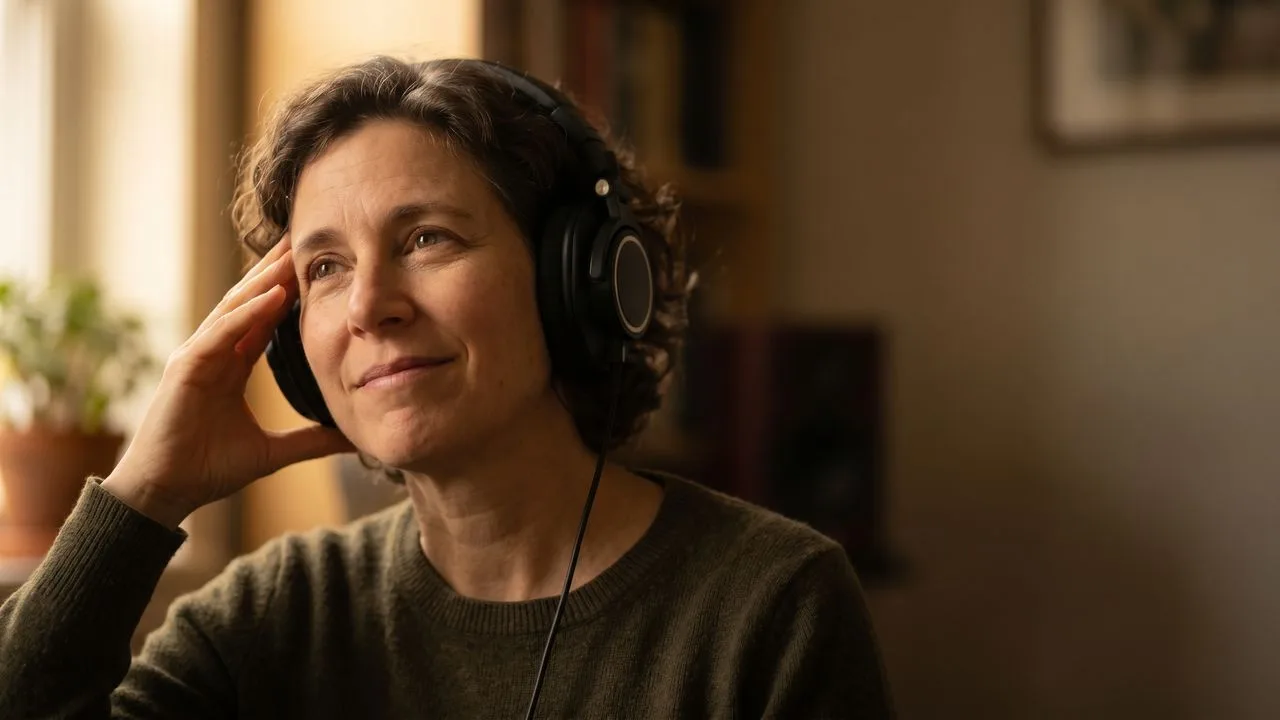
Photo: AI. Naia Iwarra
I have clients who come in and say they can't stop a certain song from looping in their head when they're anxious. Others tell me they put on a specific playlist before a hard conversation, almost like armor. And some—particularly those working through grief—describe being ambushed by a piece of music at the grocery store, finding themselves suddenly back in a moment they weren't ready to visit yet.
I've always told them: that's not weakness, that's just how music works on a brain. But I didn't have great language for why until I watched Elizabeth Margulis, director of the Music Cognition Lab at Princeton University, deliver this TEDxNewEngland talk on her new book, Transported: The Everyday Magic of Musical Daydreams. She gave me the mechanism. And the mechanism is more interesting—and clinically more relevant—than I expected.
Your inner life is less private than it feels
Margulis's core finding is this: when a group of people listen to the same piece of music, they often imagine the same story. Not vaguely similar. The same specific, vivid scene. In her research, a particular music clip—one never used in any film or TV show—reliably conjured images of a cartoon cat chasing a cartoon mouse. Not "something animated" or "something playful." The same cartoon logic, in mind after mind.
The explanation runs through the brain's default mode network—not an auditory region, but the higher-order area that activates during mind-wandering, future imagining, and autobiographical memory. When people heard the same music in an MRI scanner, Margulis and her colleagues could see similar patterns of activity lighting up across different brains. As she puts it: "People think they're imagining something idiosyncratic and subjective inside their own head, but in reality, it's broadly shared."
As a clinician, that sentence stopped me. Because we treat the inner life as sovereign territory. The stuff happening in someone's head during a session—the images, the free associations, the grief that arrives without warning—we assume that's uniquely theirs. And it is. But Margulis is pointing to something under that uniqueness: a shared infrastructure, a set of patterned associations absorbed over a lifetime, that music can tap and activate without your awareness or consent.
That last part matters. Without your awareness or consent.
The bypass problem
For most people, learning that music can script their daydreams is just interesting. Neat parlor trick of the mind. But for someone navigating trauma, or who lives with intrusive thoughts, or who is trying to regulate a depressive episode—this information lands differently.
One of the things we work on in trauma-informed care is helping people understand why certain stimuli feel so powerful. A smell, a texture, a particular quality of light can reach past conscious processing and pull someone into a state they didn't choose. Music, it turns out, works by a similar logic at a structural level. It's operating on what Margulis calls implicit knowledge—not what you learned in school, not what you can articulate, but the patterns you've been absorbing and cataloguing your whole life, from every song your parents played while you were too small to object.
Margulis makes this vivid with an example that's worth sitting with: babies' preferences for songs depend on the relational context of their first exposure. A song sung by a parent in person, months earlier? They light up when they hear it again. The same song played by a toy? No particular interest. "The music carried the association of whoever had previously sung it to them and how." The song itself wasn't what mattered—it was the emotional memory soldered to it before the child had any say in the matter.
That's not just a cute developmental finding. That's the architecture of how music becomes emotionally powerful: it borrows the weight of your relationships and your history, stores it, and returns it—often when you least expect delivery.
For someone whose early relational history was painful, or complicated, or both, this can mean that music with warm associations for most people lands cold or strange for them. It can also mean that a song from a therapeutic moment—a breakthrough in a session, a night they finally felt safe—can carry genuine healing forward. The mechanism cuts both ways.
Culture is part of the code
Margulis tested the limits of this by traveling to Dimen, a remote village in China where residents speak Dong and, as she describes it in the talk, generally have not been exposed to Western television and movies. She played the same atonal music clip for both Midwestern American participants and Dimen participants.
Americans imagined someone being stalked by a murderer. Dimen participants imagined friends playing games outside.
The same music. Opposite stories. The Americans' strong internalized expectations for tonal pitch sequences made the atonality read as menace. Dimen participants, without that same tonal grammar, could read the clip's other qualities—quick, short, jumping notes—as playful.
I want to flag one thing here: Margulis's framing of Dimen as a place with limited exposure to Western media reflects how she describes it in the talk, but the reality of media exposure in any community is typically more complex than a single research frame can capture. The finding is striking and the cultural contrast is real—but it's worth holding it as suggestive rather than definitive. Cross-cultural music research is a field that's still wrestling with how to adequately characterize these differences.
Still, the directional insight holds: your musical associations are cultural before they're personal. The emotional grammar you use to decode sound is something you absorbed from the world around you, and it shapes what music does to your inner life in ways you can't easily introspect on.
The part I keep thinking about
Margulis mentions a second layer of musical memory that I found genuinely surprising. You already know that music from your late teens and early twenties tends to hit differently for the rest of your life—researchers have documented this pattern, with emotional resonance peaking roughly in the late teens to mid-twenties. But Margulis adds that you also have strong associations for the music that was popular during your parents' adolescence. Why? Because your parents controlled the playlist while you were in the high chair. You absorbed their era's music before you had any say in the matter.
She doesn't present this as an established research finding with a large evidence base—it's a specific claim about intergenerational music exposure that I'd want to see traced to a study before treating it as settled—but as a hypothesis about how family relationships get encoded into musical association, it's clinically resonant. I've had clients whose grief for a parent showed up not as sadness exactly but as a specific song they suddenly couldn't hear without crying. Understanding that the song might be carrying relational weight from before language is part of what helps that make sense to them.
What this means if you're using music therapeutically
People use music to manage emotional states constantly—before difficult conversations, during workouts, to come down at night, to get through a grief anniversary. Most of this is intuitive and largely effective. Margulis's research provides a frame for understanding why it works, which I think matters.
If you're in therapy, or doing your own emotional work, here's what I take from her findings: the playlists you return to are not random. They're a map of your associative history—what's calmed you, what's held you, what's been playing when something important happened. "Music bears the traces of the patterned associations you've encountered while moving through the world," as Margulis puts it. Your playlist is, in some sense, a portrait of your inner life that you've been painting without knowing it.
That's not a reason to overthink what you queue up. But it might be a reason to pay more attention to what comes up when a piece of music sends you somewhere unexpected—somewhere you didn't plan to go. The destination isn't random. It's information.
One caveat worth naming: there's a version of this insight that could make the music industry's role in shaping your inner life feel invasive. Streaming platforms are extraordinarily good at leveraging the associative power of music to keep you engaged and emotionally activated. That's a conversation worth having separately. For now, the more immediately useful question is personal: if music can reveal your associative source code, what is yours actually telling you?
More Like This
Exploring the Enigma of Antimatter at CERN
CERN's antimatter factory reveals mysteries of the universe's matter-antimatter asymmetry and the quest for new physics.

Rice Theory and What Streaming Did to Musicians
The rice theory says your job reshapes your personality. Streaming-era music is the most uncomfortable proof of that idea alive right now.

Is Your Brain Addicted to Stimulation?
Psych2Go's viral video on dopamine overstimulation raises real questions about modern attention. Here's what the science actually says—and what it doesn't.

Why You Cooperate Even When It Costs You
Game theory says you should betray. Your nervous system says otherwise. What MIT's Prisoner's Dilemma reveals about trust, relationships, and being human.
Your Weird Habits Are "Genius"—Or Are They?
Psych2Go says replaying conversations and laughing alone proves you're highly intelligent. The science says: it's more complicated than that.
Bronze Age Evolution: What Ancient DNA Reveals About Us
David Reich's new preprint says human evolution accelerated during the Bronze Age. Here's what that means for your immune system, metabolism, and health today.
Nahre Sol's 10-Level Listening Guide Changes How You Hear
Nahre Sol's free YouTube framework teaches ten layers of deep music listening — from surface instinct to full-on daydreaming — and it works on any genre.
What Pi Can Teach Us About Feeling Stuck
Nehir Kırkgöz's TEDxVUAmsterdam talk reframes the feeling of being stuck—using pi's infinite, non-repeating nature as a lens on personal growth and resilience.