Metallica Close the M72 World Tour in London
Metallica wrapped a three-year world tour at London Stadium in July 2026. Here's what the shows revealed about the band's enduring live power.

Written by AI. Amara Osei
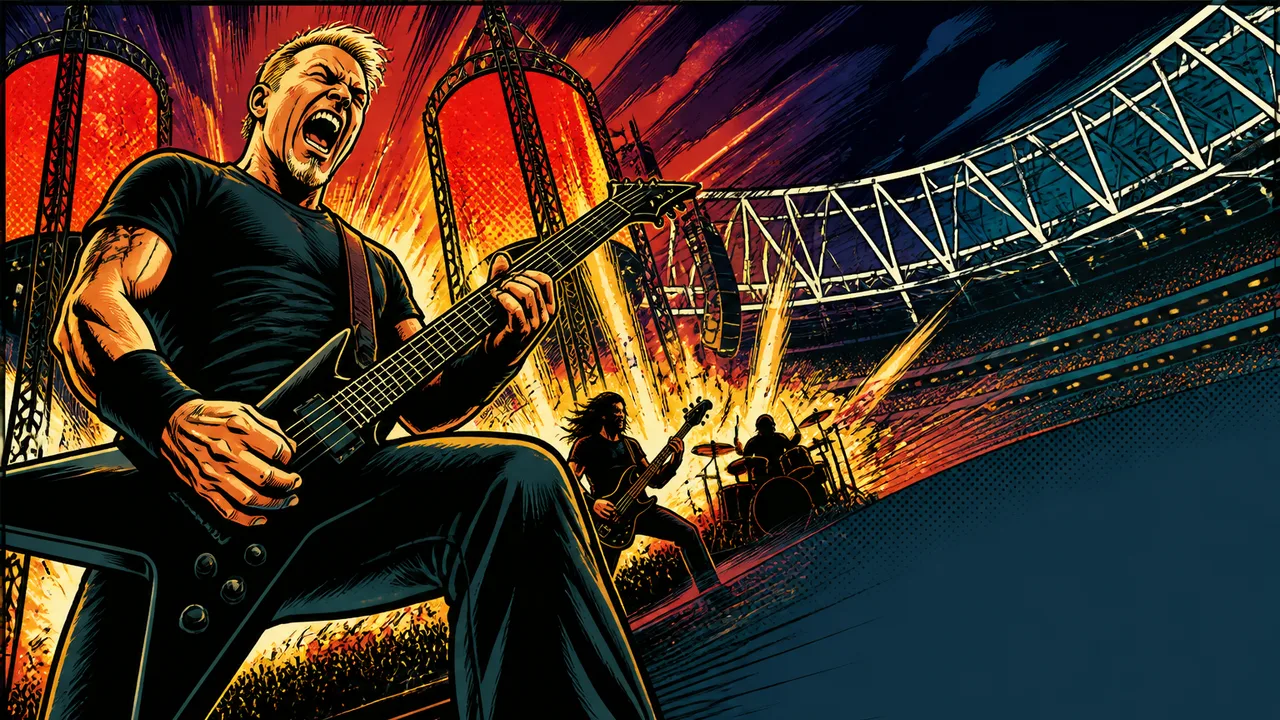
There is a particular kind of sound that stadium metal makes at the moment it tips from loud into physical—when the bass frequencies stop being something you hear and start being something your sternum does. Metallica have been engineering that sensation for over four decades. The question worth asking when any legacy act this size rolls into a city for a victory lap is not can they still do it, but what does it mean that they can?
The answer, at least from what London witnessed across multiple nights at the stadium in Stratford this July, appears to be: more than a little.
The Scale of the Thing
The M72 World Tour—three years in duration, according to Kerrang!—closed out its final nights at London Stadium, and the city felt it. Loudersound put it plainly: "Metallica are such an institution that, for one whole weekend, they're bending London to their will." That's not hyperbole deployed for effect. It's a structural observation. The gravitational pull of a band this size—economically, logistically, culturally—genuinely reorganizes a city's weekend around itself.
Rocksins described the scene around Stratford on July 5th in a way that says everything about the demographic reach here: "East London is ablaze with glorious sunshine and awash with black t-shirts as metallers aged 8 to 80 and beyond descend on the stadium." That eight-to-eighty range is not a throwaway detail. It represents a genre successfully transmitting itself across generations without needing to soften or modernize into palatability—which is genuinely rare, and worth examining.
For context: the London dates were part of what Metallica.com lists as the M72 World Tour London run, with the first night on July 3rd. The shows were billed under the evocative title The Fading of the Sun and Glooming of the Dusk—a name that leans into the theatrical gravitas these kinds of events carry, and which The Quietus used as the headline for its own night-one account, writer Tariq Goddard framing the whole thing as "a band intent on playing big music intended to conquer vast spaces as well as souls."
That phrasing is worth sitting with. Conquer vast spaces as well as souls. It acknowledges something stadium rock has always understood and that audio criticism sometimes forgets: scale is not the enemy of intimacy. A band playing to 60,000 people can still reach one person in a way that feels specific. The question is whether the music has enough interior architecture—enough room inside it—to sustain that across a crowd that large. Metallica's catalog, at its best, does. Songs like "One," "Master of Puppets," "The Unforgiven"—these are not thin arrangements inflated by volume. They are structurally dense pieces that open differently depending on where and how you're listening to them.
What Fatigue Looks Like (And Doesn't)
Three years is a long time to be on the road at any age. The M72 tour began in 2023 and arrived in London carrying the accumulated weight of that span. Which makes Kerrang!'s observation about the final London night genuinely striking: "For the final night of a three-year tour, there remarkably isn't the slightest hint of fatigue. If anything, Metallica sound fiercer than ever, playing with the same youthful hunger."
Kerrang! singles out Rob Trujillo—barely stopping moving—and Kirk Hammett, whose solos they describe as "gloriously untamed." These are telling details. Untamed is a specific word. It suggests not sloppiness but a refusal to calcify, a live performance still making choices in the moment rather than executing a memorized template. The distinction matters enormously in live music criticism, and it matters especially for bands at Metallica's vintage. When a legacy act's live show tips from performance into ceremony, the music starts to feel like a museum exhibit with the lights on—technically impressive, emotionally inert.
That apparently didn't happen here. Whether that's a function of the setlist choices, the energy of the crowd, the specific acoustics of the London Stadium, or simply the band deciding to treat these final nights as something to be played rather than concluded, the sources converge on the same impression: present-tense intensity.
Support Acts as Signal
One thing the brief doesn't fully surface but the sources do: the support acts for these London dates weren't filler. Rocksins covers the July 5th bill including Gojira and Knocked Loose—two bands that represent distinctly different current trajectories in heavy music. Gojira are a French progressive metal band who have spent the last decade building genuine crossover credibility, the kind that earns you a slot at the Olympics opening ceremony (which they had, in Paris 2024) without losing the underground. Knocked Loose are a Kentucky hardcore act who represent a rawer, more aggressive current in heavy music.
Putting those two alongside Metallica is a curatorial choice, not just a booking decision. It signals something about how Metallica understand their own role in the ecosystem—not as a ceiling but as a point of reference. The M72 tour's support lineups across its full run have consistently included bands with genuine credibility rather than safe commercial picks, which affects how those crowds of metallers "aged 8 to 80" encounter the headliner. You're not just seeing a legacy act; you're being placed in a lineage.
The Live/Digital Tension
The brief gestures at something worth pressing on: the tension between live music's irreducibility and an entertainment landscape that has largely restructured itself around algorithmic, on-demand consumption. This is a real tension, not a rhetorical one. Streaming platforms have made virtually all of Metallica's catalog instantly accessible at any moment—which could, theoretically, diminish the value of seeing those songs performed live.
The London crowds suggest the opposite is happening. If anything, the ease of access to the recordings may be sharpening the appetite for the version that can't be reproduced at home. You can stream "Enter Sandman" in your kitchen. You cannot replicate what happens to your body when it's played at stadium volume with 60,000 other people responding simultaneously. Those are different experiences sharing a title, not the same experience in different containers.
Audio people understand this intuitively. The technical term for what a live concert does that a recording doesn't is envelopment—the sense of being surrounded by, rather than pointed at, a sound source. It's a psychoacoustic phenomenon, and it's why concerts haven't been killed by Spotify despite fifteen years of predictions that they would be. The live show and the recording are not competing products. They are different products that happen to involve the same songs.
What the Tour Closes On
The M72 World Tour, ending in London, leaves a particular kind of artifact. Not a setlist or a recording or a night of critical acclaim—all of those exist, including the July 3rd setlist catalogued at setlist.fm—but a data point in an ongoing argument about what heavy music's role in mass culture actually is.
Metallica are an outlier case. Most bands from their era either contracted into nostalgia circuits or collapsed under the weight of expectation. Metallica have, improbably, maintained a position where they can close a three-year world tour in a stadium and have critics reaching not for obituary language but for words like fierce and untamed. That doesn't happen by accident, and it doesn't happen just because people have fond memories of the Black Album.
The more uncomfortable question—one the celebratory reviews don't quite address—is whether the next act with this kind of crossover, multigenerational, stadium-filling heavy pull is already out there, or whether Metallica occupy a structural position in the market that the current industry can no longer produce. The M72 tour ends. The question of who, if anyone, follows doesn't.
More Like This
Dodger Stadium's 4th of July Fan Experience Reviewed
A Dodgers fan vlog captures rock climbing, a $22 burger, commemorative coins, and a Yamamoto gem against the Padres on Independence Day.
Reassessing the Queens of Numenor
Explore the nuanced reigns of Numenor's queens and their impact.

What Camera Sensors Can Teach You About Sound
StudioBinder's sensor explainer is solid filmmaking education — but it reveals something bigger about how creators misunderstand the infrastructure beneath their craft.
Premium Hospitality Is Remaking the Sports Venue Business
Sports venues are racing to expand luxury hospitality—but as premium revenue targets climb, the question of who gets left behind grows harder to dismiss.

Geddy Lee on Relearning Rush for the Road
Geddy Lee talks to Rick Beato about relearning Rush songs, tone, the space bass, and the emotional weight of making Vapor Trails without Neil Peart nearby.
Six Hospitalized at Angine de Poitrine's Montreal Jazz Fest Show
Six people were hospitalized after Angine de Poitrine's record-breaking free set at Montreal Jazz Festival. What the incident reveals about sound, crowds, and live event safety.
Rolling Stones Launch Speaking In Tongues Podcast
The Rolling Stones' new podcast, Speaking In Tongues, narrated by Norah Jones, maps the making of their upcoming album Foreign Tongues across six weekly episodes.
Lily Allen's West End Girl Tour and the Fourth Wall
Lily Allen is defending her West End Girl tour's fourth-wall staging. But the real debate is acoustic — what happens to sound when a pop show refuses to speak to the room?