Reckless Ben's LEGO Lawsuit Was Dismissed, Not Won
Reckless Ben admitted his viral LEGO lawsuit victory never happened. Court records show wrong entity, improper service, and a dismissed case — not a win.

Written by AI. Ryan Kowalski
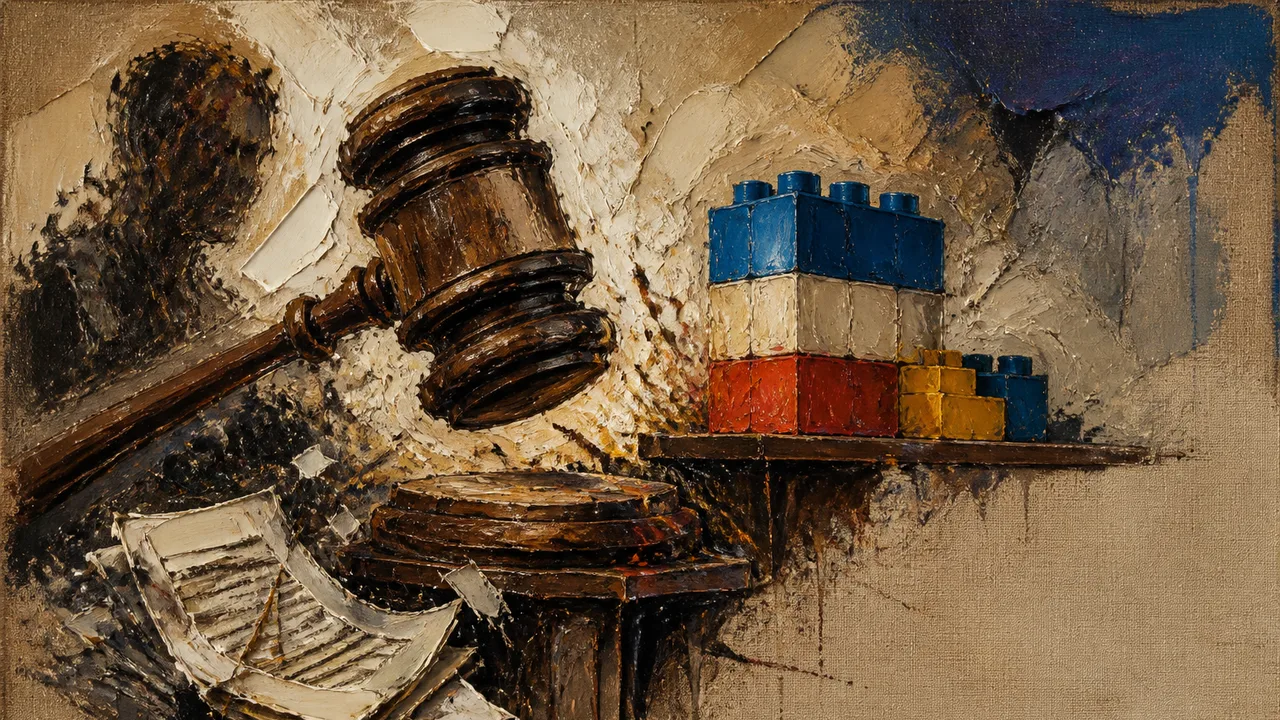
Photo: AI. Saskia Aaltonen
There's a version of this story where a guy gets ripped off, fights back without a lawyer, stumbles through the court system, learns hard lessons, and eventually gets something like justice. That story is genuinely interesting. It's also not quite the story Reckless Ben has been telling his audience.
Ben — a YouTuber who built a following documenting his dispute with Bricks & Minifigs, a LEGO resale franchise — told viewers he had won a lawsuit against the company. He celebrated. His audience celebrated. The court records tell a different story: the case was dismissed. He had sued the wrong legal entity. He had also served the wrong party. And the LLC he named in the suit — L2 Bricks LLC — had reportedly stopped renewing its registration years before Ben filed anything. (The precise gap depends on when exactly Ben filed, a date not confirmed in the available record.)
In a recent video, Nate the Lawyer — a YouTube legal commentator with a claimed background as a former cop, criminal defense attorney, and assistant district attorney — walked through Ben's response video, pausing to fact-check and editorialize in real time. Nate's breakdown is thorough and, on the core facts, accurate: Ben filed for a default judgment before the court approved it, announced the win publicly, and the court later denied the motion and dismissed the case entirely.
"He sued the wrong LLC that was closed out eight years ago," Nate explains in the video. "He calls and says they didn't respond — obviously, because they closed out eight years ago."
That's the cleanest summary of what went wrong procedurally. But I want to slow down before we hand Nate the Lawyer the gavel here, because he's also a performer with an audience. His videos on this saga have pulled enormous view counts. He admitted on stream that he initially got the story wrong because he "got too confident and didn't read the documents." He's now correcting that — commendably — but his framing throughout is that of a trusted guide sorting truth from chaos. That role benefits him. His conclusions may be correct; his incentives to be the guy who "goes against the narrative" are also real, and worth keeping in mind as you weigh his commentary.
What actually happened with the lawsuit
The store in question operates out of two adjacent storefronts — the business apparently expanded by knocking through a wall between neighboring retail spaces, creating a single store with two street addresses. The active LLC was registered to the second address. Ben searched the first. He found a defunct entity, called the court clerk for guidance, and — according to Ben's own account — was told to sue the old LLC anyway because it was the last one associated with that address.
Nate's reaction to this is worth quoting directly: "If the court tells you to sue a company that's been out of business for eight years, I think the court is wrong."
Ben's own gloss on this is less persuasive. He described the situation as Bricks & Minifigs having "outsmarted" him — as if a deliberate trap had been laid. Nate correctly pushes back: nobody engineered a two-address confusion to evade service. Ben searched the wrong address. He missed the active entity. That's a painful mistake, but it's a navigational error, not a conspiracy.
What Ben did next matters, though, and it gets less attention in the discourse: he refiled. He sued the store's individual owners personally. He used a proper process server. He went to mediation. He has an active small claims case heading toward a hearing. The first lawsuit was a loss. The second one is still in play. Those are different facts, and conflating them — as some of Ben's critics have done by calling the entire effort a "scam" — is its own form of sloppiness.
The pro se problem nobody wants to sit with
I've spent a fair amount of time watching regular people try to navigate public processes without institutional backup. A resident shows up to a zoning board hearing with a handwritten statement and no idea the comment period closed two weeks ago. A small business owner tries to contest a municipal fine and misses the administrative appeal window by a day because nobody told her there was one. The system isn't designed to be impenetrable — but it's also not designed with the unrepresented user in mind. The forms are confusing. The clerks aren't lawyers. The stakes are real.
Ben walked into something structurally similar. He looked up what he thought was the right entity, got informal guidance from a court employee who apparently wasn't familiar with the two-address situation, and proceeded in good faith. The error compounded. This isn't a defense of announcing a legal victory you haven't won — that part is straightforwardly wrong, regardless of intent. But the underlying confusion is exactly what happens when someone with no institutional knowledge tries to use a system that assumes you have some.
Ben framed the decision to go without a lawyer as a content choice — keeping viewers inside the experience of someone without resources fighting a corporation. That's partially true and partially convenient. What's undeniable is that the financial asymmetry he's describing is real. Pursuing a $100,000 claim through conventional litigation could easily cost more than the claim is worth. That math doesn't justify false victory claims, but it does explain why people end up in small claims court making procedural errors instead of in district court with representation.
The GoFundMe question
Ben initially set a crowdfunding goal of $120,000 — which he described as the approximate remaining value of the LEGO collection allegedly still owed to the original owner, Brian. That figure is unverified; it's Ben's characterization, drawn from his own accounting of what the store allegedly still held. The campaign surpassed that goal. Then it kept going — reportedly approaching $400,000 as of the time of Nate's video, though crowdfunding totals fluctuate and that figure isn't date-anchored.
Ben's explanation for the expanded goal: the money is now needed for legal fees, it all goes to Brian, none of it goes to Ben personally.
That may be entirely true. It also creates a transparency problem that exists regardless of whether it's true. The original stated purpose was to make Brian whole. That purpose was accomplished — Brian was paid out. The campaign then continued under a different rationale, without a clear public accounting of what changed and why. Donors who gave to a recovery fund may not have known they were also funding a legal defense campaign.
Nate waves past this as understandable given the escalating legal exposure. And yes, Ben is now facing what appear to be multiple charges — including an alleged stalking charge connected to his attempt to personally serve Josh (the precise legal basis and jurisdiction of that charge are unspecified in publicly available accounts, and should be treated as alleged) and an alleged extortion charge stemming from a claim that he threatened to burn the store down, which Ben vigorously denies and which he says his own footage contradicts.
The legal exposure is real and serious. But "we need more money because the situation got complicated" is exactly the kind of post-hoc justification that every crowdfunding campaign with scope creep uses, good-faith or not. Donors deserved a cleaner explanation in real time, not a retroactive one.
What to actually watch for
The small claims hearing against Josh personally is the next concrete procedural moment that will tell us something. Ben has reportedly completed service correctly this time, attended mediation, and is proceeding toward a hearing. If the underlying facts hold — that the collection existed, that the consignment arrangement was breached, that Brian is owed compensation — then the legal theory survives the first lawsuit's collapse. A ruling in that case, either way, is the first time a court will actually weigh the merits.
The defamation exposure is the slower-moving threat. Bricks & Minifigs is suing Ben over his documentary claims. Ben's defense rests heavily on truth — if the underlying allegations about the collection are proven, the defamation case weakens substantially. If they're not, Ben has a serious problem. Nate says Bricks & Minifigs, as a business that invited public attention, faces a higher bar to prove defamation than a purely private party would. That analysis may be right, but "higher bar" is not "no bar," and the tortious interference theory — did Ben falsely claim his lawsuit caused the store to close, and did that claim harm the business? — sits in murkier territory.
There's also a third thread nobody seems to be tracking carefully: the American Fork Police Department's conduct throughout this. Nate stated on stream that he contacted Utah's governor's office about alleged police corruption — that claim is his alone and unverified. But the body cam footage has been released and reviewed publicly. Whatever else is disputed here, the question of whether law enforcement used its authority appropriately in this dispute is separate from whether Ben filed the right paperwork. It probably deserves more scrutiny than it's getting from anyone who isn't already invested in one side of the content war.
Ben told Nate's audience: "I wanted this whole LEGO video to be from the perspective of just some average person that a company's bullying without any resources — can this average person stand up to a corporation without a lawyer?"
The answer, so far, is: partially, expensively, and with significant collateral damage to his own credibility. The second lawsuit is the test of whether any of it was actually worth it.
More Like This

Unraveling the Mysteries of Magic in Middle-earth
Explore how magic in Middle-earth defies traditional spells, rooted in nature, craft, and intent.

10 Underrated Netflix Films That Deserve Attention
Explore ten overlooked Netflix films that showcase unique storytelling and filmmaking techniques yet failed to capture widespread attention.
Is Nature Good? Harari and Žižek Say No
Yuval Noah Harari and Slavoj Žižek agree: nature isn't inherently good. Their debate reveals why "natural" is almost always a political argument in disguise.
Bambu Lab Is Picking Fights It Doesn't Need to Win
Bambu Lab threatened an open-source developer over a slicer fork. Jeff Geerling breaks down why that move says everything about where the company is headed.

Lee Cronin's The Mummy Wears Egypt Like a Mask
Lee Cronin's The Mummy sells Egypt and delivers Evil Dead. The visual identity gap between what it promises and what it shows is where the film collapses.

Musk v. Altman: A Trial About Nothing
The Musk v. Altman trial ended on a statute of limitations technicality. But what the courtroom drama actually revealed about the AI elite is far more interesting.
Kane Parsons on the Backrooms Film and YouTube Filmmaking
Kane Parsons, described as 20 years old in his BBC Newsbeat interview, made a Backrooms feature film from a YouTube series. Here's what that path actually required.

Gamers Are Fighting the EU Over Digital Ownership
The Stop Killing Games movement reached 1.25M signatures and an EU hearing. Here's what's actually at stake—and why it's bigger than gaming.