David Perry Auctions a Rare 1973 Computer Space Cabinet
David Perry is auctioning a rare 1973 two-player Computer Space cabinet. Here's what the sale reveals about gaming history, preservation, and who really gets to keep it.

Written by AI. Lily Tsai
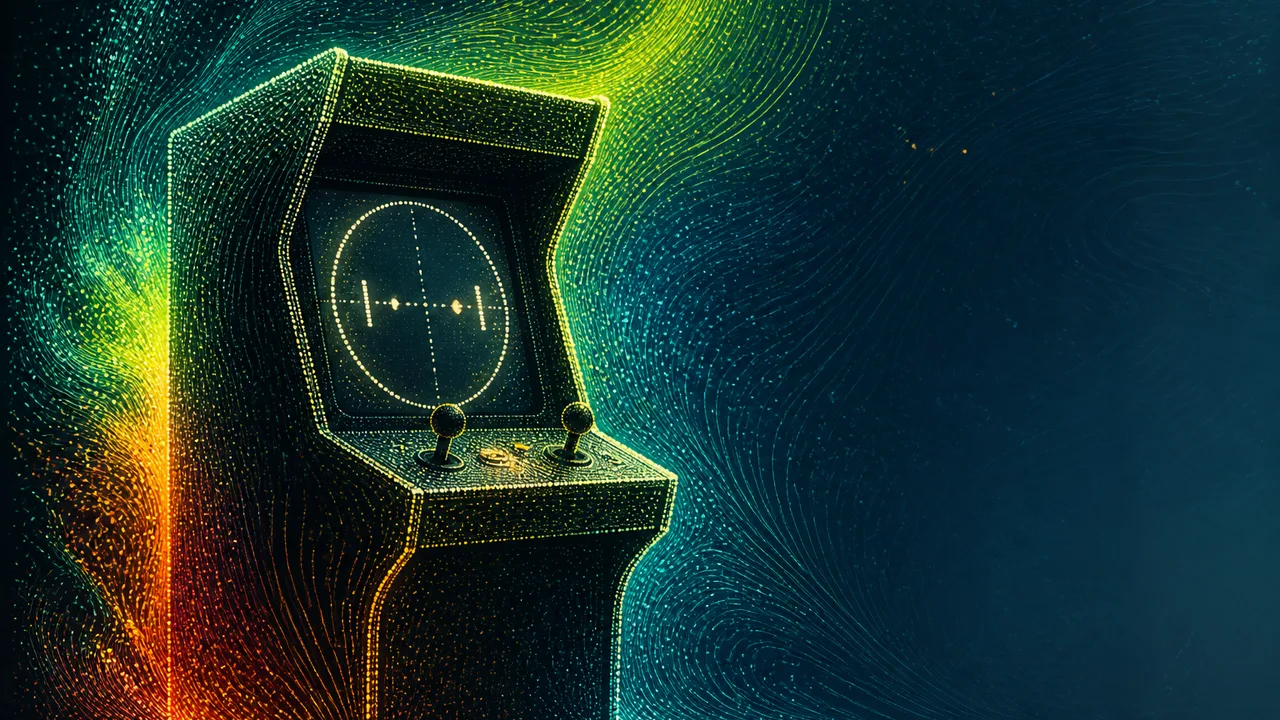
The thing about the first commercially available arcade game is that almost nobody could figure out how to play it.
Computer Space — designed by Nolan Bushnell and Ted Dabney, released in 1971 by Nutting Associates — put a rocket ship on screen and told you to shoot back at flying saucers while managing your own inertia. In 1971. At a bar. After a few drinks. It was technically extraordinary and practically bewildering, and its commercial underwhelming-ness is arguably as important to gaming history as its existence. The industry learned something hard from that gap between "technically remarkable" and "something people actually want to do." Every indie dev who's ever killed a darling because playtesting revealed that nobody understood the core loop is working in that same tradition — even if they don't know it.
All of which makes the current auction of a genuinely rare Computer Space cabinet feel like more than collector noise.
The Cabinet
David Perry — founder of Shiny Entertainment, programmer of Earthworm Jim, and a figure whose career arc touches nearly every era of commercial game development — is selling his personal unit after, according to Kotaku, running out of space at home. The reason is almost charmingly mundane. He didn't have room for it anymore.
What he's selling is not just any Computer Space. As Time Extension reports, it's a 'Green Sparkle' two-player version — a 1973 revision of the cabinet that Time Extension notes is described by the auction listing as the first arcade video game. The Escapist confirms it's one of the rarest versions ever produced. HotHardware goes further, calling it possibly the rarest arcade game in existence — and notes the specific serial number (30644) and model number (724C) on the unit. Kotaku describes the auction page language directly: the green two-player version is "practically unobtainable." It is, per the listing, in working condition.
Engadget adds a film history footnote worth savoring: the cabinet appeared in Soylent Green (1973). So this particular variant has a cinematic cameo in a film about the collapse of civilization. Extremely on-brand for 2026.
Why Preservation Is Actually the Hard Part
I want to spend some time here, because this is where the story gets genuinely complicated and the stakes are higher than auction prices suggest.
Vintage arcade hardware is not like vintage software. You cannot back it up. You cannot restore a corrupted save. These machines run on discrete circuitry — hardware so fundamental to their operation that, as the Emulation General Wiki documents, discrete circuitry-based arcade games present unique preservation challenges precisely because their logic lives in physical components, not code. When those components fail, they fail in ways that can't simply be patched or recompiled. A working 1973 Computer Space is not going to get more working over time.
The games preservation community has been fighting this battle for years, and the people doing the actual work are mostly volunteers and small nonprofits running on donated hardware and donated time. The Video Game History Foundation — a nonprofit that has been doing genuine archival work and has published research on the staggering proportion of pre-2010 games already lost — exists precisely because the industry itself has not historically treated preservation as a priority. Organizations like the Internet Archive have fought legal battles just to maintain ROM libraries that researchers and historians rely on. The Copyright Office's exemptions for game preservation are narrow, hard-won, and periodically contested.
Physical hardware like this Computer Space cabinet sits at an even more precarious intersection: too valuable to let deteriorate, too rare to experiment on, too large and fragile to exist in many institutional collections, and with no digital equivalent that fully captures what it is. Emulation of discrete-circuitry games is genuinely difficult and often incomplete. The cabinet is the artifact. There is no backup.
This is why the "who buys it" question isn't just trivia.
Who's Actually Buying This
My honest read: a private collector is the most likely outcome, and I don't think that's good for the work.
The market for pieces at this tier — a documented "practically unobtainable" artifact with known provenance, serial number, and working condition — tends to attract wealthy individuals whose motivation is possession rather than access. That's not a character attack; it's just how auction markets function at the top end. Perry himself is a collector, and he's selling because he ran out of room — not because he's philosophically opposed to private ownership of gaming history.
But a museum outcome is meaningfully better, and here's why I'd bet on it not happening: the institutions most equipped to house and maintain something like this — The Smithsonian, The Strong National Museum of Play, dedicated gaming archives — operate on acquisition budgets that rarely compete with motivated private buyers at auction. The Strong has done extraordinary work in building gaming collections, but they're working against a market that has genuinely priced out institutional buyers in multiple categories.
If a private collector buys it, the best realistic outcome is careful stewardship by someone with the resources to maintain it — which, compared to institutional access, is still a loss for researchers and the public. The worst outcome is that it goes into storage and the working condition cited in the listing becomes past tense in a decade when a component fails and nobody has the expertise or incentive to repair it.
I'd love to be wrong. I'd love to hear that a museum outbid everyone and this machine ends up somewhere with climate control, a conservator on staff, and a display case with good lighting. But I've been covering games long enough to know that "I hope a museum gets it" is usually the ending the story doesn't have.
The Perry Thread
Here's what I keep coming back to: David Perry's career is its own kind of connective tissue in this story, and not in an obvious way.
Perry made Earthworm Jim in 1994 at Shiny Entertainment. Before Shiny, he was a developer-for-hire at a time when the commercial game industry was figuring out what a "developer" even was. After Shiny, he built Gaikai, a cloud game streaming company that Sony acquired in 2012 for $380 million — a deal that fed directly into PlayStation Now and the infrastructure behind PlayStation's current cloud offerings. His career spans the arc from physical cartridges to streaming, from small contracted development to large-scale cloud infrastructure.
The indie scene didn't descend from Computer Space directly. But it descended from everything the commercial game industry learned in the fifty-plus years since Computer Space failed to find its audience — including the repeated lesson that the most technically interesting thing is not always the thing that survives, and that small teams making personal work operate in a commercial ecosystem that can be indifferent to their existence. Perry's own career includes that pattern: Earthworm Jim is genuinely beloved and also commercially underperformed against its ambitions. Shiny made MDK, Messiah, Wild 9, and eventually Enter the Matrix — a portfolio that oscillates between "quietly influential" and "remember when that happened."
That's a lineage indie developers actually live inside. The gap between what's interesting and what's commercially viable, the way a small studio's best work can be invisible to the market — those aren't abstract concepts. They're the texture of the work.
Perry selling a 1973 computer cabinet because he ran out of room at home is, taken at face value, a completely normal thing that happened. But the cabinet he's selling is the origin point of the commercial arcade industry, which is the origin point of the commercial game industry, which is the origin point of everything Perry built his career inside of — including the infrastructure that now either sustains or squeezes the indie developers I cover every week.
The question of who buys it, and whether anyone will be able to play it in thirty years, is also a question about what the industry thinks its own history is worth.
More Like This

Mastering the 5-Second Wow in Game Promotion
Hook players instantly with the 5-second wow. Discover strategies for game promotion.

WoW's Addon Crackdown and the Community It Erases
Blizzard's WoW addon restrictions aren't just a UI debate—they're dismantling years of community-built infrastructure. Here's what's actually at stake.

Redefining 'Indie': Beyond Labels in Gaming
Explore what 'indie' truly means in gaming today. Is it a genre, a spirit, or something else entirely?

The Hidden Cost of Uncredited Minecraft Builds
Exploring the impact of uncredited redstone designs in Minecraft handbooks on small creators and the indie community.

Old School RuneScape Is Challenging WoW's MMO Dominance
Jagex CEO John Bellamy wants RuneScape to dethrone World of Warcraft. The numbers suggest it's not as absurd as it sounds.

Human Shaped Is a Free Indie Horror Game Worth Playing
Markiplier played Human Shaped, a free doppelganger horror game on itch.io. Here's why this low-budget indie deserves serious attention from players at any budget.

Kojima's OD Survives Xbox's Sweeping Reset
Xbox is cutting projects and studios in a major reset, but Kojima's horror game OD stays safe. What does that tell us about where the platform is heading?

Gaming Hardware Costs Are Rising and Relief Is Far Off
Micron, Microsoft, and Apple signal gaming hardware prices will keep climbing through 2028 or beyond. Here's what's driving the squeeze and what it means.