Xbox’s Sustainable Business Model Starts to Take Shape
Microsoft’s Xbox reset shifts studios toward Activision and Bethesda as layoffs, cloud ambitions and an ad patent hint at a broader platform strategy.

Written by AI. Mike Wierzbicki
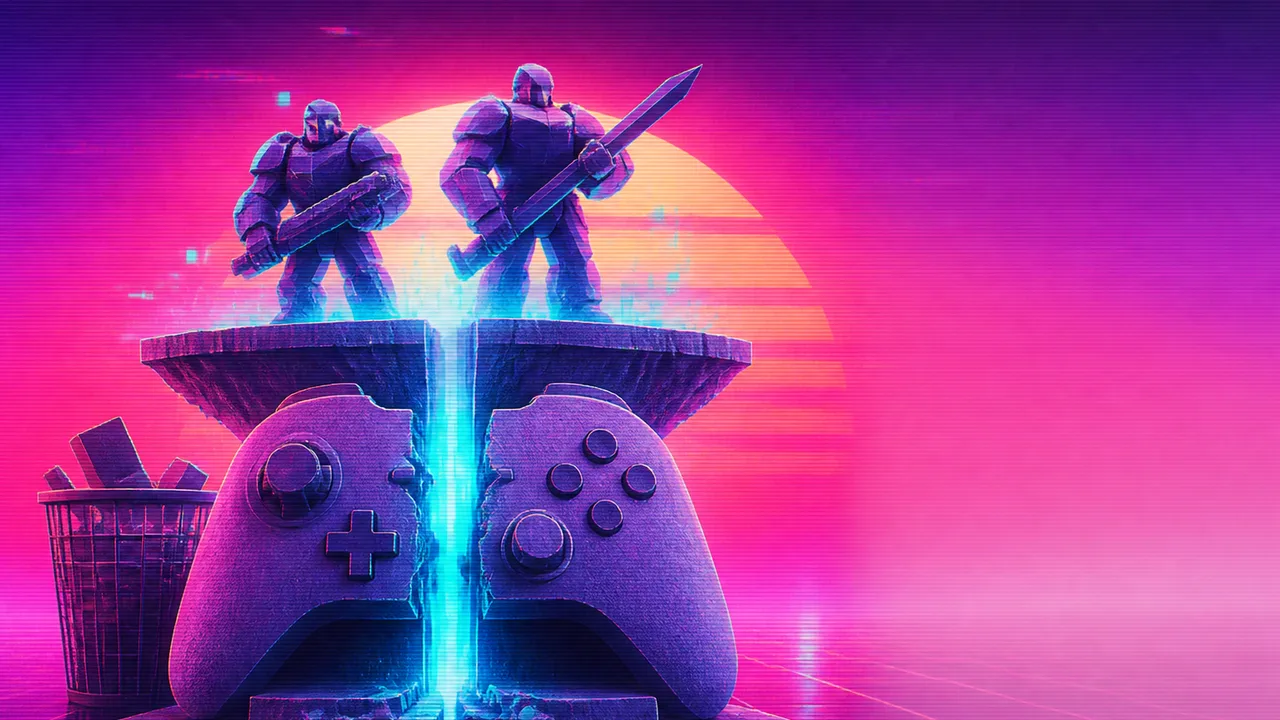
Microsoft CEO Satya Nadella says Xbox must “invent the right sustainable business model” after Microsoft announced thousands of job cuts and stripped down its first-party studio structure.
Speaking on the Sources Podcast, Nadella praised the “streamlining” led by Xbox CEO Asha Sharma and said Microsoft wants to be both a publisher and a platform provider across PCs and Xbox consoles. He also relayed management’s expectation that Xbox will return to growth next fiscal year, although he did not define the model expected to deliver it.
Microsoft’s org chart supplies clues that Nadella’s answer did not. In July, Xbox announced a plan affecting 3,200 jobs and five studio divestitures, with about half of those cuts taking effect immediately. Microsoft then cut another 268 positions and placed Halo, Rare and World’s Edge, the Age of Empires developer, under Activision, GamesIndustry.biz reported.
This looks larger than a quarterly trim around the edges. Microsoft is routing more franchises and teams through Activision and Bethesda while reducing the role of the organization that once defined Xbox’s first-party identity. Read beside Nadella’s publisher-plus-platform language, those transfers suggest that Xbox may increasingly function as a distribution and service layer while acquired publishing groups assume responsibility for more teams and properties.
The Acquisition Bill Arrived in Several Installments
Microsoft completed its $68.7 billion Activision Blizzard acquisition in October 2023. The workforce reductions that followed arrived across several years instead of appearing in one merger announcement.
Game Developer’s accounting identifies five mass-layoff rounds affecting at least 5,750 positions since the acquisition. Its timeline includes 2,550 workers cut across January and September 2024, the May 2024 closures of Arkane Austin, Tango Gameworks and Alpha Dog Games, undisclosed 2025 reductions at ZeniMax Online Studios and King, and the 3,200-position plan announced in 2026.
Some totals remain undisclosed, and part of the latest plan extends through the fiscal year. The 5,750 figure is therefore a lower-bound count that combines completed and announced reductions. It is not a final tally of people already dismissed.
Sharma replaced Phil Spencer in February 2026. Under her restructuring, Double Fine and Compulsion Games were permitted to become independent, while Undead Labs also left Microsoft’s studio structure. The company pursued other combinations: Obsidian moved under Bethesda, Playground Games and Turn 10 merged, and Rare, World’s Edge and Halo moved under Activision, according to Eurogamer’s breakdown.
The latest 268 cuts belong to that longer ledger. Microsoft bought publishing scale, then spent three years removing jobs, studios and management layers while rearranging Xbox around acquired businesses. The acquisition alone cannot establish the cause of every later cut. The timing and transfers do show that the post-deal company is being built around a different center of gravity.
Management has a defensible case for changing the structure. Polygon’s Oli Welsh assessed that Xbox Game Studios had not become a reliable hit factory and that Halo was not where Microsoft needed it to be. Preserving every reporting line would not have addressed those concerns. A reorganization could remove duplicated operations and put troubled franchises inside larger publishing groups.
Microsoft is asking the remaining workforce to discover whether it repaired the production machine or merely removed parts from it. A cleaner org chart can hide either outcome until projects ship.
Activision is Becoming the Center of Gravity
After the closures, divestitures and transfers, Xbox Game Studios comprises only three studios, Polygon reported. Activision, Blizzard, Bethesda and Mojang still leave Microsoft with an enormous games portfolio. Development continues, but authority over major Xbox properties is moving into Activision and Bethesda through the documented transfers of teams and franchises.
Combined with Nadella’s publisher-plus-platform formulation, that structure supports an inference: Microsoft increasingly sees Xbox as an audience, distribution and service layer spanning devices, while Activision and Bethesda take responsibility for a larger share of its development portfolio. Under that arrangement, a game can serve Microsoft without selling an Xbox console. It can generate software sales, subscriptions or recurring spending through other distribution channels.
The inference has limits. Nadella’s remarks did not announce a plan to retire the console or make it irrelevant. Moving Halo under Activision could represent an attempt to stabilize one damaged franchise instead of a template for every Xbox property. The next release slate and Microsoft’s platform choices will test the broader interpretation.
Org charts usually follow the work executives expect to monetize. Activision now holds responsibility for Halo, Rare and World’s Edge while Xbox Game Studios has been reduced to three teams. That arrangement places Activision near the middle of Microsoft’s games operation. The Xbox box remains an endpoint, but the company no longer appears organized around making every road lead back to it.
An Advertising Patent Points to One Possible Model
A newly reported Microsoft patent offers one candidate for Nadella’s unnamed business model. The filing, titled “Contextually Aware Management of Interactive Software Application Access,” describes using triggers such as loading screens or pauses to present advertising, BGR reported. Xbox has also floated an ad-supported cloud-gaming tier.
Netflix and other streaming services have introduced advertising tiers that exchange a lower entry price for another source of revenue. Xbox could apply the same basic commercial logic to cloud gaming: reduce the price barrier, expand the reachable audience and monetize some users through ads instead of relying entirely on subscriptions or console purchases.
The comparison breaks once implementation begins. Interactive games present commercial and design conditions that streaming video does not have to solve in the same form. Xbox spans premium releases, free-to-play games and third-party software, each carrying different player expectations and potential business agreements. An advertisement attached to an optional cloud tier occupies a different bargain from one inserted into a full-price game. Microsoft would also have to settle questions involving developer participation, revenue sharing, privacy and interruption points.
The patent supports only a possibility. Microsoft has announced no product based on it, and companies frequently patent systems they never ship. Microsoft has not said who would see these ads or whether the technology will reach Xbox at all. Free-to-play games and an optional cloud tier look like more plausible test beds than premium releases, but even that remains an inference.
The patent still belongs in the discussion because it fits the incentives created by the reorganization. A business organized around reach needs ways to earn money from people who do not purchase its hardware. Multiplatform software, subscriptions, cloud access and advertising all answer that problem through different pipes.
Growth Depends on the People Left in the Pipeline
Cost reductions can improve a division’s financial profile before they prove anything about production. One worker affected by the cuts told Game Developer that triple-A development is highly collaborative and interconnected around specialists, comparing mass layoffs to pulling threads from a wide piece of cloth.
That account comes from one unnamed worker and cannot establish conditions across every Microsoft studio. It identifies a production risk behind the headcount totals: a studio can retain an intellectual property, a project name and a release window after losing people who understood how its pipeline worked.
Other employee accounts sharpen that concern without resolving how widespread it is. TheGamer, relaying reporting by Aftermath, said current and former staff described aggressive goals that would have been unrealistic before the layoffs. It also cited id Software staff characterizing the environment as “chaotic” and attributing to leadership a demand for “higher profits” immediately. These perspectives do not provide a complete picture of Xbox’s finances or represent every studio, but they challenge the assumption that fewer reporting lines automatically produce a healthier development operation.
Microsoft’s strongest argument rests on the assets it still owns. Activision, Blizzard, Bethesda, Mojang and the remaining Xbox teams give the company a large portfolio and several publishing organizations through which to assign projects. On Polygon’s assessment, Xbox Game Studios had failed to become a reliable hit factory. Consolidation could remove operations that management believes have underperformed and give troubled projects different support structures.
The labor ledger supplies the counterweight. At least 5,750 announced job losses, studio closures and repeated transfers create opportunities for institutional knowledge to leave faster than a new reporting structure can replace it. Intellectual property survives on a balance sheet indefinitely. Production knowledge has to come to work on Monday.
The next fiscal year will provide harder evidence than executive adjectives. Growth can come from subscriptions, software releases, cloud access, advertising or reduced costs, and each route assigns the risk differently. If Xbox grows while its release cadence stabilizes and remaining teams retain staff, Microsoft will have evidence that the reset rebuilt the operation. If revenue improves mainly because payroll fell while projects slip and more specialists leave, “sustainable” will describe the spreadsheet before it describes the business.
More Like This

Xbox Mythic Achievements Redefine Game Completion
Xbox Mythic Achievements may reward base-game completion without Gamerscore. Here is what the leak shows, what remains uncertain, and why it matters.
Xbox’s Layoff Plan Raises Studio Control Questions
Xbox’s reported cuts fit a preannounced 3,200-job plan, while studio consolidation and Halo rumors raise fresh questions about control inside Microsoft.
Is AAA Gaming Headed for a Structural Collapse?
Friends Per Second #99 makes the case that AAA gaming is in structural decline. Here's what the argument looks like when you actually stress-test it.
Xbox Workers Push Back as 1,600 More Jobs Loom
Xbox workers are organizing across six studio locations as 1,600 more jobs hang in the balance. Here's what the unions are demanding—and what it means for gaming.

ESO's Leadership Purge Is a Preservation Crisis
Xbox layoffs gutted ZeniMax Online's leadership after 200+ cuts. For ESO's 11-year history, the real loss may be institutional knowledge no one wrote down.

Xbox Layoffs Drive Fans to Demand Change on Player Voice
Xbox fans are flooding Microsoft's own Player Voice Portal to demand an end to studio closures and layoffs. Here's what the campaign reveals—and what it can't change.

A Warcraft Franchise Leak That Keeps Checking Out
A dismissed Warcraft franchise leak keeps proving itself right. Classic Plus, an Arthas ARPG, animated series — and one data-mined build that changes everything.
Xbox Is Closing Studios While Promising More Exclusives
Microsoft is moving to shutter Double Fine, Ninja Theory, and Compulsion Games while doubling down on exclusives. The math does not work out.