Is AAA Gaming Headed for a Structural Collapse?
Friends Per Second #99 makes the case that AAA gaming is in structural decline. Here's what the argument looks like when you actually stress-test it.

Written by AI. Jordan Mercer
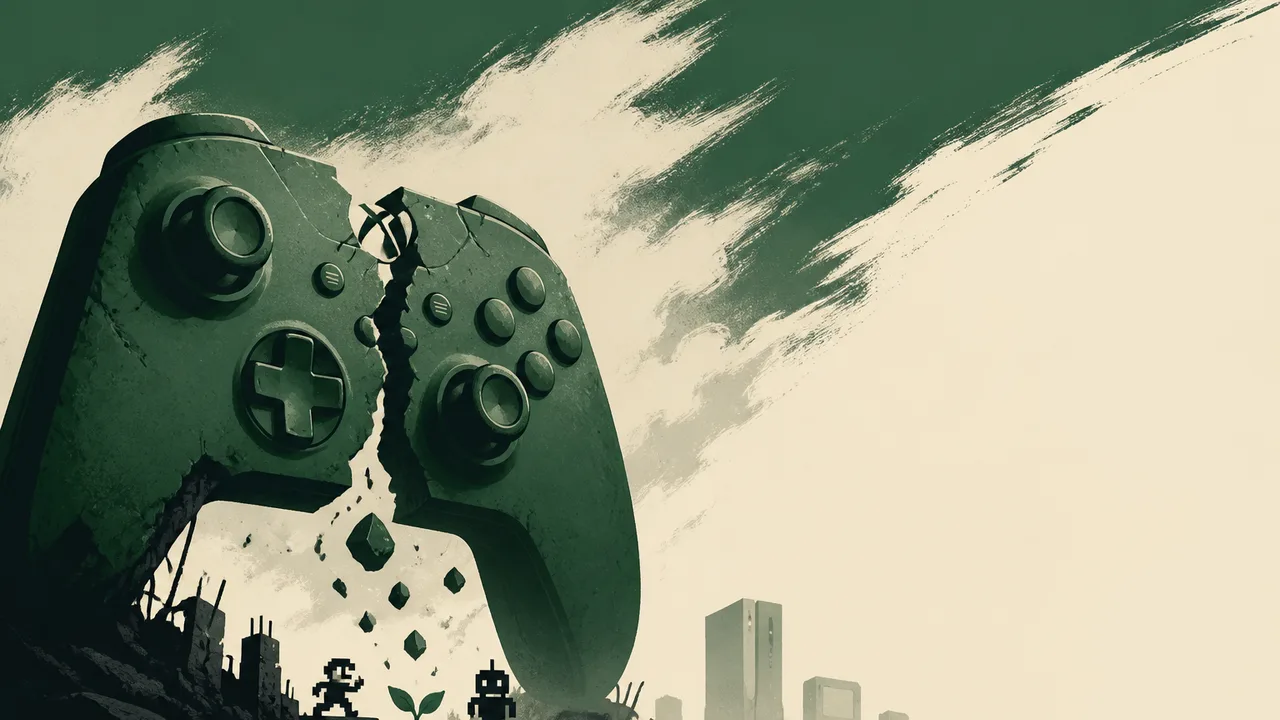
Photo: AI. Mika Sørensen
The question isn't new, but the people asking it are getting louder. On episode 99 of the Friends Per Second podcast — the Skill Up crew joined by Chris Grant, who co-founded Polygon and spent years running major games outlets — the conversation landed somewhere more specific than the usual doom-posting: not "is gaming dying," but "is the version of gaming most of us grew up with already structurally over?"
That's a sharper question, and it deserves a sharper look.
The Xbox Layoffs Are the Hook, But Not the Whole Story
The episode opens its industry segment with Microsoft's recent wave of studio cuts and spinoffs — Double Fine and Compulsion going independent, Arcane Austin's situation, and significant reductions at ZeniMax Online. The hosts don't treat this as a one-off corporate fumble. They treat it as evidence of something systemic.
Ralph's read is blunt: Microsoft acquired these studios under certain terms, managed them toward certain outcomes, and then discarded them when the strategy changed. "If you don't respect what ID is," he says, "I think it just shows you don't respect what this thing is." His point isn't purely emotional. It's that the decision-making logic — strip out talent when margins don't align, regardless of output quality or institutional legacy — reveals something about how a company like Microsoft values game development at all.
Grant sharpens that into a structural critique. "People went to Microsoft to retire," he says. "That's not how they're feeling now." His argument is that Xbox's margins will never compete with Microsoft's cloud and AI businesses, and that a publicly traded company chasing infinite growth will always deprioritize the lower-margin creative work. The problem isn't bad management in isolation — it's that game studios are being asked to perform inside a financial logic that wasn't built for them.
What neither host fully engages with: this same pressure exists at Sony and at every major publisher. Microsoft is the clearest current example, but the underlying dynamic — quarterly earnings expectations colliding with multi-year development cycles — isn't unique to Redmond.
"Cooked" Is Doing a Lot of Work Here
Grant has been saying gaming is "cooked" for a while, and the episode finally forces him to define the term. His answer: hardware is dead, AAA development costs are unsustainable, and indie games are consistently outperforming expensive productions both in sales and margin. The audience that cares about bleeding-edge console specs will age out. The incoming audience — raised on Roblox and mobile — has entirely different expectations.
"The hardware is cooked, the software development costs are cooked," Grant says. "Indie games are obliterating expensive AAA productions in sales numbers and certainly in margin, over and over again."
The music industry analogy he reaches for is clarifying. MP3s and then streaming radically democratized access to music, which was good for listeners and catastrophic for artist economics. More music than ever got made. Most successful musicians stopped making money from recordings and had to tour instead — and then, as he notes, even that became harder. Grant's question is whether gaming is about to go through the same compression: infinite access, micro-audiences, fragmented revenue, and a wholesale devaluation of the product.
Ralph pushes back — not on the diagnosis, but on the framing. He points to breakout hits from small teams as evidence that the creative ecosystem is alive. Games with tiny budgets have won Game of the Year recognition and moved millions of copies. Grant's counter: those are the hit songs from one artist on Spotify. They're real, but they don't change the structural math for the industry as a whole.
Both positions have something going for them. The disagreement isn't really about facts — it's about which facts you weigh most heavily.
The Back Catalog Problem Nobody Wants to Talk About
The most interesting thread in the whole episode is the one about why new games are struggling to compete — and it's not the one you'd expect.
Grant cites data suggesting the average age of a PC game by monthly active users is roughly a decade. Most people playing PC games right now are playing games that are about ten years old. Not because they're nostalgic, but because those games are genuinely good and still available and already paid for.
Think about what that means. GTA V has been one of the most-played and most-lucrative games for over a decade. The recent AC Black Flag remaster shipped alongside the original, which many players already owned. The back catalog isn't just competition for new releases — it's winning. Consistently.
This is genuinely new. For most of gaming's history, older titles got left behind by hardware incompatibility, format changes, and shifting genre conventions. You couldn't just boot up a ten-year-old game and have it feel current. That's changed. Grant's observation — that Bioshock, released in 2007, still holds up as a complete, modern-feeling experience in a way that a game from twenty years before its release absolutely would not — points to a plateau in the "vernacular" of games. The grammar of how games play hasn't changed as dramatically as it did in earlier decades. Which means the back catalog keeps getting more competitive, not less.
Nintendo vs. Everybody
The episode's most direct contrast is between Nintendo and Xbox, and it's not subtle. Where Xbox has been consolidating around its biggest IPs and cutting creative risk, Nintendo just shipped a new entry in Rhythm Heaven — a niche rhythm franchise that used to live on handhelds — because they apparently still think weird small bets are worth making. Ralph frames this as stewardship: Nintendo is a company you can hand to your kids without wondering if it'll still exist or care about games in fifteen years.
That's not a flawless defense of Nintendo — the hosts acknowledge the company's well-documented issues with fan communities, legal overreach around emulation, and pricing practices. But as a counter-argument to "everything is cooked," Nintendo's current posture is genuinely useful data. It's possible to run a large games company with a philosophy that includes both blockbuster Zelda titles and small experimental games. That's a choice, not an inevitability.
Sony gets a more complicated read. Grant points out that Astrobot — one of the most celebrated recent PlayStation games — is essentially a love letter to Sony's own hardware history, physical media included. And then Sony has been steadily stepping back from physical releases. The internal tension there is real, and neither host is sure where it ends.
The Actual Open Question
Here's what the episode doesn't fully resolve, and it's the part that matters most: who does the "cooked" argument serve?
If you're a game developer or publisher making decisions right now, "everything is about to change" is either a reason to panic-cut your workforce and consolidate around safe IPs — which is what Microsoft appears to be doing — or a reason to get lean, stay creative, and position for the audience that's coming. Those are opposite strategic responses to the same diagnosis.
Grant himself is excited about what comes next, even while acknowledging that for many people in the industry, the transition will be "an extinction level event." That's a real tension. Creative destruction sounds fine in the abstract. It's harder when you're one of the people being destroyed.
The Lethal Company example the crew brings up is instructive here: one developer, cut their teeth building Roblox games, built something that became a cultural moment on Steam. That path exists. It's also not available to the hundreds of people who just got laid off from a AAA studio mid-project. The micro-success stories and the macro-destruction are both real and happening simultaneously.
What you believe about the future of gaming probably depends heavily on which of those two realities you're currently living in.
More Like This
Gaming Hardware Costs Are Rising and Relief Is Far Off
Micron, Microsoft, and Apple signal gaming hardware prices will keep climbing through 2028 or beyond. Here's what's driving the squeeze and what it means.
Diablo IV: Lord of Hatred Expansion Review
Explore Diablo IV's Lord of Hatred expansion. New classes, zones, and a thrilling campaign await.
Xbox Cuts 3,200 Jobs and Guts Its Best Studios
Xbox's 'Great Reset' means 3,200 layoffs, five studios gone, and id Software decimated. Here's what actually happened and what it means.

Forza Horizon 6 Review: Beautiful Map, Frozen Formula
Forza Horizon 6's Japan map is stunning, but its stale progression and hollow storytelling reveal a franchise too scared to evolve. Here's where it stands.
Xbox Workers Push Back as 1,600 More Jobs Loom
Xbox workers are organizing across six studio locations as 1,600 more jobs hang in the balance. Here's what the unions are demanding—and what it means for gaming.
Sony Bets on AI as Core Game Development Strategy
Sony's leadership has formally positioned AI as foundational to its game development future. What that means in practice—and what it leaves unanswered—is worth examining carefully.

ESO's Leadership Purge Is a Preservation Crisis
Xbox layoffs gutted ZeniMax Online's leadership after 200+ cuts. For ESO's 11-year history, the real loss may be institutional knowledge no one wrote down.

Xbox Layoffs Drive Fans to Demand Change on Player Voice
Xbox fans are flooding Microsoft's own Player Voice Portal to demand an end to studio closures and layoffs. Here's what the campaign reveals—and what it can't change.