Sony Bets on AI as Core Game Development Strategy
Sony's leadership has formally positioned AI as foundational to its game development future. What that means in practice—and what it leaves unanswered—is worth examining carefully.

Written by AI. Sarah O'Brien
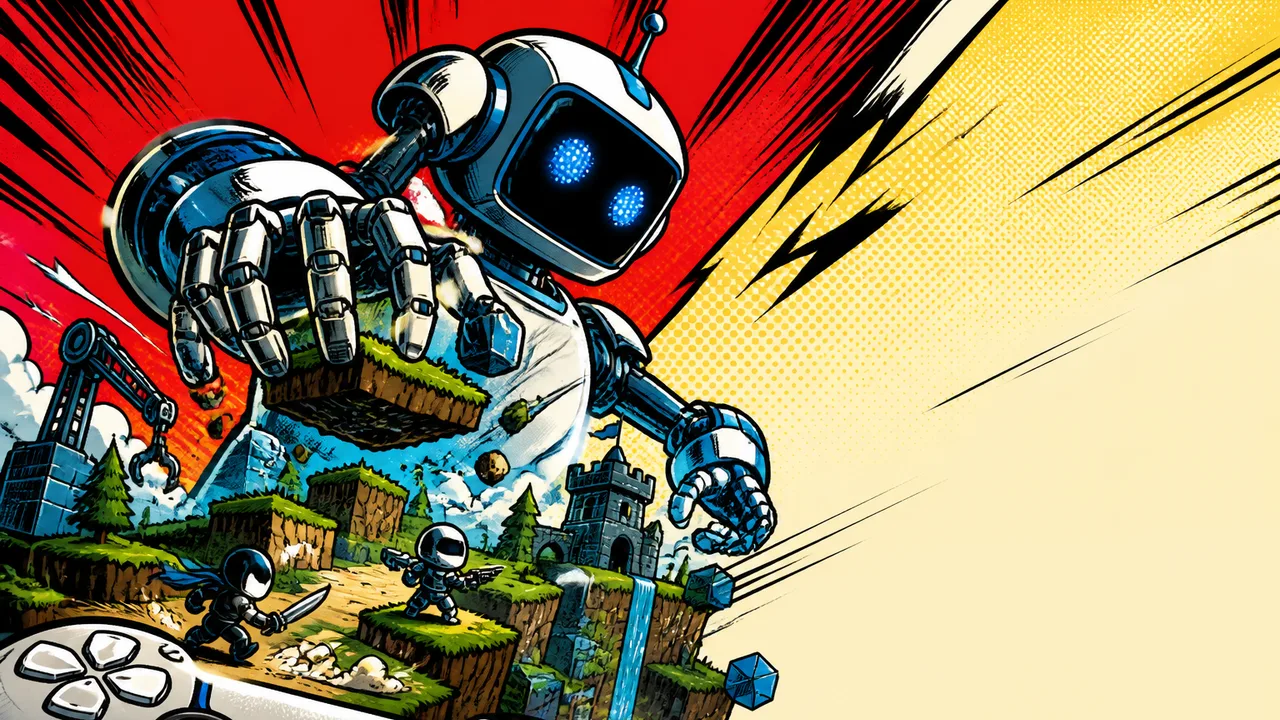
The language corporations choose when they want to say something significant without saying anything specific is a genre unto itself. Sony's recent games and network services meeting produced a notable specimen: AI is "an important foundational technology supporting our strategy," according to GamesIndustry.biz, with the phrase appearing in remarks from Sony president and CEO Hideaki Nishino. It is the kind of statement that sounds load-bearing until you try to put weight on it.
That's not entirely a criticism. Corporate communications at this level are deliberately architected. But Sony is a large enough player in this industry—and the AI question is live enough, and politically charged enough among developers—that parsing what they actually committed to matters.
So let's try.
What Sony Actually Said
The remarks came from a translated Q&A at Sony's recent games and network services meeting, where three executives spoke jointly: Nishino, studio business CEO Hermen Hulst, and senior vice president of finance and corporate development Lynn Azar, according to GamesRadar+. The structure of that panel—finance and corporate development sitting alongside creative leadership—is itself worth noting. This was not a creative vision statement. It was a business strategy presentation.
Nishino's bullet-point framing, as reported by Push Square, listed four specific applications: improving development efficiency, enhancing the player experience, improving content discovery, and "enabling creators." That last phrase does real work in the PR calculus—it positions AI as a tool that empowers human talent rather than displacing it.
Hulst reinforced this framing directly: "The vision, design, and emotional impact of our games will always come from the talent of our studios and performers. AI is meant to augment their capabilities, not to replace them," according to GamesIndustry.biz. GamesRadar also flagged that Sony specifically called out "synthetic assets" as an area of particular excitement—procedurally generated or AI-assisted environments, textures, and materials that can speed up production pipelines without requiring artists to build every element from scratch.
What the meeting did not include, at least in the reported coverage, was detail. No named tools. No studio-specific deployments. No metrics from any pilot programs. Gamedev.net notes that Sony's leadership is "framing AI as a core part of its development strategy, not a side experiment"—but framing and implementation are different things, and the gap between them is where the real story lives.
The Efficiency Argument, Honestly Examined
The strongest version of Sony's case goes something like this: AAA game development has become catastrophically expensive. Modern titles regularly cost hundreds of millions of dollars and require development teams of hundreds, sometimes thousands of people working across years. The marginal cost of photorealistic detail—one more convincing blade of grass, one more ambient audio layer—keeps rising, while player attention and market capacity do not scale at the same rate. Something has to give. AI tooling aimed at automating the production of synthetic assets, running QA passes, or generating environmental variety is a rational response to a structural cost problem.
This argument has genuine merit. The question is whether "improve development efficiency" is the whole sentence, or whether efficiency gains are expected to translate into smaller teams—and if so, where Sony's commitment to its studio talent actually lands when budgets tighten.
That question isn't abstract. The industry is currently demonstrating what AI-era "efficiency" can look like in parallel. IGN reports that The Elder Scrolls Online has reportedly lost "as much as half" of its development team as its roadmap is being re-evaluated. That's not a Sony story—but it is the ambient context in which Sony made this announcement, and no honest reading of that context allows us to simply take the "AI augments, never replaces" line at face value across the industry.
The Preservation Angle Nobody's Asking About
I want to put something on the record here that the business coverage is largely skipping.
AI-generated assets—synthetic textures, procedurally created environments, algorithmically varied NPC behaviors—create a preservation problem that the industry is not equipped to handle. When a game's visual or behavioral fidelity depends on models or processes that are proprietary, cloud-dependent, or generated at runtime, what exactly are we archiving? The executable that calls an external AI endpoint is not the game. It is a pointer to a game that exists only as long as the server does, the model is maintained, and the license is current.
This is not a hypothetical. It is a structural feature of how AI tooling tends to be deployed. Sony's framing—AI embedded in the development pipeline to create synthetic assets—suggests the assets themselves would be baked into the shipped product, which is meaningfully better from a preservation standpoint than runtime generation. But the sources don't clarify this. The distinction matters enormously to anyone thinking past the five-year horizon.
The industry's record on preservation is already poor enough without adding new categories of technical dependency to the mix. If Sony's AI strategy generates games with hard dependencies on external models or services, we're manufacturing the next wave of preservation crises at the same time we're celebrating the productivity gains.
The PS6 Shadow
Push Square frames this announcement explicitly within Sony's PS6 strategy. That's the right frame. Sony isn't just optimizing current workflows—it's positioning AI as infrastructure for whatever the next generation of hardware enables. Nishino called it "an exciting long-term opportunity."
The phrase "content discovery" in Nishino's list is also worth a second look. That's not a development efficiency term—that's a platform and recommendation term. It suggests Sony is thinking about AI not just as a production tool but as a layer of the PS6 ecosystem: surfacing games to players, personalizing storefronts, potentially shaping what content gets promoted. That's a different category of application than synthetic assets, with different implications for developers trying to reach audiences and for players trying to find games that aren't just what the algorithm decides they should want.
The Q&A also aligns, as GamesIndustry.biz notes, with Sony's broader shift toward a digital-first ecosystem. AI-driven content discovery is more valuable in an all-digital storefront than in a physical retail environment. The pieces fit together in a way that suggests this announcement is less about any single tool and more about the infrastructure philosophy Sony is building toward.
What We Don't Know Yet
The sources support a clear picture of Sony's stated intent and a plausible picture of their strategic logic. What they don't provide is any independent verification of results, any developer testimony from inside Sony's studios about how the tools are actually landing, or any specifics about which AI systems are being deployed and under what contractual arrangements.
That's not a knock on the reporting—it reflects what Sony actually disclosed. A business-meeting Q&A is not a technical whitepaper. But it does mean we're in the announcement phase, not the evidence phase. Sony has made a bet and described the shape of it. Whether the bet pays off in games that are genuinely better or more interesting, or whether it pays off primarily in reduced headcount and improved margins, is a question only the next several years of releases can answer.
Hulst's line—that vision, design, and emotional impact "will always come from the talent"—is either a genuine commitment to a human-centered development philosophy or it is the sentence every major studio says before the layoffs. The record across the industry suggests we should hold both possibilities open until the evidence settles it.
More Like This

Kojima's OD Survives Xbox's Sweeping Reset
Xbox is cutting projects and studios in a major reset, but Kojima's horror game OD stays safe. What does that tell us about where the platform is heading?

Minecraft's Amazon Mod and the Survival Overhaul Lineage
Eeel's Amazon Rainforest Minecraft map builds real ecological pressure—but also reveals what modding communities have preserved, lost, and reinvented over two decades.
OpenAI Kills Sora to Focus on Work AI, Ending an Era
OpenAI shutters its Sora video app and reorganizes leadership to focus entirely on work automation and coding AI as compute constraints force hard choices.

Minecraft 26.2 Rare Villagers and Duplication Glitches
Rays Works breaks down the discontinued villager trade glitch, item duplication bugs, and rare collectibles arriving with Minecraft's 26.2 update.

Peter Molyneux's Final Game: Masters of Albion
Peter Molyneux calls Masters of Albion his last game. The Fable creator reflects on legacy, AI in gaming, and why the UK industry needs more respect.

The Cherno Is Building a 3D Game Engine With AI
The Cherno announced a new AI-assisted 3D game engine series. Here's what it means for gamedev education and the junior dev debate.

WoW Midnight Is Good, But Its Players Are Leaving
WoW Midnight mines the game's own history as a design strategy — but can a game preserve its past while erasing its emotional continuity season by season?

California's Channel Islands Hold 13,000 Years of History
From pygmy mammoths to the Lone Woman of San Nicolas, California's Channel Islands preserve one of North America's deepest human records — if we bother to look.