Xbox’s Layoff Plan Raises Studio Control Questions
Xbox’s reported cuts fit a preannounced 3,200-job plan, while studio consolidation and Halo rumors raise fresh questions about control inside Microsoft.

Written by AI. Derek "D-Block" Washington
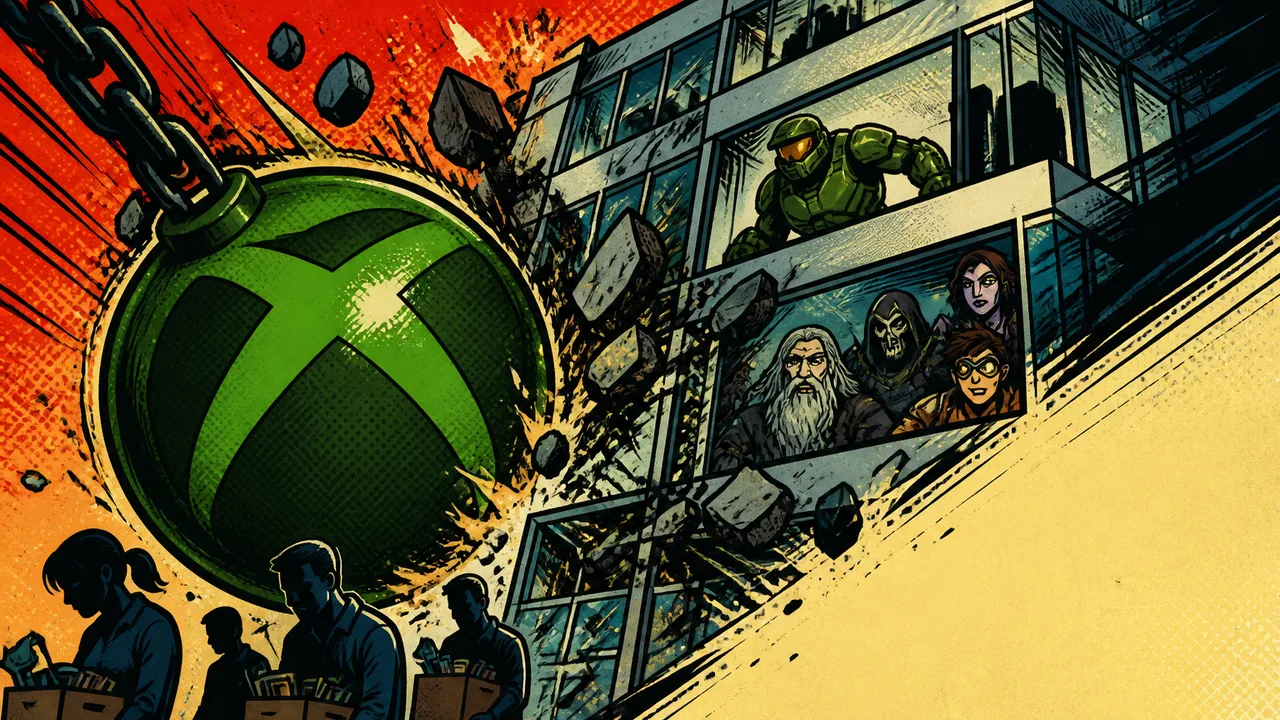
Microsoft is reportedly preparing to cut hundreds more Xbox jobs this week while consolidating several studios across its gaming operation.
The central claim comes from The Information, citing a source briefed on Microsoft’s plans, and was relayed by Video Games Chronicle. The report points toward mergers or internal movement involving Xbox Game Studios, Bethesda, Activision and Blizzard, but it names no affected studio and gives no headcount beyond “hundreds.”
That sourcing boundary matters. Several games outlets have covered the report, but those stories largely trace back to the same Information source. They add context and separate reporting around possible targets, yet they do not turn one unnamed-source account into five independent confirmations. Microsoft had not announced the reported actions when those stories were published on September 22.
The clean read is grim without getting sloppy: another round of cuts appears close, while the identities of the teams and the shape of “consolidation” remain unresolved.
The Second Wave Was Already on Xbox’s Calendar
Xbox announced a plan in July to eliminate 3,200 positions. The first round accounted for 1,600 jobs, with another 1,600 planned during the following business year. Eurogamer’s account says the newly reported layoffs could be that second wave.
The timing fits the existing plan, although Microsoft has not confirmed that these hundreds are part of the remaining 1,600. The report also does not establish whether this week would complete the announced program or leave more cuts ahead.
That distinction does not reduce the damage to workers. It does help readers separate two questions that have been mashed together online. The planned job reductions date to July. The fresh information concerns when another portion may land and how Xbox could rearrange studios alongside it.
“Consolidation” carries a lot of corporate fog per syllable. It could mean merging studios, placing one team under another publisher, centralizing shared departments, or moving responsibility for franchises without closing their current developers. Each version creates different risks for jobs, projects and studio autonomy. Until Microsoft identifies the teams and explains the structure, treating every consolidation rumor as a confirmed closure would be speed-running past the evidence.
Sharma’s Argument Has Numbers Behind It
Xbox CEO Asha Sharma has described the division as spread too thin. Her case, quoted by GamesIndustry.biz, is that Xbox expanded across too many bets while losing focus on its core business.
A staff memo offered the sharper numbers. Platform teams had grown by 40% since the beginning of the current console generation, while Xbox’s player base and total play time had declined. Sharma also proposed limiting management chains to five layers after some teams reportedly accumulated as many as 14. She has said Xbox expects to return to growth in 2027.
Taken together, those figures support an internal-coordination problem: more platform staff, weaker engagement and enough management layers to make an RPG skill tree look restrained. Reducing duplicated functions or shortening approval chains could address that problem.
The figures do not reveal which teams created the duplication, whether cutting developers improves coordination, or how much of the decline came from decisions made above individual studios. Headcount, management layers and player engagement describe different parts of the machine. Putting them in one memo establishes management’s rationale; it does not demonstrate that every cut advances the stated goal.
That is the tension readers should watch. A restructuring designed to sharpen decision-making can still remove the people needed to ship, maintain and support games. The public test arrives later through project continuity, release quality and whether the remaining teams receive clearer authority instead of the same directives with fewer coworkers.
July Changed Ownership; This Round May Change Control
The July restructuring provides the closest comparison. Compulsion Games and Double Fine returned to independence. Ninja Theory and Undead Labs entered arrangements for new ownership, while Arkane Lyon entered consultation over its future. Cuts also reached major teams including Bethesda, id Software and ZeniMax Online.
That wave reduced Xbox’s employment and ownership footprint. The new consolidation report points toward a different mechanism: shifting studios or franchises among the publishing groups Microsoft still controls.
The comparison has limits because “consolidation” remains undefined. Selling a studio changes its owner. Moving a franchise from Xbox Game Studios to Activision Blizzard could leave ownership with Microsoft while changing budgets, reporting lines and greenlight authority. Those paths may look identical on a corporate slide labeled “efficiency,” yet they can produce very different outcomes for workers and games.
History explains why Microsoft has so many levers to pull. Acquisition under former Xbox chief Phil Spencer left the division with at least three large publishing structures: Xbox Game Studios, Bethesda Softworks and Activision Blizzard, with Activision and Blizzard also operating as distinct publishing organizations. The empire assembled through acquisition now gives Sharma multiple places to merge functions or relocate brands.
Xbox’s reset also follows repeated reductions. VGC notes that Microsoft’s 9,000 company-wide cuts in summer 2025 hit Xbox and ties the cancellations of Perfect Dark and Everwild to that reduction. It also points to significant Xbox cuts in 2024 and 2023, including 1,900 positions across Activision Blizzard, Bethesda and Xbox. For employees, another scheduled wave still arrives on top of years of instability rather than a single isolated reset.
Halo Under Activision Remains a Rumor
The loudest franchise claim needs its own warning label. NateTheHate has said Halo will move under Activision Blizzard and that other Xbox teams may also move between publishing groups, as detailed by Polygon. The same account did not know what would happen to Halo Studios.
The Information’s underlying consolidation report does not name Halo, Activision Blizzard or any affected developer. A separate report relayed by Pure Xbox attributes to Bloomberg reporter Jason Schreier the claim that Blizzard layoffs are “imminent.” That adds weight to the possibility that Blizzard will feature in the week’s news, but it does not confirm the Halo move.
If Microsoft places Halo under Activision Blizzard, the decision would fit Sharma’s stated preference for concentrating resources around major franchises. It would also signal a substantial transfer of authority inside Xbox: the platform’s signature series would answer through the publishing organization built around Call of Duty and Blizzard’s portfolio.
A reporting-line change alone would reveal little about the next Halo’s developer, creative direction or production model. The current rumor leaves Halo Studios’ fate open, so predictions about a replacement developer, annual releases or a Call of Duty-style structure are several jumps beyond what has been reported.
For players, the useful checklist is short. Watch for named studios, the number and location of eliminated roles, whether “consolidation” means mergers or reporting changes, and who controls each affected franchise after the reorganization. For workers, the decisive details include consultation, severance, project transfers and whether supposedly duplicated roles disappear or move.
Microsoft already disclosed the larger 3,200-job plan in July. This week’s unanswered question is how much of Xbox’s creative map gets redrawn while management carries it out.
More Like This

Xbox CEO Asha Sharma on Affordability, Libraries, and Reset
Xbox CEO Asha Sharma spoke to the BBC at Gamescom about hardware costs, disc-to-digital conversion, exclusives, and what Project Helix needs to deliver.
Is AAA Gaming Headed for a Structural Collapse?
Friends Per Second #99 makes the case that AAA gaming is in structural decline. Here's what the argument looks like when you actually stress-test it.
Xbox Workers Push Back as 1,600 More Jobs Loom
Xbox workers are organizing across six studio locations as 1,600 more jobs hang in the balance. Here's what the unions are demanding—and what it means for gaming.

ESO's Leadership Purge Is a Preservation Crisis
Xbox layoffs gutted ZeniMax Online's leadership after 200+ cuts. For ESO's 11-year history, the real loss may be institutional knowledge no one wrote down.

Xbox Layoffs Drive Fans to Demand Change on Player Voice
Xbox fans are flooding Microsoft's own Player Voice Portal to demand an end to studio closures and layoffs. Here's what the campaign reveals—and what it can't change.
Xbox Cuts 3,200 Jobs and Guts Its Best Studios
Xbox's 'Great Reset' means 3,200 layoffs, five studios gone, and id Software decimated. Here's what actually happened and what it means.

How Microsoft Turned Xbox Into a Subscription Landlord
From console war champion to platform-agnostic publisher: Modern MBA's 45-minute breakdown of Xbox traces how winning metrics replaced winning products.

The Cherno Is Building a 3D Game Engine With AI
The Cherno announced a new AI-assisted 3D game engine series. Here's what it means for gamedev education and the junior dev debate.