Xbox Disc-to-Digital Program Converts Physical Games
Xbox's new disc-to-digital program lets players convert physical game discs into digital licenses. Here's what it actually means for your library—and the industry.

Written by AI. Zara Chen
Here's the thing about physical game discs that nobody in a press release will tell you: you were never really "buying" the game. You were buying a license key embedded in plastic. The disc was a delivery mechanism. The ownership was always conditional.
Xbox just made that visible — in the most consumer-friendly way possible.
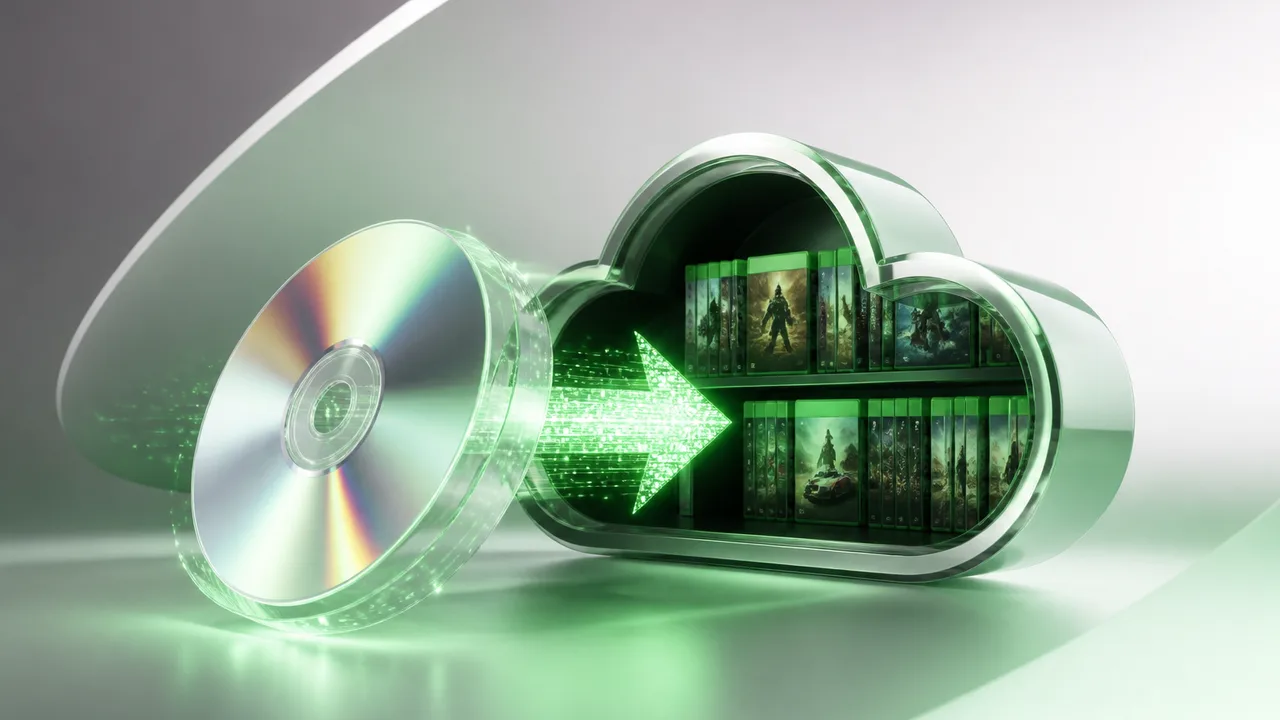
The company has officially announced a disc-to-digital conversion program, confirmed across reporting from The Verge, Engadget, and Tom's Hardware. Xbox Insiders — the company's beta testing community — will be among the first to try it. According to Tom's Hardware, the program includes support for Play Anywhere and Cloud Gaming, meaning once you convert a disc, that game follows you across devices. You insert the disc to verify ownership, and Xbox grants you a digital license. The disc doesn't disappear. The license gets added to your library.
On paper, this is genuinely good for the portion of the fanbase that still buys physical. You get the resale optionality of a disc and the device-agnostic convenience of digital. That's not nothing. That's actually the combination people have been asking for for years, usually framed as "why can't I just do both?"
But it's worth slowing down on what this program actually does versus what it implies — because those aren't the same thing.
The One-Way Street Nobody's Talking About
The program converts physical to digital. Not digital to physical. Once you've claimed the digital license, the disc remains yours, but the meaningful transaction has already happened: you've moved your ownership relationship from an object you can hand to someone else into a platform account that can be suspended, restructured, or discontinued.
I want to be careful not to overstate the risk here, because Xbox has been genuinely better than most platform holders about backwards compatibility and preservation. But the mechanics are worth naming plainly. The thing that actually travels when you digitize a game isn't the game — it's a promise from Microsoft. That promise is worth something. It's just not the same thing as a disc you can put in a box.
Digital Trends frames the timing as making "perfect sense," and they're right about the commercial logic: disc-free Xbox hardware exists, the all-digital console is no longer a novelty, and the friction between disc-buying habits and disc-free devices is a real problem Xbox wants to solve. The disc-to-digital program is the patch for that friction.
What it doesn't do — and this is what the questions-deferred observation usually gestures at without completing — is resolve the underlying question of who actually controls your library long-term. But here's my honest read: Microsoft has more institutional interest in not nuking its library goodwill than almost any other platform holder right now. Their backwards compatibility record is the thing they legitimately brag about. If they torched that with a sudden license restructuring, the PR damage would cost them more than whatever they'd gain. That's not a guarantee — corporate incentives shift — but it's a real constraint on the worst-case scenario, and I think coverage that skips it does readers a disservice.
Why This Hits Different If You Were There in 2011
If you came up in gaming culture during the 360/PS3 era, you know exactly the moment the floor shifted. For me, it was the Xbox Live Arcade store closures and game delisting announcements — the slow realization, absorbed mostly through forum posts and Reddit threads, that games people had "bought" were quietly becoming inaccessible. Not all at once. Just... a title here, a service there. The Games for Windows Live shutdown in 2014 was probably the most clarifying: people discovered they couldn't play games they'd legitimately purchased because the authentication servers went dark. No refund. No warning that was actually prominent enough to act on.
The community reaction wasn't outrage so much as this low-grade, collective "oh. Oh." — the moment the license language in the terms of service stopped being abstract. A lot of the discourse around digital ownership that's still happening now crystallized in that window. It's why "do you actually own your digital games?" became a semi-serious philosophical debate instead of just a weird legal hypothetical.
That context sits underneath every announcement like this one. Xbox knows it. That's part of why they've been so careful to emphasize backwards compatibility as a brand value. The disc-to-digital program is, in part, an acknowledgment that the people who still buy discs aren't being irrational — they're being historically informed.
The Industry-Wide Question Xbox Just Triggered
Ars Technica and Slashdot both flag the broader industry implication: does this become a template? And on that question, I'll stop being coy — I don't think PlayStation follows this quickly, and here's why. Sony's relationship with physical media is structurally messier than Xbox's. They make money on the PlayStation Store and on disc sales through retail partnerships that matter more to their hardware volume. Disrupting that balance by actively encouraging people to convert discs into digital licenses would create friction with retail partners they can't easily afford to alienate, especially in markets where physical is still dominant. Sony also tends to move on consumer features when it's strategically useful for them specifically, not because a competitor did something interesting. The history of PlayStation Store pricing, their resistance to cross-buy in the early days, their handling of the PS3/PS4/PS5 library situation — none of it suggests a company that leads on library flexibility.
Nintendo, meanwhile, is doing its own thing entirely, as it always is. Their relationship to digital ownership has always been device-tethered in ways that feel almost retro, and I don't see an Amiibo-era company suddenly deciding to be the most progressive platform on library portability.
Which actually makes the Xbox move more interesting in isolation. BGR had been tracking this as a potential future feature before the announcement landed — the leaked roadmap details we covered earlier suggested an August timeline that appears to be materializing. The program starting with Xbox Insiders is the classic Microsoft move: test the infrastructure, catch the edge cases (What happens if a disc is from a different region? What about games that have been delisted?), then roll wider.
What Actually Changes
CNET's framing is the honest, slightly uncomfortable version of this story: the program might accelerate the end of physical discs. I think that's probably true, and I also think "accelerate" is doing a lot of work in that sentence. Physical disc sales have been declining for years. The people who are still buying discs are doing so deliberately — for offline access, for resale, for the collector's instinct, or because of exactly the ownership anxiety I described above. Converting some of those buyers into people comfortable with digital doesn't eliminate the instinct that made them disc-buyers; it just offers an on-ramp.
The more interesting question isn't whether this kills physical media faster. It's whether it meaningfully changes the negotiating position of the people who use it. Right now, a disc buyer has options Xbox doesn't control: sell, lend, trade, or just keep the disc on a shelf. A digital license holder has options Microsoft does control. The conversion program doesn't take away the disc. But it trains a habit — and habits are where the real leverage lives.
So yes, insert disc, get digital license, play anywhere. The convenience is real. The tradeoff is real. Both of those things are true at the same time, and you're allowed to weigh them differently depending on how much the Games for Windows Live era lives in your muscle memory.
More Like This
This Creator Got Shadowbanned on YouTube in 25 Days—On Purpose
A vidIQ creator deliberately shadowbanned their channel with AI-generated content to expose how YouTube's algorithm actually works. The results are wild.
Ubisoft Quietly Drops Its Claim That Microtransactions Are Fun
Ubisoft removed its claim that monetization makes games 'more fun' from its annual report. What changed, what didn't, and what it means for the industry.

GTA 6's $100 Ultimate Edition Is Outselling the $80 Version
GTA 6's $100 digital-only Ultimate Edition is topping PS Store charts in nine markets. Here's what the pre-order data actually tells us—and what it doesn't.
Sunderfolk Is Free on Xbox — Here's What That Means
Sunderfolk is free to play on Xbox for a limited time. We dig into what this trial reveals about indie co-op marketing, Secret Door's origins, and the game's unusual design.

Starlink Satellites Are Now Scanning Earth's Atmosphere
Kyoto University researchers repurposed 1,200 Starlink satellites as an accidental atmospheric scanner. Here's what that means for science—and who controls it.
Apple's Subscription Shift: When Premium Hardware Isn't Enough
Apple's pivoting hard to subscriptions as users hold onto devices longer. Creator Studio signals where this is heading—and raises questions about value.

Apple Sues OpenAI Over Alleged Trade Secret Theft
Apple filed a federal lawsuit accusing OpenAI of orchestrating a systematic theft of hardware trade secrets via former employees. Here's what we know.
Ben Bernanke Joins Anthropic's AI Oversight Trust
Former Fed Chair Ben Bernanke joins Anthropic's Long-Term Benefit Trust. Here's what his economic expertise actually means for AI governance—and what it doesn't.