Why Wavy Windows Distort Reflections But Not Your View
Wavy glass warps reflections while leaving your view through the window clear. The physics behind this everyday paradox is more elegant than you'd expect.

Written by AI. Priya Sharma
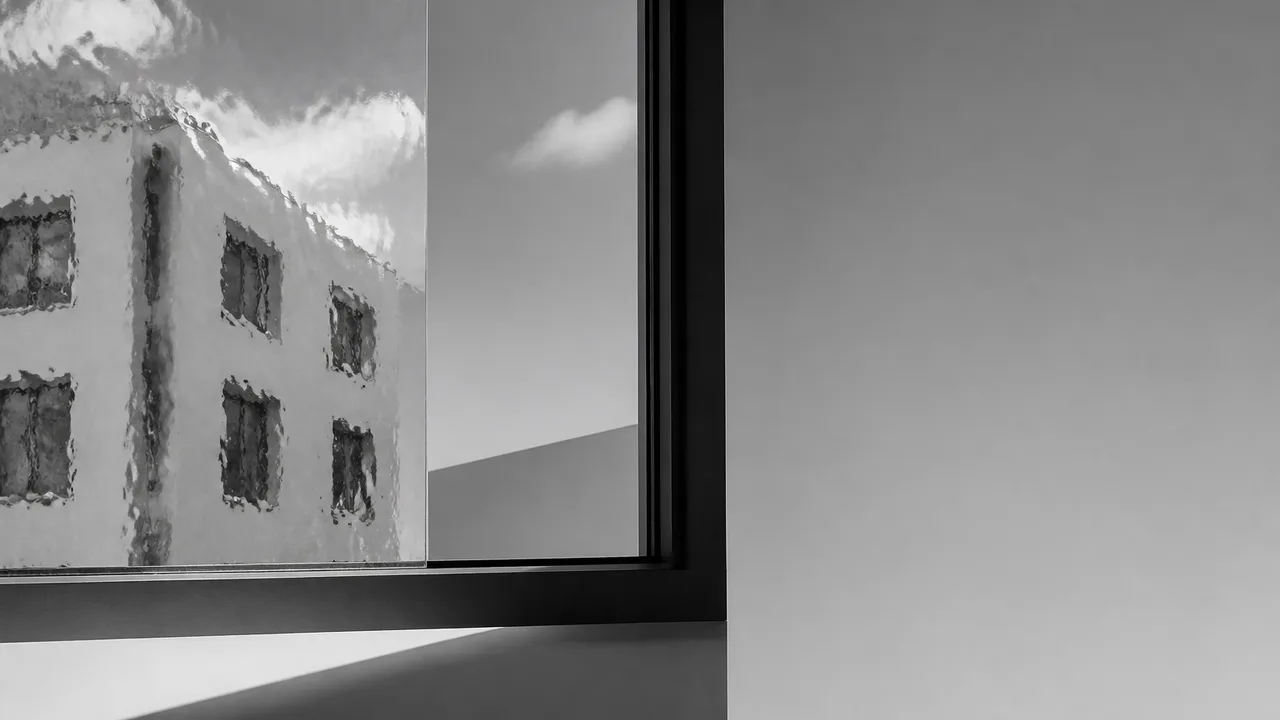
Photo: AI. Tomoko Hayashi
Stand on the sidewalk outside almost any modern office building and you will notice something that, once noticed, is genuinely hard to ignore. The glass curtain walls ripple. Trees and clouds in the reflections bend and warp like images in a funhouse mirror. The architecture reads as pleasingly organic, almost liquid. Then you look up at the people on the other side of those same windows, and they are looking out at you with perfect, undistorted clarity. The wobbly surface that scrambles the reflection of a tree does not scramble the face of the person peering through it. That asymmetry is the puzzle. It is also, as minutephysics creator Henry Reich lays out in a recent three-minute video, a genuinely elegant piece of physics hiding in plain sight.
The answer sits in Snell's law — a mathematical relationship first articulated in the 17th century that governs how light bends when it crosses from one material into another. The speed of light changes depending on what it's traveling through. It moves faster in air than in glass. When it crosses that boundary at any angle other than perfectly perpendicular, it bends. The formula that describes exactly how much bending occurs depends on the incoming angle and the ratio of the two speeds — what physicists call the index of refraction.
None of that is especially counterintuitive on its own. The part that matters for the window paradox — and that Reich puts at the center of his explanation — is that Snell's law is symmetric. If you reverse the materials, you reverse the angles by exactly the same amount. A ray of light entering a pane of glass bends inward as it slows down crossing from air into glass. Then it hits the other side of the glass and crosses back into air. It speeds up, and the mathematics of Snell's law bend it back outward by exactly as much as it was bent inward.
"Light passing through a window ends up traveling the exact same direction that it started," Reich explains, "just offset a little bit."
The offset is real — the light ray emerges slightly shifted from where it entered — but the direction is preserved. This means that for transmission (light you see through the glass), the window is acting as an extraordinarily forgiving optical system. You can tilt the glass, bow it, let it sag slightly under its own weight: as long as air is sandwiching both sides of the glass layer, the bending on the way in and the correction on the way out happen symmetrically. "The glass can rotate or bend quite a lot and not really affect your ability to see through it," Reich notes.
There is a caveat worth dwelling on, because it clarifies the limits of the symmetry argument. If the two surfaces of the glass are not parallel to each other — if the pane is slightly thicker at the bottom than the top, as is common in old hand-blown glass — then the correction on exit is not quite a perfect mirror of the bending on entry. The angles are slightly off, and the image you see is displaced by a small amount. The thick, wavy glass in 19th-century windows does produce visible distortion when you look through it, precisely because the surfaces are rarely uniform. Modern float glass, manufactured by floating molten glass on a bed of molten tin, achieves much better surface parallelism — which is one reason skyscraper windows distort less visually when you look through them than a Victorian-era window pane would. The waviness you see in the reflection of a modern building is not primarily about thickness variation; it is about surface curvature, and curvature is where reflections and transmission behave completely differently.
This is where the physics gets interesting. When light bounces off a surface rather than passing through it, the two-surface correction never happens. There is only one interaction — one bounce — and no second surface to undo the deflection. Reflections follow a simpler rule: the angle of incidence equals the angle of reflection. If the glass surface tilts by one degree, the reflected ray deflects by two degrees. One degree of deflection in the glass, doubled in the reflection.
The practical consequence of that doubling is more dramatic than it sounds. Reich offers a concrete number: if you are standing ten meters from a window, a one-degree deflection in the glass surface will shift the apparent position of the reflected sun by about 70 centimeters. Upward. A single gentle degree. Anyone who has pressed a fingertip lightly against a window and watched the reflection of an overhead light skitter and swirl will recognize this immediately — you barely have to push. "Gently touching a window can result in surprisingly large distortions of the reflections in it," Reich observes. The same effect, scaled up, is what produces those rippling tree-reflections on architectural glass. Slight, continuous variations in surface angle. Each variation doubling its own contribution to the apparent displacement of whatever is being reflected.
There is an additional layer to the paradox that depends on time of day, and it is the kind of thing that you may have already noticed without having a framework for it. During daylight hours, the light coming from outside a building is much brighter than the ambient light inside. If you are standing outside, the bright exterior light dominates — you see the glass mostly as a reflective surface, and so you are looking at reflections. If you are inside, the opposite: the bright exterior dominates in the other direction, and you are looking through the glass. At night, the geometry flips. The illuminated interior of a room makes the glass act like a mirror from the inside. The person sitting near a window at night, trying to see the street below, is mostly looking at a reflection of their own room.
What that means is that the daytime outside observer and the nighttime inside observer are having the same optical experience — they are both, in their respective contexts, looking primarily at reflections. And reflections, as we now understand, are the sensitive ones. The easily distorted ones.
The framing Reich uses — calling the transmission property a "minor miracle of physics" — is justifiable hyperbole, but it points at something real. The symmetry of Snell's law is not a design feature of glass. Nobody engineered it in. It is a consequence of the underlying mathematics of wave behavior at interfaces, mathematics that works the same way regardless of what you're transmitting. The fact that a cheap, imperfectly formed pane of glass can still produce a useful, clear view of the world outside is an accident of geometry — a lucky consequence of the fact that light has to cross two surfaces to get through, and those two surfaces apply the same rule in opposite directions.
The reflection, by contrast, gets no second chance. One surface, one deflection, doubled. There is no symmetry to rescue it.
Which leaves a question worth sitting with: we build entire cityscapes out of glass, and we have done so for long enough that the aesthetic of wavy, reflective curtain walls reads as quintessentially modern. We do it partly because the waviness looks good from the outside — the distorted reflections are considered an architectural feature, not a flaw. But what we are actually doing, whether we realize it or not, is exploiting a physical asymmetry. We are making the reflective surface intentionally imperfect while relying on the transmission-correcting symmetry of Snell's law to ensure the people inside still have a clear view out.
The building looks alive from the street. The people inside it can see the street plainly. Both of those facts are consequences of the same underlying physics — just pulling in opposite directions.
More Like This

How Opponent Recognition Unlocks Cooperation in Evolution
A Rutgers physicist argues that tailoring cooperation to specific opponents—not blanket strategies—may be evolution's simplest path out of the Prisoner's Dilemma trap.
Measuring the Sun's Temperature Without Touching It
How 19th-century physicists used spectroscopy and radiation laws to calculate the Sun's temperature from Earth—no probe, no contact, no vaporized instruments required.

The Next Generation of Windows Is Already Here
From squid-inspired liquid panes to transparent wood, new window technologies promise dramatic energy savings—but how close are they to your wall?

Exploring Black Holes and Asteroids with StarTalk
Neil deGrasse Tyson delves into black holes, asteroids, and more in StarTalk's latest Cosmic Queries episode with Chuck Nice.

Olbers' Paradox: Why the Night Sky Is Dark
The night sky should blaze like the sun's surface. Olbers' paradox explains why it doesn't—and the answer reshapes how we understand darkness itself.
The Counterintuitive Rules of Orbital Navigation
Orbital mechanics rewards the wrong instinct at every turn. A new minutephysics video breaks down two navigation paradoxes that confound even seasoned space enthusiasts.
The Quantum Twin Paradox and the Nature of Time
A new trapped-ion experiment may finally reveal whether time is a quantum property—bridging the long-standing gap between quantum mechanics and general relativity.
Nuclear Clocks Are Now Real — Here Is What That Means
Two independent teams built working nuclear clocks in 2026. Here's what the thorium-229 breakthrough actually achieved — and what it hasn't yet.