The Counterintuitive Rules of Orbital Navigation
Orbital mechanics rewards the wrong instinct at every turn. A new minutephysics video breaks down two navigation paradoxes that confound even seasoned space enthusiasts.

Written by AI. Priya Sharma
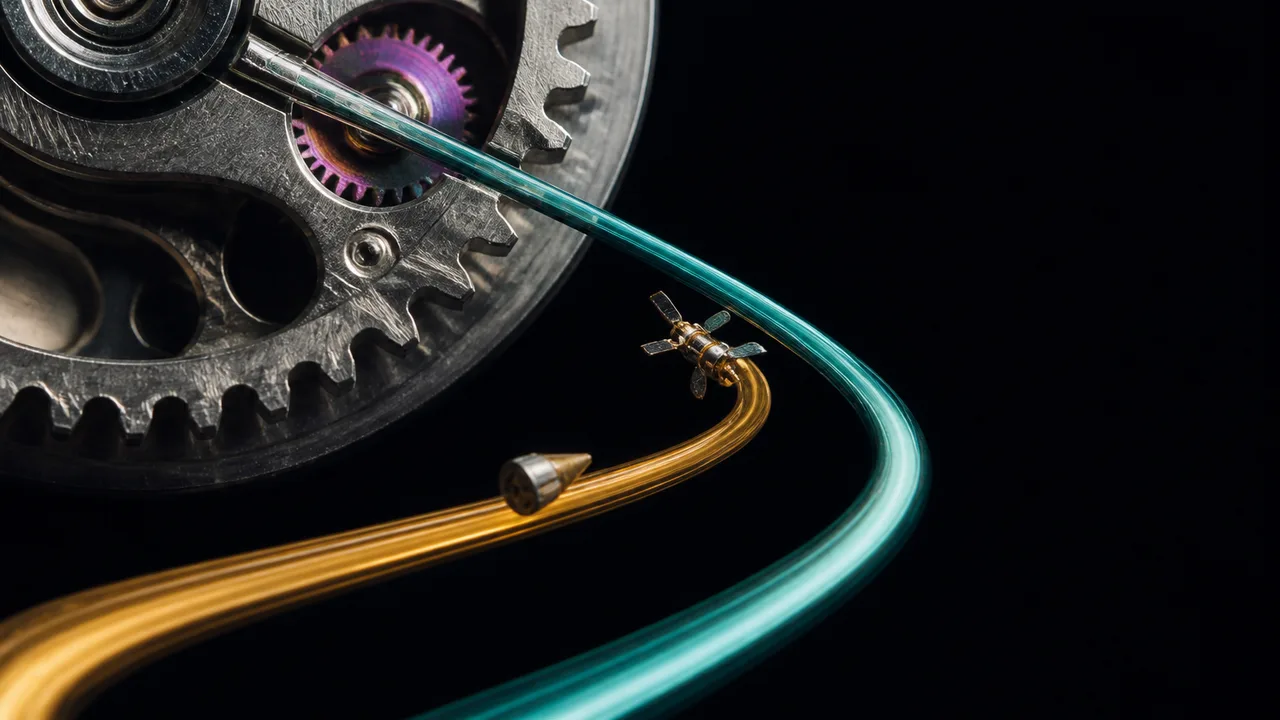
Photo: AI. Pippa Whitfield
Space has a reputation for being inhospitable, but its cruelest trick might be conceptual. The intuitions that serve us perfectly well on Earth — speed up to go faster, steer toward the thing you want to reach — become liabilities the moment you're in orbit. A recent video from Henry Reich's minutephysics channel, clocking in at just over three minutes, lays out two navigation paradoxes that expose this problem with unusual clarity.
The paradoxes are not obscure edge cases. They're the everyday operational reality of every crewed mission, every resupply run, and every satellite deployment. Understanding why they're counterintuitive turns out to be more instructive than the solutions themselves.
The first paradox: higher is slower, but you must accelerate to get there
Start with a well-established fact of orbital mechanics: outer planets take longer to complete their orbits than inner ones, and the reason is not simply that the path is longer. The orbital speed itself is lower. As Reich explains, "the formula for orbital speed is clear — as R increases, V decreases." Higher orbit, lower velocity. That much is textbook.
The paradox materializes the moment you try to act on it. If you're in a low circular orbit and want to reach a higher, slower one, the seemingly logical move — slowing down — will not put you in a higher orbit. It will drop you into a lower one. Gravity doesn't care about your destination. It only responds to your current speed. Reduce that speed below what's needed to maintain your circular path and you'll start falling inward toward Earth.
So how do spacecraft actually climb? They do it through a two-burn maneuver called a Hohmann transfer, and it requires speeding up first. The initial burn pushes the spacecraft beyond circular-orbit speed, which flattens the trajectory into an ellipse that arcs outward. As the spacecraft climbs, it trades kinetic energy for gravitational potential energy — decelerating as it rises, exactly like a ball thrown upward. When it reaches the far end of that ellipse, it's at the target altitude but moving too slowly to maintain a circular orbit there. A second burn accelerates it again, circularizing the path.
The result: two acceleration burns, and a final orbit that is nevertheless slower than the starting one. The gravity climb consumed more speed than both burns provided. As Reich puts it, "even though you speed up twice to get to a higher orbit, you lose even more speed due to gravity on the climb upwards, so the final orbit is slower."
The paradox is real, but once you accept that orbits are a dynamic negotiation between speed and gravity — not a fixed track you simply drive along — it resolves into something almost elegant.
The second paradox: to catch up, slow down
If the first paradox is counterintuitive, the second is actively hostile to common sense.
Imagine you're in circular orbit, following a space station that's ahead of you on the same path. You want to close the gap and dock. Every instinct says: accelerate toward the station. Fire your engine. You'll go faster, it'll go the same speed, and you'll catch up.
This is exactly wrong.
Firing your engine in the direction of travel does increase your speed — but it also alters your orbit. As with the first paradox, extra speed in a circular orbit converts to altitude. Your spacecraft rises onto an elliptical path, climbing away from the planet. And as it climbs, it decelerates. The net effect: you've burned fuel, gained altitude, and fallen further behind the station you were trying to reach. Intuition, thoroughly defeated.
The correct maneuver is the one that feels like surrender: fire your engines in the direction away from the station, which means braking. Slowing down drops you onto a lower, inner ellipse. As you descend, gravitational acceleration speeds you up. You travel a shorter path at higher speed, which means you complete the arc and swing back up to the station's altitude having gained ground on it. When you arrive at the high point of that ellipse — the same altitude as the station — you fire the engine forward again to circularize your orbit and match its speed.
Reich captures the geometry of this beautifully: "to catch up to an object orbiting ahead of you, you actually need to accelerate directly away from the object, which slows you down so that you fall inwards along an elliptical orbit. As you fall, you speed up, which allows you to catch up."
The analogy Reich draws to the brachistochrone curve — the classical problem in which a ball rolling down a curved slope can outpace one sliding along a straight horizontal path — is genuinely apt. In both cases, taking the route that initially moves you away from your destination is the fastest way to arrive. The optimization is non-obvious because it involves surrendering positional advantage to gain speed.
Why this matters beyond the textbook
These two paradoxes aren't just physics puzzles. They have direct operational consequences.
Every crewed docking — from the Apollo missions to the International Space Station's regular resupply runs, including the commercial crew vehicles operated by SpaceX and Boeing — requires flight controllers to apply this non-intuitive logic under real constraints, with real margins for error. The Hohmann transfer, first described by German engineer Walter Hohmann in 1925, remains the backbone of most orbital rendezvous planning precisely because it minimizes fuel expenditure. And in space, fuel is everything.
The fuel question surfaces another counterintuitive result that Reich mentions in passing, describing it as "bonkers": it takes less fuel to escape the solar system entirely than to reach a stable circular orbit near Jupiter. The escape route is energetically cheaper than the parking orbit. This is a direct consequence of the same orbital mechanics — escaping doesn't require the second burn that circularization does — and it's the kind of result that suggests our intuitions about space travel are not merely imprecise but consistently, structurally wrong.
That pattern is worth sitting with. The problem isn't that orbital mechanics is exotic or newly discovered. Hohmann worked this out a century ago. Kepler identified the inverse relationship between orbital radius and speed in the seventeenth century. This is settled, well-documented physics. And yet the results remain counterintuitive to the point that even people with scientific backgrounds often need to work through the logic twice.
Part of that is because our intuitions are calibrated for a world where friction exists and where speed is what keeps you moving rather than what keeps you from falling. In orbit, the satellite isn't fighting gravity — it's falling around the planet continuously. Speed is what maintains the fall rather than arresting it. That conceptual inversion is the key to everything, and it doesn't come naturally.
Reich describes this as "just a taste of the weirdness of orbital mechanics" — a phrase that, given what precedes it, functions as both understatement and invitation. If slowing down to catch up and accelerating to reach a slower orbit are the introductory examples, the implication is that the subject gets stranger before it gets more familiar.
That's probably accurate. And the strangeness isn't a flaw in the physics — it's a flaw in the intuitions we bring to it.
More Like This
Crafting Supercars: The Science Behind Speed and Style
Explore how supercars like Alfa Romeo 4C and Aston Martin Vanquish are meticulously crafted using cutting-edge materials and precision engineering.
NASA's Nuclear Mars Spacecraft: What SR-1 Freedom Means
NASA approved SR-1 Freedom, a nuclear electric spacecraft targeting a 2028 launch. Here's what the mission actually tests—and what it doesn't solve.
How Io's Shadow Revealed the Speed of Light
How 17th-century astronomers tracking Jupiter's moon Io—for colonial navigation—accidentally measured the speed of light. The discovery that changed physics.

How Fractals Moved From Math Curiosity to Tech
Fractals aren't just beautiful—they're inside your smartphone antenna, your microchip cooling system, and your eye exam. Here's how the math became engineering.
Artemis II's Clever Safety Maneuvers, Explained
NASA's moon mission uses vintage hardware and ingenious orbital mechanics to give astronauts an escape route at every stage. Here's how it works.
Exploring the Cosmic Balance: Lagrange Points
Discover how Lagrange points revolutionize space exploration, offering energy-efficient paths and potential for space construction.
Primordial Black Holes as Dark Matter Candidates
After decades of failed WIMP searches, physicists are turning to primordial black holes as a serious dark matter candidate. Here's what the evidence actually shows.

Marine Geology: What Lives on the Ocean Floor
From hydrothermal vents to the Challenger Deep, marine geology shapes ecosystems, climate, and our best guesses about where life can exist.