Olbers' Paradox: Why the Night Sky Is Dark
The night sky should blaze like the sun's surface. Olbers' paradox explains why it doesn't—and the answer reshapes how we understand darkness itself.

Written by AI. Nadia Marchetti
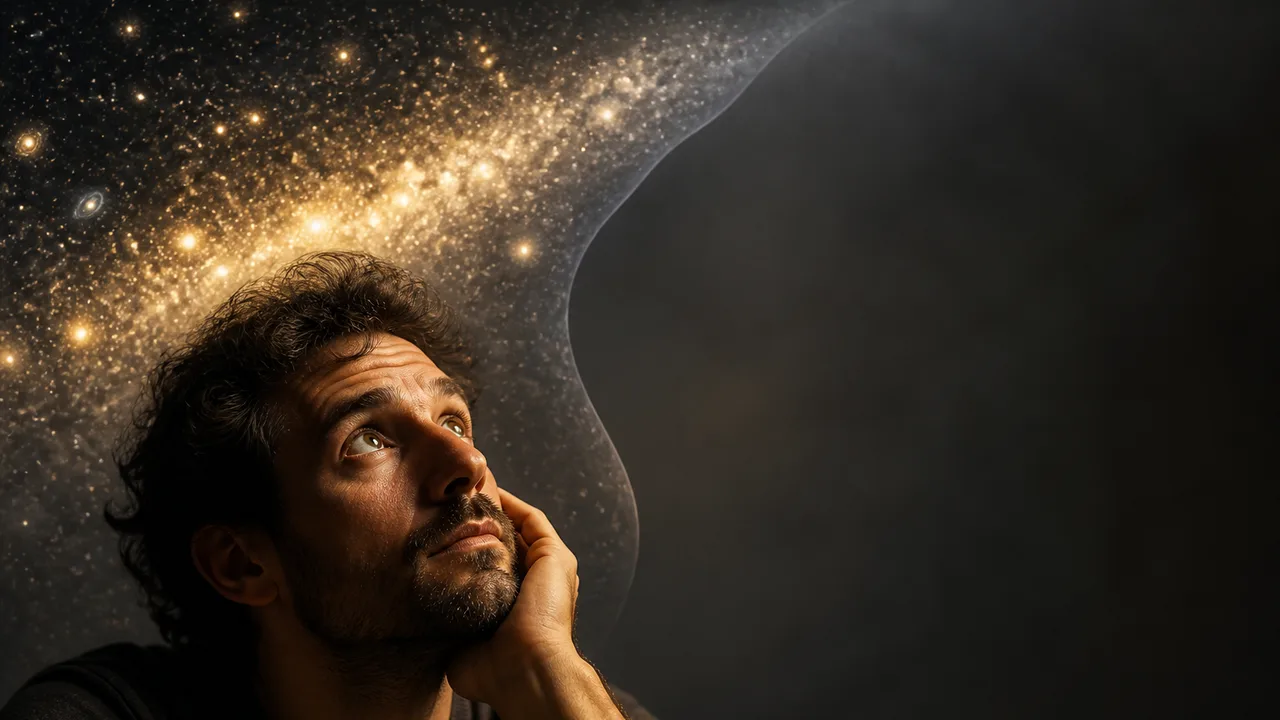
Photo: AI. Naia Iwarra
Go outside tonight, somewhere away from streetlights if you can manage it, and just look up. What you see is mostly nothing. A few thousand stars on a good night, the occasional smear of the Milky Way, and an awful lot of black. That blackness feels like the most natural thing in the world — of course space is dark, what else would it be?
Here's the thing: by the logic of classical physics and an infinite cosmos, space shouldn't be dark at all. The night sky should look like the surface of the sun. Every single inch of it, blazing.
This is Olbers' paradox, and it's been quietly disturbing astronomers since the 1500s.
The Problem with Infinite Stars
The intuitive escape hatch most people reach for goes something like: yeah, but distant stars are really dim. A recent video from The Action Lab walks through exactly why that doesn't work, and it's worth sitting with the argument for a moment because it's genuinely unsettling.
When a star is twice as far away, yes — it delivers one-quarter the light to your eye. But it also appears one-quarter the size. Those two effects cancel each other out exactly. The surface brightness — how bright each tiny patch of that star looks — stays constant regardless of distance. As the video puts it: "every point in the sky would therefore have roughly the surface brightness of a star. In other words, the night sky should literally look like the surface of the sun."
The math is clean and the conclusion is genuinely alarming. If the universe contains an essentially infinite number of stars distributed through infinite space, then every line of sight you could draw from your eye outward would eventually terminate on the surface of a star. No gaps. No darkness. Just wall-to-wall stellar surface. The night sky should be uniformly, blisteringly bright.
Johannes Kepler fretted about a version of this. So did Edmond Halley. Heinrich Olbers gave it a formal treatment in 1823, lending the problem his name — though the paradox predates him by centuries. Smart people looked at the dark sky and felt, correctly, that something wasn't adding up.
The First Attempted Fix, and Why It Fails
The obvious modern response: maybe the universe isn't actually infinite and eternal. Maybe it had a beginning, and light from the most distant regions simply hasn't had enough time to reach us yet. Problem solved, paradox dissolved, everyone go home.
Except it doesn't work. And the reason it doesn't work is where things get genuinely strange.
The early universe wasn't a sparse scattering of distant stars slowly lighting up. Right after the Big Bang, the entire universe — all of space, everywhere — was filled with a hot, dense plasma. There were no gaps, no dark patches, no empty stretches between galaxies-to-be. It was a uniform, glowing sea of matter and energy. If you could somehow look back far enough in time (which, because of the finite speed of light, is exactly what looking at distant objects means), you wouldn't see darkness — you'd see that plasma, in every direction, with no exceptions.
As the video puts it: "if we look far enough back in time before there were any stars at all, we shouldn't see darkness, we should see that hot glowing plasma in every direction. So we're right back to where we started."
Finite age, by itself, doesn't rescue us. The early universe is as bright a problem as the infinite one. You've just replaced infinite stars with infinite plasma.
What Actually Saves Us
The resolution came in pieces, and required one of the stranger ideas in modern physics to click into place: the universe isn't just finite in age, it's expanding.
And expansion does something to light that nothing else does. As photons travel across the cosmos, the space they're traveling through is itself stretching. That stretching elongates the wavelength of the light — a process called cosmological redshift. Longer wavelength means less energy. Stretch a photon far enough and it slides out of the visible spectrum entirely.
All that light from the primordial plasma — the light that should be making the night sky look like a furnace — has been stretched. Shifted. Demoted from visible light down through infrared, down through radio, all the way into the microwave range. It's still there. It's arriving from every direction, every moment. We just can't see it with our eyes.
We can detect it with instruments, though, and we do. It's called the cosmic microwave background, or CMB, and it is almost exactly what early astronomers were worried about: a glow filling the entire sky in every direction without exception. The Action Lab captures this nicely: "It's almost exactly what early astronomers predicted, a glowing sky in every direction. Except instead of visible light, it's been stretched into the microwave part of the spectrum."
The night sky is not dark. It's blazing with microwave radiation that our biology simply isn't equipped to perceive. Olbers and Kepler and Halley were right to be troubled. They just didn't know about the particular mechanism that hid the evidence from them.
The Second Layer: You Can't See True Black Anyway
Here's where the video takes a left turn that I find almost more interesting than the cosmology.
Say you grant all of the above. The CMB is real, expansion explains the darkness, paradox resolved. Now ask a different question: what does genuine, absolute darkness actually look like? Not the night sky between stars — what does no light at all look like?
The answer, apparently, is that you'd never know. Because your eyes won't let you see it.
Try it right now if you want. Turn off the lights, cover your eyes completely, let your vision adapt. The color you see isn't black. It's a dim, neutral gray — in German, Eigengrau, which translates roughly as "intrinsic gray" or "own gray." It's the brain's resting state when deprived of input, and it's not nothing. It's something. A permanent low-level haze that your visual system generates entirely from within.
The mechanism is your rod cells — the photoreceptors responsible for low-light vision. They don't only fire when a photon hits them. Random thermal fluctuations in the retina occasionally trigger them spontaneously, with no light present at all. Your brain receives those signals and dutifully interprets them as faint illumination. It has no way to know the difference.
The practical upshot: there is a hard floor to how dark anything can look to a human observer. True black — zero photons, zero signal — is phenomenologically inaccessible to us. The darkest thing you can ever see is Eigengrau.
What This Leaves Us With
Set these two facts side by side. The universe is genuinely not dark — it glows in microwave frequencies we can't perceive. And even if it were genuinely dark — zero radiation, empty space, no CMB — our own neurobiology would still generate a faint gray where pure blackness should be.
Darkness, it turns out, is something we construct. It's not the absence of light so much as the limit of our ability to detect it, combined with a floor our retinas impose regardless. The black of the night sky is a perceptual artifact layered on top of a physical one.
Which raises a question worth sitting with: how many other things we take as obviously, fundamentally given — darkness, silence, stillness — are similarly constructed? How much of what we experience as the baseline reality of the universe is actually the edge of our instruments, biological or otherwise?
The night sky looks dark. The universe disagrees.
More Like This
Hawking Radiation and the Ghost Light of Dead Universes
Hawking radiation may be the mechanism that erases one universe and seeds the next. Here's what the physics actually supports—and what it doesn't.
Did Our Universe Bounce Into Existence Inside a Black Hole?
A new preprint proposes the Big Bang was actually a bounce inside a black hole. Here's what the model claims, what it can't yet prove, and why it won't leave me alone.
Adam Riess on the Hubble Tension and Cosmic Expansion
Nobel laureate Adam Riess explains why two precise measurements of the universe's expansion rate keep disagreeing—and what that could mean for cosmology.

Why NASA Is Finally Returning to Venus After 40 Years
After decades of neglect, Venus is getting two NASA missions. Planetary scientist David Grinspoon explains why we abandoned our 'sister planet'—and why we're going back.
Solar Flares, Earth's Magnetosphere, and StormWall
Recent X-class solar flares and CMEs have prompted serious discussion about Earth's space weather vulnerability—and a theoretical plasma shield called StormWall.
Hubble Tension: The Universe's Unsolved Mystery
Explore the Hubble tension and its implications for our cosmic understanding.

Why All Mammals Share Seven Neck Bones
Giraffes and humans both have seven cervical vertebrae. The evolutionary reason involves Hox genes, cancer risk, and the surprising anatomy of the diaphragm.
Einstein vs Quantum Mechanics: The EPR Paradox Explained
Physicist Jim Al-Khalili unpacks the EPR paradox—Einstein's 1935 challenge to quantum mechanics that inadvertently gave us the concept of entanglement.