Wheeler's One-Electron Universe and the Nature of Time
Wheeler told Feynman all electrons are identical because there's only one. The theory died—but the fragment that survived quietly unsettled everything we think about time.

Written by AI. Amelia Nwofor
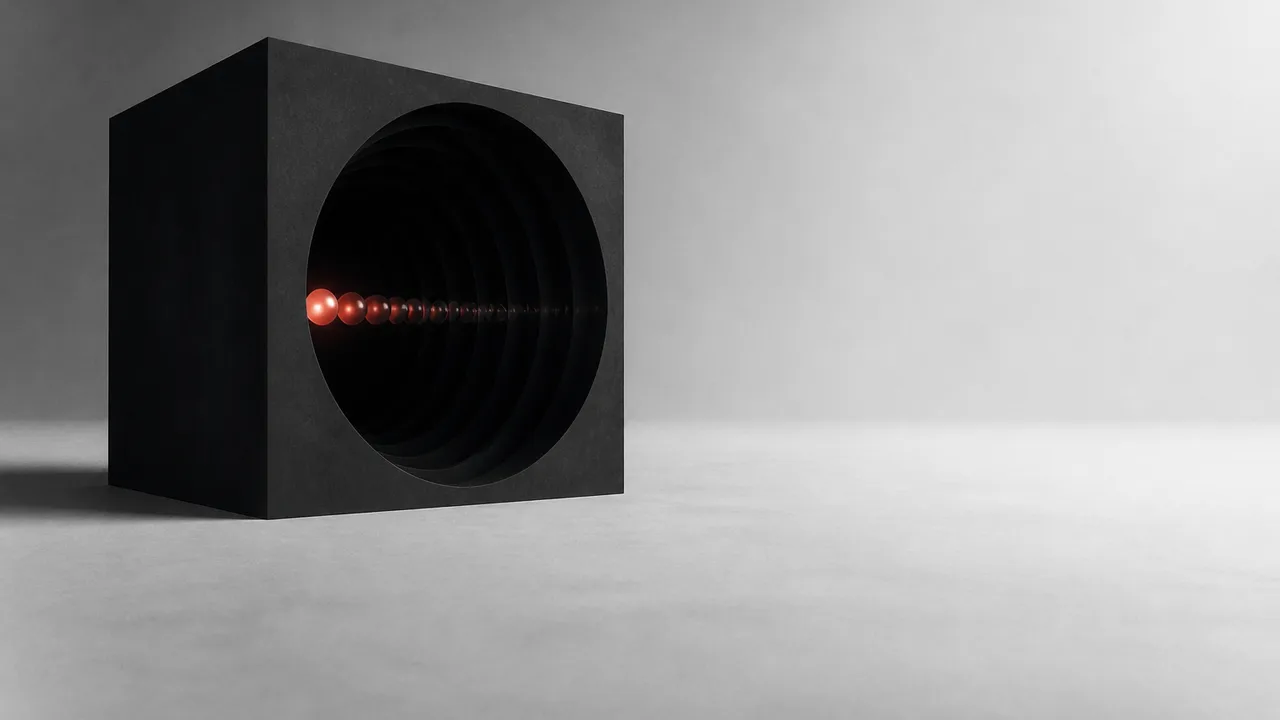
Photo: AI. Tomoko Hayashi
Hold up your hand. Look at the back of it—the knuckles, the veins, the particular geography of your skin. Inside that hand are electrons. A lot of them. And every single one of them is a perfect, flawless, zero-tolerance copy of every other electron in the observable universe.
That last part is the problem. Nature doesn't do perfect copies. No two snowflakes, no two grains of sand, no two atoms of gold are exactly identical if you look closely enough. Sameness has causes—shared molds, shared origins, shared blueprints. It points backward. So when physicists measure the electron's magnetic properties and find agreement with theoretical predictions to around 12 decimal places, and when every single electron gives the same answer, the question isn't just interesting. It's structurally strange. Perfect identicality at that scale demands an explanation, and physics doesn't have a consensus one.
John Wheeler thought he did.
The Phone Call
In the spring of 1940, Wheeler—already one of the most respected physicists alive—called his graduate student Richard Feynman at Princeton. He didn't open with pleasantries. He said, "Feynman, I know why all electrons have the same charge and the same mass."
Feynman asked why.
"Because they are all the same electron."
The idea Wheeler sketched out on that call is documented in exactly one primary source that matters: Feynman's own 1965 Nobel lecture, "The Development of the Space-Time View of Quantum Electrodynamics," where he recounts the exchange almost in passing, buried in a talk that is less formal address than honest intellectual autobiography. If you want to go to the source—and I'd argue you should—it's available through NobelPrize.org, and it reads unlike almost any other scientific lecture you'll encounter.
The theory Wheeler proposed is easier to follow than it first sounds, and considerably stranger than it sounds after that.
One Thread Through All of Time
Start with what physicists call a world line: the complete trace of a particle's existence through spacetime, drawn as a single thread from birth to destruction. Now take Wheeler's leap. What if you gave that one electron an impossibly, cosmically long world line? What if it was born at the Big Bang, traveled forward through time, then turned around and traveled backward, then forward again—zigzagging through the entire history of the cosmos, threading through every atom that would ever exist, before ending at the heat death of the universe?
One thread, woven back and forth through all of spacetime.
Now ask: what does that look like to observers stuck in a single moment? Imagine the whole tangled thread as a crumpled ball of string, and slice through it with a flat sheet of glass representing right now. Every place the string pokes through the glass looks like a separate dot. Millions of dots. Trillions. The whole apparent population of electrons in the universe—but there's only one string. Every "electron" you've ever seen is the same object caught at a different crossing point in its one impossibly long life.
That's the one-electron universe. And as an answer to why all electrons are identical, it is—I'll say it plainly—the most elegant solution anyone has ever proposed. It doesn't explain the perfection by naming it. It dissolves the problem entirely. Of course they're all identical. They're not copies. There's nothing to copy. There's one object, and you're seeing it from an incomprehensible number of angles simultaneously.
The Part That Killed It (and the Part That Didn't)
Feynman, to his credit, spotted the fatal flaw in about four seconds.
If the electron's world line zigzags backward through time, those backward-running segments have to appear as something when we observe them. A particle running backward in time, it turns out, looks exactly like a particle running forward but with its electric charge reversed. Same mass, opposite charge. That's not a theoretical prediction—it's a particle we've made in labs, photographed, and studied. It's the positron. Antimatter.
Wheeler's picture gave antimatter a beautiful new meaning: a positron isn't a separate kind of stuff. It's an electron mid-U-turn in time. When an electron and positron annihilate each other in a flash of light, that's not two particles destroying each other. That's one particle reaching a turning point in its world line.
Here's where the theory breaks. If every backward segment of the thread is a positron, then the universe should contain precisely as many positrons as electrons. One U-turn up for every U-turn down. But the universe is made overwhelmingly of matter. Positrons are vanishingly rare. Antimatter, for reasons that remain one of the genuine open puzzles of cosmology, barely exists at all.
Wheeler's response, by Feynman's own account in the Nobel lecture, was essentially a shrug: maybe the antimatter is hidden somewhere, tucked inside protons. Everyone in the conversation knew that was a handwave. And that handwave is where the one-electron universe, as literal cosmology, quietly dies.
But Feynman didn't throw out the whole idea. He threw out the cosmology and kept the mechanism.
The Fragment That Won the Nobel Prize
The specific piece Feynman salvaged—the idea that a positron is an electron running backward in time, and that particles can be treated as moving through time in either direction as a normal, computable part of quantum calculations—became the foundation of Feynman diagrams. These are not philosophy. Physicists use them as standard working tools to predict the outcomes of particle experiments. Their predictions match experimental results to that same extraordinary precision. That's what earned Feynman the 1965 Nobel Prize in Physics, shared with Julian Schwinger and Sin-Itiro Tomonaga for the development of quantum electrodynamics.
The fragment of an unhinged phone call became the most precisely verified framework in science.
And that creates a genuinely uncomfortable implication that's easy to slide past: if the equations of physics work—if they make correct predictions—while treating particles as running backward in time as freely as forward, then the direction of time is not built into the particle. The electron doesn't carry an arrow. The fundamental physics is time-symmetric. Forward and backward are, to the mathematics, equally valid.
The distinction between past and future, which feels like the most unshakeable fact of conscious experience, doesn't appear in the equations at all.
Does Time Flow?
This is where a story about electrons becomes something else.
When two independent lines of reasoning converge on the same strange place, it's worth paying attention. Quantum electrodynamics arrives at time-symmetry through the behavior of particles. Einstein's relativity arrives at something similar through a completely different route: the block universe.
The block universe holds that past, present, and future all exist equally—that time is not a moving spotlight illuminating one moment after another, but more like a spatial dimension. New York doesn't cease to exist because you're in Tokyo. On this view, the moment of your birth still exists. The moment of your death already exists. Every point in time simply sits at its address in a four-dimensional structure that is, in its entirety, already complete and static.
The flow of time—the felt sense of one moment giving way to the next—is, in this picture, not a feature of the universe. It's a feature of how a conscious creature threaded through the block experiences it from the inside. The film already exists on the reel. You experience it as motion because you're running through the frames.
If you find that unsettling, I think you should. The block universe is a serious position among physicists and philosophers of physics, not a fringe notion—and the time-symmetry of fundamental physical law is the thing that keeps pushing serious thinkers toward it.
The Loneliness
Wheeler's full theory is almost certainly false. The missing antimatter saw to that. But it left something behind: a working, tested demonstration that the arrow of time is not written into the particles we're made of. That the flowing river from past to future might be something that happens in us, not in the universe.
And there's one more thing worth sitting with—the thought experiment the one-electron universe invites even after you've accepted its death as cosmology.
Suppose, just for a moment, Wheeler had been right. Every electron in your hand is the same particle, also burning inside a star whose light won't reach Earth for billions of years, also present in the body of someone you've never met, also in every moment of every life that has ever unfolded or ever will. Everything you've ever touched—the same single particle, meeting itself, over and over, never once knowing it.
The loneliness in that image is precise. If everything is one electron, that electron has nothing to touch that is not also itself. It is by definition alone in a way nothing else could be—not abandoned, not isolated, but the only thing that exists, forever encountering only more of itself.
Wheeler's answer was probably wrong. But it was at least an answer—the only one anyone has ever proposed that accounts for the perfection rather than just asserting it.
The identicality of electrons remains unexplained. Every electron in your hand still weighs exactly the same as every electron in a galaxy 11 billion light-years away, to more decimal places than we can measure. Physics calls that a fundamental property of a fundamental particle and moves on. Which is fine. Naming something is not the same as understanding it, though—and the difference between those two things is exactly where the interesting work lives.
More Like This
The Deeper Geometry Behind the Pythagorean Theorem
Explore why the Pythagorean Theorem appears in unexpected places, from geometry to relativity.
Why Light Beams Seem to End: Physics Explained
Discover why searchlight beams appear to stop and how physics and atmospheric conditions contribute to this phenomenon.
The Top Quark and the Fate of the Universe
Physicist Kate Shaw explains how measuring the top quark's mass with precision could reveal whether the universe is stable—or sitting on a quantum knife-edge.
Donald Hoffman: Evolution Hid Reality From Us
Cognitive scientist Donald Hoffman argues on StarTalk that evolution gave us a VR headset, not a window—and the math behind Darwin backs him up.
Does Money Really Buy Happiness? Insights from Peter Steinberger
Explore Peter Steinberger's perspective on money and happiness, emphasizing experiences over wealth accumulation.
Maxwell's Demon and the Physics of Information
Physicist John Goold explains how a 19th-century thought experiment about entropy became central to quantum mechanics, computation, and the nature of information.
Gravity's Strangest Effects, From Time to Cosmic Voids
From gravitational time dilation to the Dipole Repeller and LIGO's detections, here's what gravity actually does—and what it still can't explain.
JWST's Little Red Dots May Be Cocooned Black Holes
New JWST spectral data on a single "little red dot" galaxy offers the strongest case yet that they're supermassive black holes wrapped in dense gas cocoons.