Webb Finds Evidence of an Atmosphere on Lava World TOI-561 b
Webb tracked TOI-561 b through nearly four orbits. Its cool nightside points to a reflective atmosphere, while mineral clouds and its survival remain open questions.

Written by AI. Amelia Nwofor
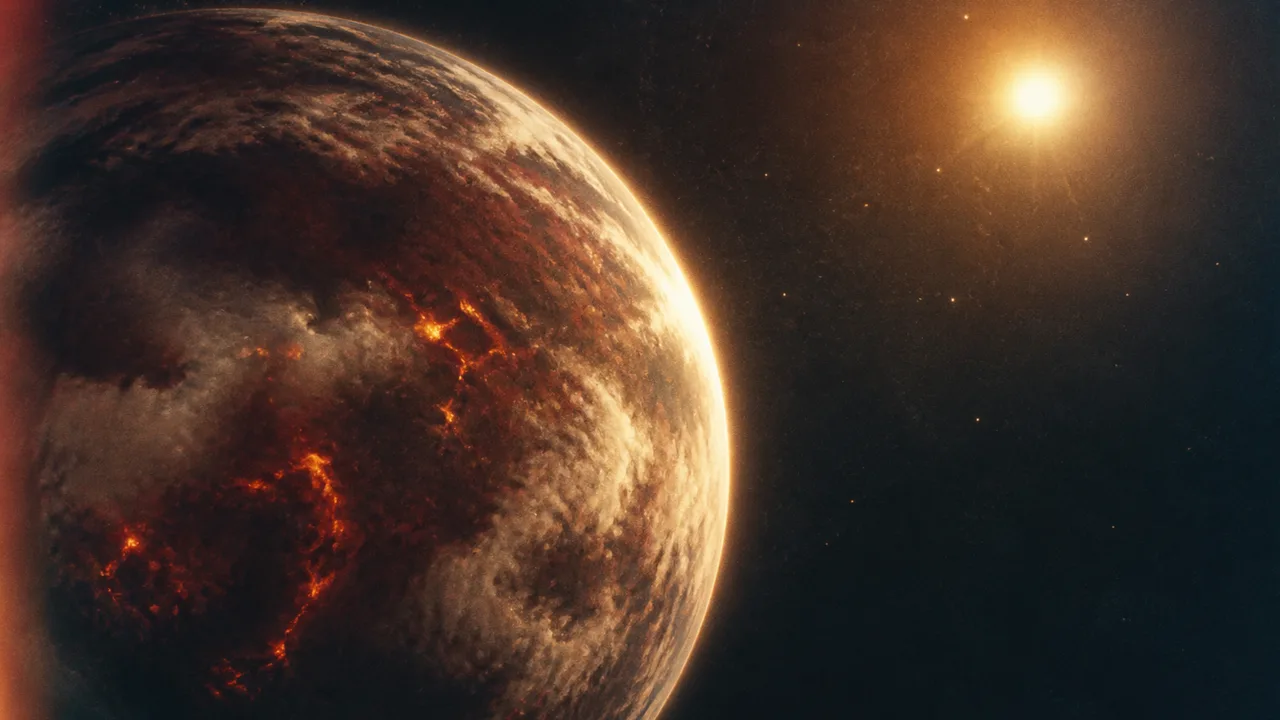
The James Webb Space Telescope watched TOI-561 b for 37 hours and found stronger evidence that this intensely heated rocky planet has an atmosphere. The planet’s dark side gave researchers a way to investigate a puzzle left by earlier observations: its sunlit side was cooler than expected for exposed, dark rock so close to a star. Heat carried around the planet explained some of that difference. The nightside was too cool to explain all of it.
The team infers that TOI-561 b reflects roughly 75% of the starlight reaching it. That is a striking result for a world about 280 light-years away whose surface may be an ocean of molten rock. It also presents two questions with different answers still to find. What makes the planet so reflective? And how has it retained, or replaced, gas while enduring intense stellar radiation for billions of years?
Following the Missing Heat
TOI-561 b circles its star in about 10.5 hours. Researchers monitored nearly four complete orbits, measuring how its brightness and thermal emission changed as different parts of the planet faced Webb. That changing signal is called a phase curve. For a planet thought to keep the same face toward its star, it offers a view of both the permanently lit dayside and the nightside, which receives no direct starlight.
Earlier measurements had already raised the atmospheric question. A 2025 study using more limited Webb observations suggested an atmosphere; the planet’s bulk density and dayside emission contributed to that assessment. The dayside was cooler than researchers predicted for a bare, dark surface. One possible destination for the apparently missing energy was the nightside: an atmosphere could carry heat there. Another was space, if the planet reflected much of its incoming light.
The new observation tested the first possibility by measuring the dark hemisphere. Some heat appears to move around the planet, supporting the case for an atmosphere. But the nightside was not warm enough to account for the dayside’s temperature on its own. Researchers therefore infer strong reflection as well. A cool dayside alone left those explanations difficult to separate; watching the planet throughout its orbit gave them a second temperature constraint.
It narrows the planet’s energy budget without identifying the material responsible. The inferred reflectivity comes from interpreting the planet’s changing light and heat, rather than from an image of a bright cloud deck. The two atmospheric clues, heat redistribution and reflection, strengthen a shared explanation, but they answer different parts of the temperature puzzle.
Where the Rock Clouds Enter
Researchers compared the measurements with climate simulations. In those models, dayside clouds containing silicon dioxide or magnesium silicate could reflect substantial incoming radiation. These are mineral compounds associated with rock. In the proposed sequence, material from the hot planet enters the atmosphere and forms bright clouds that intercept starlight before it heats the surface.
That proposal makes physical sense of a bright planet with a relatively cool dayside. It remains a model-based explanation: Webb measured the planet’s changing signal, while the simulations supply possible cloud materials. An atmospheric haze or another source of high reflectivity also deserves consideration. The nightside measurement rules out transporting heat as the whole explanation for the cool dayside; it does not select silicon dioxide over magnesium silicate or identify a cloud layer directly.
The atmosphere’s main gases are unresolved too. Carbon dioxide, which would invite a comparison with Venus, and sulfur dioxide, associated with volcanic activity on Jupiter’s moon Io, are among the possibilities researchers have raised. The cloud question depends partly on those conditions: which materials can form and remain aloft depends on the atmosphere in which they circulate.
Venus offers a useful, narrow comparison. TOI-561 b’s inferred reflectivity of about 75% is comparable to Venus’s, while Earth reflects about 30%. The comparison shows how unusual a highly reflective planet can look beside Earth. It cannot tell researchers whether TOI-561 b has Venus-like gases. A similar fraction of reflected light can accompany different atmospheric ingredients and very different conditions; TOI-561 b orbits its star in less than half an Earth day.
An Atmosphere with a History Still to Explain
The planet’s location makes its apparent atmosphere surprising. Intense irradiation is expected to erode gaseous envelopes around rocky planets on close orbits. If TOI-561 b has a substantial atmosphere now, its present brightness cannot, by itself, reveal how much gas it began with or how often gas has escaped and been replaced. Reflecting starlight could reduce heating at the surface, but the measured reflectivity does not establish that clouds prevented atmospheric loss over billions of years.
Researchers have proposed several possible histories. The planet might have started with an unusually large supply of gas. Its molten interior might release gas into the atmosphere as material escapes to space. Its earlier orbit and the timing of its exposure to intense radiation could also affect how much atmosphere remains. These possibilities need not be mutually exclusive. A snapshot of heat moving around the planet cannot distinguish a long-lived envelope from one replenished over time.
Longer-wavelength Webb observations could help distinguish atmospheric compositions and test the proposed histories. A carbon-dioxide-rich atmosphere, a sulfur-dioxide-rich one and a cloud-bearing mixture would give researchers different clues about exchange with the molten interior. For now, the most useful picture of TOI-561 b includes the dark hemisphere: cool enough to show that moving heat cannot do all the work, and brightening the case for an atmosphere whose ingredients are still unknown.
More Like This

Webb Finds the Farthest Fast Radio Burst’s Dwarf Host
Webb measured the host of the farthest fast radio burst. Its dwarf galaxy and dispersed signal offer different clues about the burst and matter along its path.

TON 618: The Black Hole That Defies Its Own Physics
TON 618 weighs 66 billion solar masses—more than current black hole growth models can explain. Here's what that gap in our knowledge actually means.

JWST's Little Red Dots May Be Cocooned Black Holes
New JWST spectral data on a single "little red dot" galaxy offers the strongest case yet that they're supermassive black holes wrapped in dense gas cocoons.
A Doomed Water World Is Falling Into Its Star
Astronomers have found a hot, water-rich exoplanet spiraling toward its star. Here's what its slow destruction reveals about planetary life cycles.
James Webb Telescope Data Strains Big Bang Cosmology
Philosopher of science Bjørn Ekeberg argues Webb's early galaxy findings expose a deeper problem: cosmology's dependence on interpreting light it cannot fully verify.

3I/ATLAS: An Interstellar Comet Older Than the Sun
James Webb observations of interstellar comet 3I/ATLAS reveal unusual deuterium and carbon isotope ratios that may point to an origin 10–12 billion years old.

The Relativistic Submarine Paradox, Explained
A submarine moving at near-light speed should sink in one frame and rise in another. Here's why that contradiction took decades to untangle—and why it still isn't fully settled.

A 2023 Math Kangaroo Problem Solved Two Ways
A geometry problem from the 2023 Math Kangaroo competition reveals how two different theorems can reach the same answer—and why that matters for mathematical thinking.