US Plans 1,000 Rocket Launches Per Year by 2030
The White House's new National Space Transportation Policy targets over 1,000 rocket launches per year by 2030. Here's what the ambition actually requires.

Written by AI. Olivia Meng
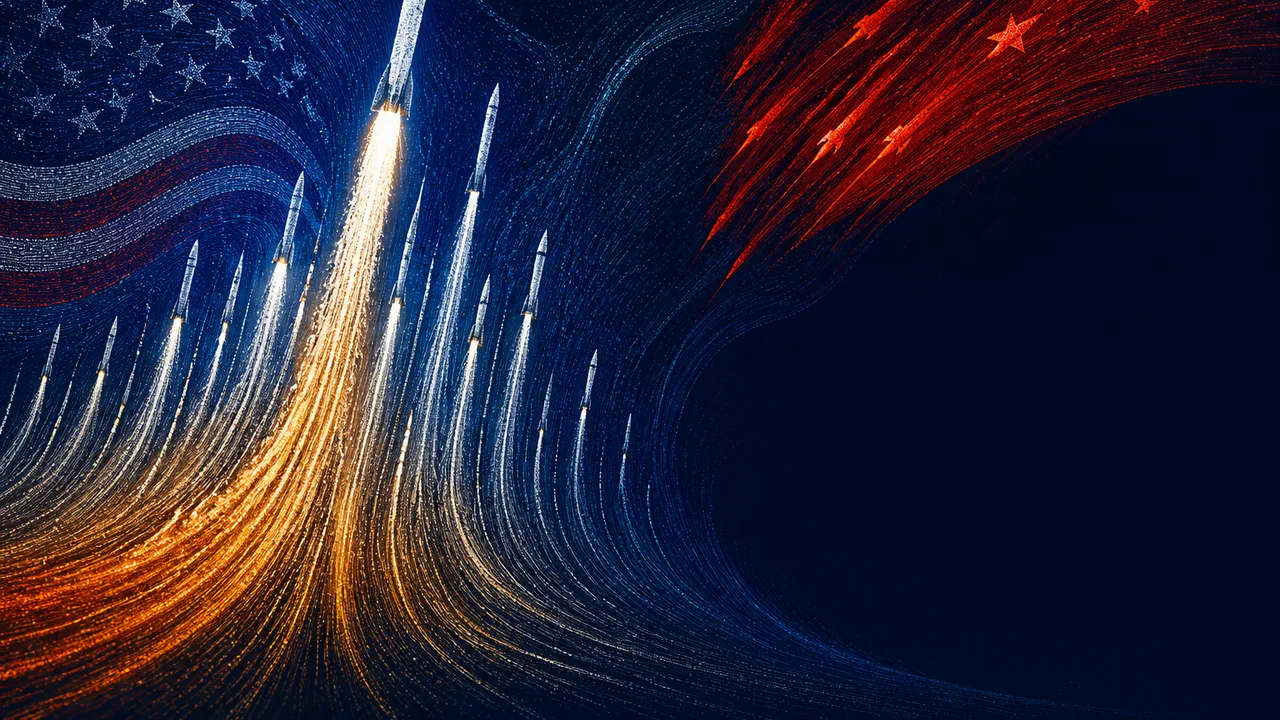
Three launches a day, every day, by the end of the decade. That is the arithmetic behind the White House's newly signed National Space Transportation Policy — and stated plainly like that, it either sounds like the opening of a science fiction novel or a procurement nightmare, depending on your disposition.
The policy, announced by the White House and reported by the New York Times as a bid for "leadership in space transportation," sets a target of more than 1,000 rocket launches and spacecraft re-entries per year on American soil by 2030. Space.com reports that the US is simultaneously updating its entire framework for managing spaceflights that lift off and land within its borders — meaning this is not just a number on a whiteboard but a systemic redesign of how American launch infrastructure is regulated and resourced.
To understand what that redesign involves, consider where the US currently stands. Even with SpaceX having genuinely transformed the cadence of American launches over the past decade, the country is nowhere near triple-digit annual launches, let alone four-digit ones. The gap between here and 1,000 is not a rounding error. It is a different order of magnitude.
What the Policy Actually Does
The administration's document is less a moonshot declaration than a directive to build the plumbing for one. According to Benzinga, the National Space Transportation Policy directs NASA and other federal agencies — Benzinga's sourcing notably used the anachronistic title "Secretary of War," a designation that hasn't been official since 1947, when the office became the Secretary of Defense — to identify federal land for an additional reentry site within 90 days. That 90-day clock is one of the more concrete deliverables in what is otherwise a document heavy on aspiration.
Fox News frames the policy explicitly in competitive terms, noting that the 1,000-launch target is tied to deploying satellites for GPS, military communications, and weather forecasting — and that the urgency is driven, at least in part, by the perceived need to stay ahead of China. That framing is honest in one respect: a significant portion of those projected launches would serve national security functions, not purely commercial or scientific ones. The distinction matters when evaluating what "space leadership" actually means in this context.
KOTA Radio's reporting captures the rhetorical pitch neatly: the administration wants to transform spaceflight "from spectacle to status quo." That is a genuine shift in philosophy from the Apollo-era model, where a launch was a national event, toward something closer to commercial aviation — routine, high-frequency, and largely invisible to the public. Whether you find that inspiring or unnerving probably reflects your priors about industrialization more than your views on space.
Reason.com summarizes the policy's ambition as entering a "new space age," contextualizing it within a broader shift toward commercial launch operations and reduced regulatory friction. The libertarian outlet's enthusiasm is predictable but not wrong on the mechanics: achieving 1,000 launches will require the FAA's Office of Commercial Space Transportation to process licenses at a pace that its current staffing and procedures were not designed to handle. Regulatory reform is not just a talking point here — it is a prerequisite.
The Infrastructure Gap
Infrastructure is where aspiration meets friction. The United States currently operates a small number of licensed launch sites — primarily the Kennedy Space Center and Cape Canaveral in Florida, Vandenberg in California, and a handful of smaller commercial spaceports. A 20-fold increase in launch cadence cannot be absorbed by the existing footprint. The 90-day federal land identification mandate is a start, but identifying land and building launch-capable infrastructure are separated by years and billions of dollars.
Workforce is the quieter constraint. Launch operations require highly specialized technicians, engineers, and safety personnel. The pipeline for that workforce does not scale overnight, and no policy directive can compress the timeline for training people who know how to handle liquid hydrogen or process range safety data. The administration's document acknowledges this — the brief notes that the policy calls for investment in workforce development — but the specifics, at least in what has been publicly released, remain thin.
The Atmosphere Is Also an Interested Party
Here is the question that the policy document, at least in its public framing, does not appear to wrestle with: what does 1,000 launches per year do to the atmosphere?
This is not a rhetorical provocation. It is an open and active area of atmospheric science, and the current state of knowledge should give policymakers pause — not as a reason to halt ambition, but as a reason to build monitoring and mitigation into the architecture from the start rather than retrofitting it later.
Rocket engines, depending on fuel type, emit a mix of water vapor, carbon dioxide, black carbon (soot), and aluminum oxide particles. The concern is less about any single launch and more about cumulative deposition at altitude. Unlike ground-level emissions, which cycle through the troposphere relatively quickly, particles deposited at stratospheric altitudes can persist for years, where they interact with ozone chemistry and affect radiative forcing in ways that are still being quantified.
Research published by Maloney and colleagues in the Journal of Geophysical Research: Atmospheres — available here — found that black carbon from rocket launches was already warming the stratosphere at a rate disproportionate to the mass emitted, precisely because of where and how long it resides there. That paper was analyzing launch volumes dramatically lower than what this policy envisions. The science is not yet conclusive enough to define a hard atmospheric limit for annual launches, but it is developed enough to demand that the question appear somewhere in the policy conversation.
That it does not — or at least, not in what's been publicly disclosed — is the coherence cost the administration's internal logic hasn't paid yet. A policy built around velocity has to eventually account for what velocity leaves behind.
The Competition Frame and Its Limits
The China-competition rationale is the load-bearing beam of the political argument for this policy, and it is worth examining what it actually holds up. The logic runs: China is expanding its space capabilities aggressively; satellites underpin modern military and economic infrastructure; therefore the US must launch more, faster.
This is not an unreasonable argument. It is also an argument that could justify almost any launch target, which is why it needs more scrutiny than it typically receives. "Ahead of China" is a strategic orientation, not a program design. The relevant questions — how many satellites are actually needed, what orbits, what redundancy, what deorbit plans for end-of-life spacecraft — require answers that are operationally specific in ways that a high-level policy document is not designed to provide.
There is also an international dimension that the competition frame tends to flatten. Other nations are watching this policy announcement and will draw their own conclusions about how much launch capacity they need. The dynamic is not simply US-vs-China; it involves the European Space Agency, India's ISRO, Japan's JAXA, and a growing roster of commercial launch operators in multiple countries. A race dynamic that accelerates globally produces more cumulative atmospheric loading than a race dynamic that stays bilateral.
None of this means the policy is wrong. It means the policy is early — a declaration of intent that still requires the harder work of specifying how the intent gets executed, measured, and, where necessary, corrected. The 2030 target is four years away. The 90-day land identification deadline will arrive long before that. What happens in between will tell us whether this was a vision document or a governing one.
The question is whether the agencies now holding 90-day mandates have the resources and the appetite to answer it.
More Like This

Rethinking Cosmic Acceleration: A Local Illusion?
Exploring the debate on whether the universe's acceleration is a local phenomenon, challenging the concept of dark energy.

How the Asteroid Impact Ended the Dinosaur Era
Explore the catastrophic asteroid impact that ended the dinosaurs, its immediate aftermath, and the long-term environmental changes.

Subcritical Reactors: Nuclear Power's Safety Fix?
A new generation of subcritical reactors promises to make nuclear meltdowns physically impossible. But can they deliver on cost, scale, and timeline?

White House Science Chief Lays Out a Plan to 10x Research
Michael Kratsios outlines the Genesis Mission, AI-driven grant reform, and the case for treating scientific productivity as a national security issue.

Understanding the Real Risk of Brain-Eating Amoebas
Explore the facts and myths surrounding brain-eating amoebas. How real is the threat, and can climate change affect its spread?
Starlink Satellites Are Now Scanning Earth's Atmosphere
Kyoto University researchers repurposed 1,200 Starlink satellites as an accidental atmospheric scanner. Here's what that means for science—and who controls it.

Spain's 2026 Total Solar Eclipse: Best Cities to Watch
On August 12, 2026, a total solar eclipse crosses Spain. Here's which cities sit in the path of totality — and what it actually means to be there.

How Humidity Makes Extreme Heat Deadly
Wet bulb temperature, not air temperature, determines when heat kills. Joe Hanson's lab experiment reveals what our bodies face in a hotter, more humid world.