US Airlines Fight Air China's Transpacific Expansion
US airlines oppose more Air China flights, arguing Russian overflight access skews costs while travelers face fewer choices across the Pacific market.

Written by AI. Tomas Reyes-Kim
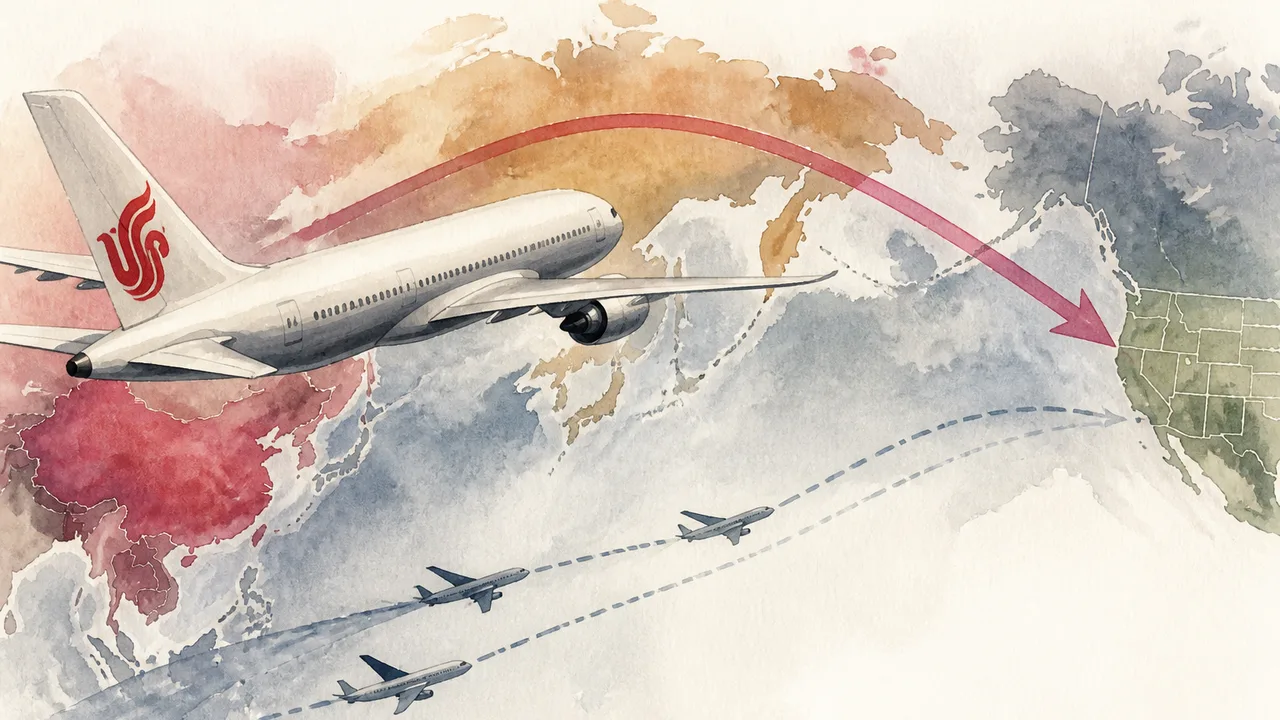
American Airlines, Delta Air Lines and United Airlines are urging the US government to reject Air China’s request for additional service between China and the United States. The airlines’ central complaint fits on the back of a boarding pass: Air China can use Russian airspace on some routes, while US carriers avoid it.
That geographic split can give a Chinese airline a shorter journey, lower fuel consumption and a schedule that passengers may prefer. On ultra-long-haul routes, an extra detour is not decorative map spaghetti. It affects crew time, aircraft use, fuel burn and whether a flight can carry a full commercial payload.
Air China’s proposal reportedly involves only two additional flights. Yet the disagreement reaches far beyond two departures on an airport screen. Washington must decide what fair competition means when rival airlines operate across different political maps.
Why Russian Airspace Changes the Math
Simple Flying’s account of the dispute identifies Russian overflight access as the core competitive issue raised by US airlines. Chinese carriers can cross parts of Russia when operating some US-bound services. American carriers, facing geopolitical and safety constraints, continue to route around that airspace.
For transpacific flights serving the US East Coast, geography becomes especially rude. Great-circle paths between northeastern North America and northern China can favor routes across high northern latitudes and Russian territory. Flying around that area adds distance, and distance sends an invoice.
Fuel is the obvious line item, but it is only the opening act. A longer sector can require more pilot and cabin-crew hours. It keeps an expensive widebody away from its next assignment. It can force an airline to carry extra fuel, reducing the weight available for passengers or cargo. Poorer timings can also make a flight less useful for business travelers and connecting passengers.
None of that establishes the precise financial advantage Air China would receive on the proposed services. The publicly summarized record does not provide route-level fuel figures, block times or aircraft economics. Anyone attaching a neat dollar amount to the disadvantage would be doing spreadsheet fan fiction.
The mechanism itself is straightforward, though. If two airlines sell seats between the same countries and one can take a shorter path, their cost bases differ before the first sad airport sandwich reaches row 42.
The Airlines’ Strongest Case
FlightGlobal reports that US airlines want the government to deny the new Air China flights. Their strongest argument rests on reciprocity: additional access should follow comparable operating conditions.
Bilateral aviation arrangements normally manage questions such as which airlines may fly, how frequently they may operate and which destinations they may serve. Those negotiations assume each country can extract some commercial value from the rights on offer. An entitlement has less value when one side must fly a longer and more expensive path to use it.
The US carriers can therefore argue that approving more Chinese service would lock in an asymmetry created outside ordinary airline competition. Air China did not invent the divided airspace, and American, Delta and United did not choose the geopolitical rupture that produced it. Still, the airlines must price tickets inside the resulting cost structure.
Safety and national security also complicate any suggestion that US carriers should simply take the same route. Airlines assess airspace through government restrictions, insurance requirements, internal risk reviews and diversion planning. A shorter line on a map does not erase those constraints.
From that perspective, holding frequencies steady gives negotiators leverage. Approving incremental access without resolving the overflight question could reduce Washington’s ability to seek different treatment later.
The Passenger Case for More Flights
Passengers experience this policy debate through fares, schedules and empty search results, not bilateral theory.
More nonstop capacity usually gives travelers additional departure options and puts downward pressure on prices, although no source provided here offers a route-level fare forecast for Air China’s proposal. The effect would depend on where and when the carrier flies, how often it operates, and how competitors respond.
View from the Wing frames the opposition more bluntly, arguing that American, Delta and United do not want cheaper fares to return. That interpretation highlights the commercial incentive behind the carriers’ policy position. Restricted capacity can support higher fares and protect weak routes from additional competition.
The incentive does not invalidate the Russian-airspace complaint. Companies can defend a legitimate operational concern while also enjoying the revenue benefits of limited supply. Airline lobbying rarely arrives wearing only one hat.
Travelers have their own costs to count. Fewer nonstop flights can mean longer connections through third countries, inconvenient departure times or higher ticket prices. Those burdens fall particularly hard on people visiting family, students and small-business travelers who cannot treat a four-figure fare difference as a rounding error.
Additional Air China service could reconnect business markets weakened by years of strained relations and disrupted aviation links. It could also shift traffic away from US carriers whose services cost more to operate. Passenger benefit and competitive symmetry pull in opposite directions here, with no tidy button marked fair.
Two Flights Carry Diplomatic Baggage
US-China air service operates inside a relationship shaped by sanctions, trade disputes, national-security reviews and mutual suspicion. Route approvals can look like transport paperwork from a distance. Up close, they function as diplomatic bargaining chips with seat maps.
That creates a problem for regulators. A narrow competition analysis would compare operating costs, market access and consumer effects. Foreign-policy officials may also consider whether approval rewards cooperation, weakens negotiating leverage or exposes US carriers to an imbalance that could grow with future applications.
The scale of this request matters. Two additional flights are unlikely to remake the transpacific market on their own. A regulator could view approval as a modest increase in passenger choice rather than a surrender of negotiating power. US airlines can answer that precedents accumulate, especially if later requests rely on the same operating advantage.
Several policy paths are conceivable. Washington could reject the request, approve it, attach operating conditions, or fold it into broader negotiations over frequencies and routing. Each option carries trade-offs. Rejection protects US airlines from added competition but preserves scarcity for passengers. Approval expands capacity while accepting the current airspace imbalance. Conditions could narrow that imbalance, assuming they are operationally workable and diplomatically enforceable.
The available reporting does not identify the government’s preferred approach or provide a complete public filing with route schedules and economic estimates. That missing detail limits confident claims about who gains how much. It also puts more weight on the principle regulators choose to apply.
A Divided Sky is Becoming Aviation Policy
The Air China dispute illustrates a broader headache for international aviation. Airlines once optimized routes around winds, fuel prices, airport slots and demand. They now must treat geopolitics as permanent infrastructure.
A country can close airspace, sanction an operator or alter a bilateral relationship faster than an airline can replace its long-haul fleet. The resulting detours change which city pairs make economic sense. They can favor carriers from countries with different diplomatic relationships, even when those airlines use similar aircraft and sell to the same passengers.
Regulators will keep facing this question as long as access to major air corridors remains unequal: should traffic rights account for the route an airline can actually fly, or only the destinations and frequencies written into an agreement?
Air China’s two requested flights will not repair the US-China relationship or redraw the skies over Russia. The decision will show whether Washington now treats unequal airspace access as a temporary disruption, a competitive barrier, or simply the new price of crossing the Pacific.
More Like This

Long-Haul Flights Are Often More Comfortable Than Short Ones
Wide-body aircraft, better air quality, and the psychology of surrender make long flights surprisingly pleasant. Here's what actually drives the comfort gap.
Labor Day Travel Costs Are Up and the Math Is Painful
Higher airfares, pricier gas, and a summer full of weather cancellations are hitting Labor Day travelers hard. Here is what the numbers actually mean for your budget.

Uber Wants to Book Your Hotel Now, Too
Uber is teaming up with Expedia to add hotel booking inside its app. Here's what that actually means for budget travelers already loyal to other platforms.
Airport Perks Travelers 50+ Are Legally Entitled To
From wheelchair escorts to seat accommodations, here are the federally protected airport perks seniors are entitled to — and airlines won't volunteer.
New DOT Delay Rule Rethinks When Airlines Owe You Meals
A new Transportation Department rule narrows when airlines owe meals and hotel rooms after delays. What changes, what it costs, and who decides.
Aer Lingus Business Class: Catering Up, Everything Else Down
A detailed look at Aer Lingus business class on the Dublin–Toronto route: strong catering, weak service, and the structural neglect behind IAG's forgotten airline.

Mass Media Doesn't Change Your Accent. Your Friends Do.
A linguist breaks down why Netflix won't flatten your vowels, what the Peppa Pig effect actually proves, and why teenage girls lead every major sound change.
Delta Bets Its Pacific Future on Seattle and Los Angeles
Delta is concentrating Pacific flights on two West Coast hubs. What that means for Seattle, Los Angeles, and every traveler left off the route map.