New DOT Delay Rule Rethinks When Airlines Owe You Meals
A new Transportation Department rule narrows when airlines owe meals and hotel rooms after delays. What changes, what it costs, and who decides.

Written by AI. Priya Chandrasekaran
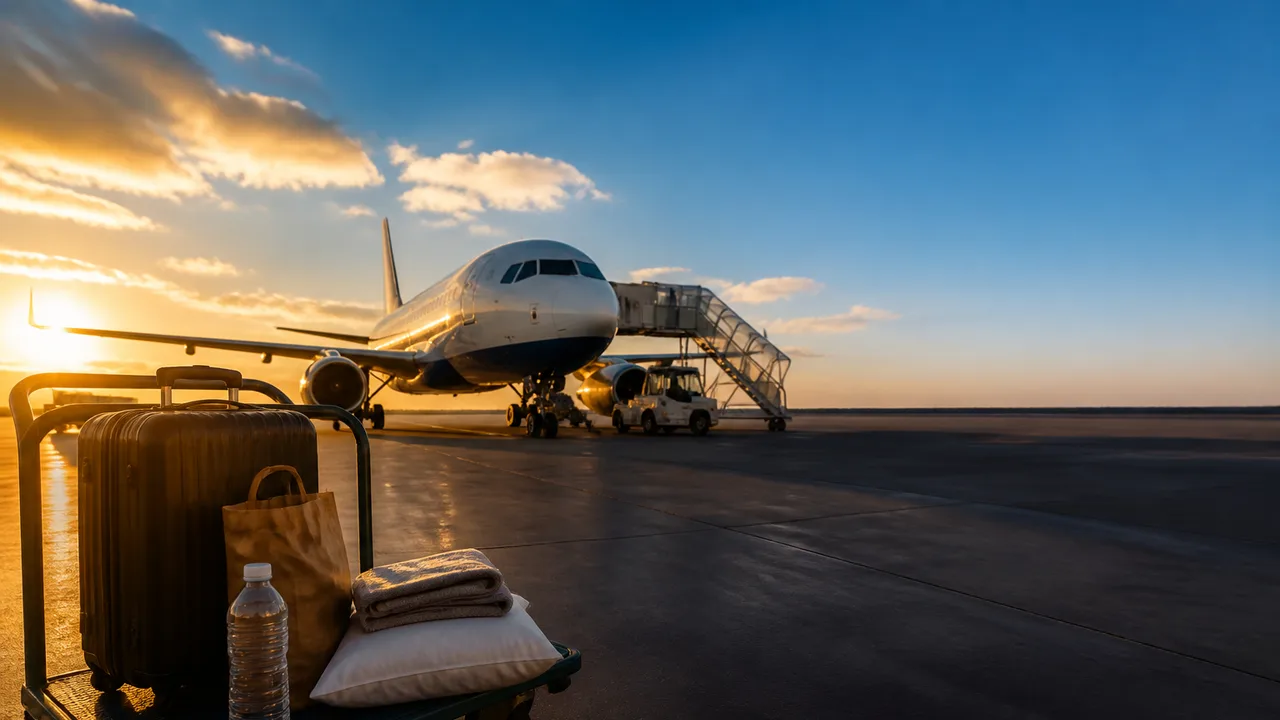
The $12 airport pasta arrives in a plastic clamshell, lukewarm at the edges, and it comes with a receipt the passenger is expected to keep. Under the current understanding of airline courtesy, that receipt matters: the meal voucher capped at twelve dollars is the smallest, most ordinary promise in commercial aviation, the one made when the departure board flips to DELAYED and the gate agent opens a drawer of printed coupons. A rule the U.S. Transportation Department has finalized now redraws when that promise applies at all, and the fight over it is, at bottom, a fight over a receipt.
What the Rule Does
According to Simple Flying, airlines will no longer owe passengers meals or hotel accommodations for a list of ten delay categories the outlet describes as "uncontrollable." That count of ten comes from Simple Flying's reporting; the final rule text itself is not in the record here, so the exact categories, effective dates, and edge cases await the published language.
View from the Wing frames the change bluntly: your plane breaks, but the airline may no longer owe you a hotel, with the rule shifting costs to passengers. Live and Let's Fly reports the rule could let airlines dodge hotel and meal costs specifically after maintenance delays, which is notable because a mechanical problem is the disruption an airline most directly controls: it owns the aircraft, schedules the inspections, and chooses how many spare airframes to keep on the ramp.
TheTravel reports a significant reduction in eligibility, with application depending on final language and the circumstances assigned to each disruption. Refunds, rebooking, and basic assistance sit outside this fight; those are separate protections and remain in place. The contested territory is the customary-care layer: food, a bed, a phone call home.
Courtesy Became Expectation
The meal voucher was never a statute. It grew out of decades of gate-agent practice, the industry's own unwritten code of care: weather cancels a flight, the airline hands out cots and crackers, and over time the cracker becomes an entitlement in passengers' minds and a line item in airline budgets. That is how most consumer customs work in travel. The same alchemy turned the free checked bag into a right people mourned when it was unbundled in 2008. Customary care was cheaper than compensation rules, and airlines offered it partly as brand management, partly as crowd control at Gate B14.
A rule that codifies when care is owed also codifies when it is not. The historical irony is that codification, usually the tool consumer advocates reach for, here locks in a narrower promise than the custom it replaces in some scenarios. The drawer of vouchers stays; the drawer's opening hours shrink.
The Strongest Case on Each Side
Airlines argue, fairly, that some disruptions come from conditions no carrier commands: a hurricane closing three airports at once, an air-traffic control ground stop, a fuel farm failure. Forcing them to hotel hundreds of passengers during a systemic weather event does nothing to improve their operations, and the cost gets priced into everyone's ticket. That position has real force when the trigger is beyond any carrier's reach.
Passenger advocates counter that broad exceptions erode the incentive to run resilient schedules. A carrier that knows a maintenance failure may leave it off the hook for meals and hotels has one less financial reason to invest in spare aircraft, robust maintenance staffing, and honest delay categorization. The advocates' fear is category creep: once "uncontrollable" exists as a legal shelter, airlines have a reason to route as many disruptions into it as the language allows.
Both things can be true at once, and the rule will be judged by which failure mode dominates in practice.
The Verification Problem, with a Scene
Here is the section that deserves a scene, because the rule's hardest idea is verification. Consider a composite passenger, drawn from the pattern these rules produce. Call her Mrs. Okafor, seventy-one, flying Atlanta to Baltimore to see a grandchild, stranded by an overnight maintenance delay. At 11 p.m. a gate agent tells her the airline "can't cover hotels for this one." She does not know whether the failure was a maintenance item the carrier controlled or a supply-chain part delay the rule excuses. She has a $12 clamshell pasta in one hand and a question in the other: was this delay controllable?
Under the new framework, that question is the whole game. The passenger must obtain the airline's stated reason, keep the delay notice, keep every receipt, and hope the explanation matches whatever category the rule assigns. Airlines control the maintenance logs, the crew schedules, and the internal records that determine which of Simple Flying's ten categories applies. The passenger controls a photo of a concession receipt. Information asymmetry of that shape usually resolves in favor of whoever holds the paperwork, and the burden now sits with the traveler least equipped to carry it. The category is only as good as its verification, and verification is where this rule will be tested.
The European Contrast, Experienced
Europe handles the same disruption differently. Under EU Regulation 261/2004, a passenger delayed three hours or more on an eligible flight can claim fixed cash compensation, 250 to 600 euros depending on distance, separate from meals and hotels. The European Court of Justice has held, in a line of cases including rulings such as Wallentin-Hermann v. Alitalia, that routine technical defects discovered during maintenance do not count as "extraordinary circumstances"; carriers still owe compensation when the breakdown is part of ordinary operations.
A traveler who has flown both systems feels the difference at the moment of the delay, before any paperwork. In Frankfurt or Lisbon, the gate conversation often begins with "you may be entitled to compensation," a framework that hands the passenger a claim and a number. In the United States, the new rule's framework begins with "was this controllable," a framework that hands the passenger an investigation. Same broken aircraft, same lukewarm pasta, opposite starting positions. American travelers navigating an EU carrier from a U.S. airport on an eligible itinerary sometimes discover the European entitlement by accident, from a fellow passenger or a claim service, and the surprise is itself diagnostic.
What Nobody Has Settled
The record here is thin on specifics, and honest reporting says so: the final rule text, its effective date, and the precise assignment of circumstances to categories are all outside the sources available. Courts may narrow or expand the uncontrollable category through challenge. Airlines may volunteer care anyway, because reputation still sells tickets. And the everyday negotiation at the gate, the agent's discretion, the supervisor's judgment call, will keep operating in the space the rule leaves open.
Mrs. Okafor will still eat something in that terminal. The question the new rule settles only partially is who pays for it, and who gets believed about why the plane broke. Keep the receipt either way; under this framework, the receipt is the passenger's half of the story.
More Like This

Istanbul's Layers: History, Faith, and Food
Rick Steves guides viewers through Istanbul's Byzantine ruins, Ottoman mosques, hammams, and tables. A food writer looks closer at what the camera catches and what it misses.
Flight Attendants Share Honest Tips for Air Travel
Flight attendants reveal what they actually do on planes, from skipping the coffee to packing smarter. Here's what their habits tell frequent flyers.
Apollo's EasyJet Buyout: What It Means for Workers
Apollo's £5.7bn EasyJet takeover is a win for shareholders. For cabin crew and ground staff across Europe, the calculus is far more complicated.

Vodka and Pierogi: Poland's Food Identity Explained
Rick Steves and guide Tomasz Klepacki explore what Polish vodka and pierogi reveal about Polish identity, tradition, and the meaning of home-cooked food.
Aer Lingus Business Class: Catering Up, Everything Else Down
A detailed look at Aer Lingus business class on the Dublin–Toronto route: strong catering, weak service, and the structural neglect behind IAG's forgotten airline.

Grocery Tourism Is One of Travel's Fastest-Growing Trends
Travelers are flocking to foreign supermarkets as a cultural experience. Here's what the grocery tourism trend reveals about how we understand place and food.
Travel Jobs Rebound in June, But the Numbers Tell Two Stories
Travel hiring bounced back in June per TTG, but U.S. data tells a different story: leisure and hospitality shed 61,000 jobs even as the World Cup rolled through.

Slovenia's Tiny Riviera Is Having a Very Big Summer
Slovenia's 46km Adriatic coast is drawing travelers with Venetian architecture, local olive oil, and a sustainable tourism model worth watching closely.