UK Wildfires Leave Habitats Facing Centuries of Recovery
From Welsh peatlands to Suffolk heathland, recent UK wildfires have set back ecosystems by decades or centuries. Here's what recovery actually looks like.

Written by AI. Olivia Meng
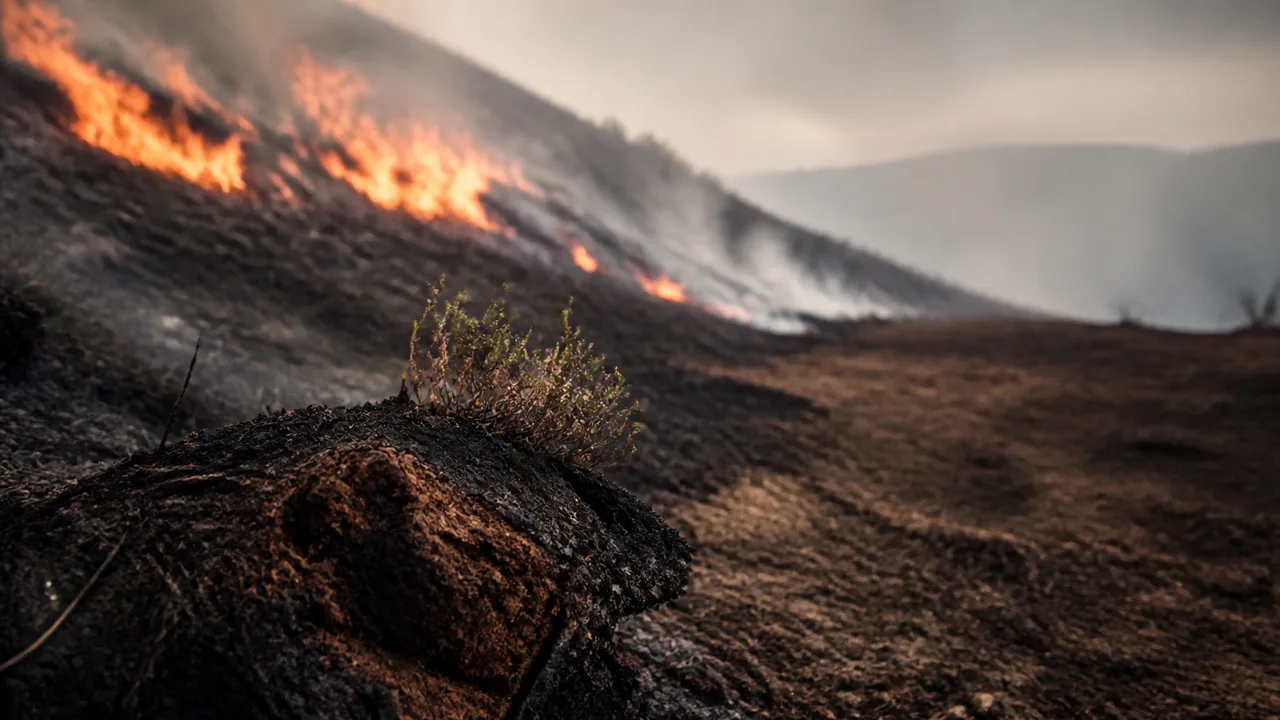
Peat grows at roughly one millimetre a year. Let that settle for a moment before considering what it means that recent wildfires have incinerated centimetres — sometimes much more — of it across upland Wales.
Nick Thomas of Natural Resources Wales put the timeline plainly: if peat-rich soils have been burned through, the vegetation they support could take centuries to return. Not decades. Centuries. BBC News reported his assessment in the context of a wave of Welsh wildfires that has alarmed conservationists, and the word "centuries" has a way of stopping a reader cold — which is, perhaps, exactly the point Thomas was making.
This is not alarmism. It is arithmetic.
What burns and what doesn't come back quickly
The nature of habitat loss after fire depends almost entirely on what was there before the flames arrived. Heathland and upland peat bog are not forest. They are not built on deep, resilient mineral soil that can anchor new growth within a growing season or two. Peat is effectively ancient, compressed, waterlogged organic matter — a slow-motion carbon archive that took thousands of years to accumulate. When it burns hot enough to incinerate rather than merely scorch, the substrate itself is gone. There is no root system waiting underground, no seed bank preserved in cooler soil layers. You are starting from biological zero.
At Dunwich Heath in Suffolk — a nationally significant lowland heathland managed by the National Trust — a major fire prompted a public fundraising campaign that raised £350,000 in just four days, according to BBC News. That level of public response reflects genuine public attachment to the site, and with good reason: heathland like Dunwich supports species that have nowhere else to go. Experts cited in a separate BBC report on the Dunwich Heath fire put the recovery timeline at up to 25 years — and that is for lowland heathland with active management and intervention. The Welsh uplands, where peat depth and geographic remoteness make restoration dramatically harder, operate on a different order of magnitude entirely.
The distinction matters because it reveals something about how wildfire damage compounds. A heathland that takes 25 years to recover is, in management terms, a serious crisis. A peatland that takes centuries is something closer to a permanent loss within any planning horizon that human institutions are actually capable of holding.
The pollutant layer that lingers
Combustion doesn't only consume habitat. It produces a chemical signature that settles across the surrounding landscape long after the fire is extinguished. According to Plantd, wildfire pollutants reduce sunlight availability, alter plant growth patterns, and impose sustained stress on already fragile ecosystems. The fire event itself may last hours or days; its atmospheric footprint can persist for weeks and its soil-chemistry effects for years.
This matters most for the species living at the margins of what their habitat can support. Not every animal or plant in a heathland or bog is at risk because fire physically occupies its home range. Many are at risk because the web of conditions sustaining them — the microclimate, the specific vegetation structure, the invertebrate prey base — unravels in stages after the fire has moved on. Ecology is relational. Disrupt one layer and the layers that depend on it don't automatically stabilise.
A context of escalating fire
The Welsh and Suffolk fires are not anomalies in a stable baseline. The UC Davis Environmental Health Sciences Center has documented that wildfires have dramatically increased in number, size, and duration over recent decades globally — a trend they trace across ecosystems from the Siberian taiga to the Australian bush. The framing is worth holding loosely: wildfire trend data varies by region and measurement method, and some of that variation is contested in the literature. But the broad directional signal — more fire, burning hotter, in places that historically saw little — is consistent with what climate projections have long anticipated as warming increases drought frequency and extends fire-weather seasons.
The World Resources Institute notes that natural forest recovery after wildfire can take decades to centuries, and that active interventions — tree planting, soil stabilisation, controlled reseeding — can accelerate that timeline, but only where the baseline ecological conditions still exist to support them. Where fire has been hot enough, or repeated frequently enough, to fundamentally alter soil chemistry or eliminate seed sources, even well-resourced restoration efforts face hard limits.
That is the part of the recovery conversation that often gets lost in the immediate aftermath of a fire. The question is not just "how long will this take?" but "what are we trying to restore it to, and does that reference state still exist anywhere nearby?"
The slow-motion policy problem
There is a gap — uncomfortable and worth naming — between the timescales on which these ecosystems operate and the timescales on which political and institutional decision-making tends to function. A parliamentary term is five years. A funding cycle for conservation grants is typically three to seven. A peat bog recovering from incineration is operating on a 200-year clock.
Fire management policy in the UK has historically emphasised suppression: get the fire out, assess the damage, move on. The emerging argument from ecologists is that this framing is insufficient — that in fire-prone upland and heathland environments, managed burning regimes and preventive vegetation management might reduce the severity of the uncontrolled fires that cause irreversible damage. This is genuinely contested ground. Managed burning on peatland, in particular, has been the subject of sustained scientific debate, with researchers divided on whether low-intensity rotational burns protect against catastrophic fire or simply add cumulative stress to ecosystems already under pressure from drainage and climate shifts.
What is less contested is that doing nothing — or rather, continuing with suppression-only approaches while the fire-weather window lengthens — will produce more events like Dunwich and the Welsh uplands. The question of what to do is harder than the question of whether action is needed.
Recovery as a multi-generational commitment
The £350,000 raised for Dunwich Heath reflects something real about public appetite for ecological restoration. But money, while necessary, runs up against biology. You cannot buy faster peat growth. You cannot shortcut the 15-to-20-year process by which lowland heathland re-establishes the vegetation structure that specialist species require. What restoration funding buys is active management, monitoring, the removal of invasive species that colonise disturbed ground before native species can re-establish, and the labour of people who understand these systems well enough to read what the land is doing.
The World Resources Institute's analysis of wildfire recovery draws a useful distinction between areas where natural regeneration is possible and areas where it is not. In the latter category, human intervention is not optional — it is the only pathway back. And even then, the endpoint is not guaranteed.
What the Welsh peatland fires and Dunwich Heath share — beyond the immediate spectacle of burning — is that they represent the loss of ecological time. Not just the current state of these places, but the accumulated biological history embedded in them: centuries of carbon storage, of species adaptation, of habitat complexity that cannot be reconstructed from a planting plan.
Whether the institutions responsible for managing Britain's uplands and heathlands can develop fire strategies that operate on anything like the timescale these ecosystems require is, at this point, an open question. One millimetre of peat per year does not wait for funding reviews.
More Like This

Rethinking Cosmic Acceleration: A Local Illusion?
Exploring the debate on whether the universe's acceleration is a local phenomenon, challenging the concept of dark energy.
How the Asteroid Impact Ended the Dinosaur Era
Explore the catastrophic asteroid impact that ended the dinosaurs, its immediate aftermath, and the long-term environmental changes.
What the Dinosaur Asteroid Actually Did to Earth
New research reframes the Chicxulub impact—not just as a mass extinction event, but as a creative force that may have built the Amazon rainforest.

Subcritical Reactors: Nuclear Power's Safety Fix?
A new generation of subcritical reactors promises to make nuclear meltdowns physically impossible. But can they deliver on cost, scale, and timeline?

The WWII Flying Boat Still Fighting Wildfires Today
The Martin Mars water bomber—a WWII relic with a 60m wingspan—is fighting Mexico's worst wildfires in 30 years. Here's how it actually works.

Understanding the Real Risk of Brain-Eating Amoebas
Explore the facts and myths surrounding brain-eating amoebas. How real is the threat, and can climate change affect its spread?
Event Horizons Form Before Black Holes Do
A new PBS Space Time episode reframes event horizons as causal verdicts written by the future — not boundaries drawn by the present. The implications run deep.

Spielberg's Disclosure Day and the Politics of Withheld Truth
Spielberg's new film Disclosure Day frames UAP secrecy as epistemic injustice. A climate reporter finds the argument uncomfortably familiar.