Tungsten: Why the World's Most Extreme Metal Resists Us
Tungsten has the highest melting point of any metal and near-unworkable properties. Here's what makes it essential—and nearly impossible to manufacture.

Written by AI. Amelia Nwofor
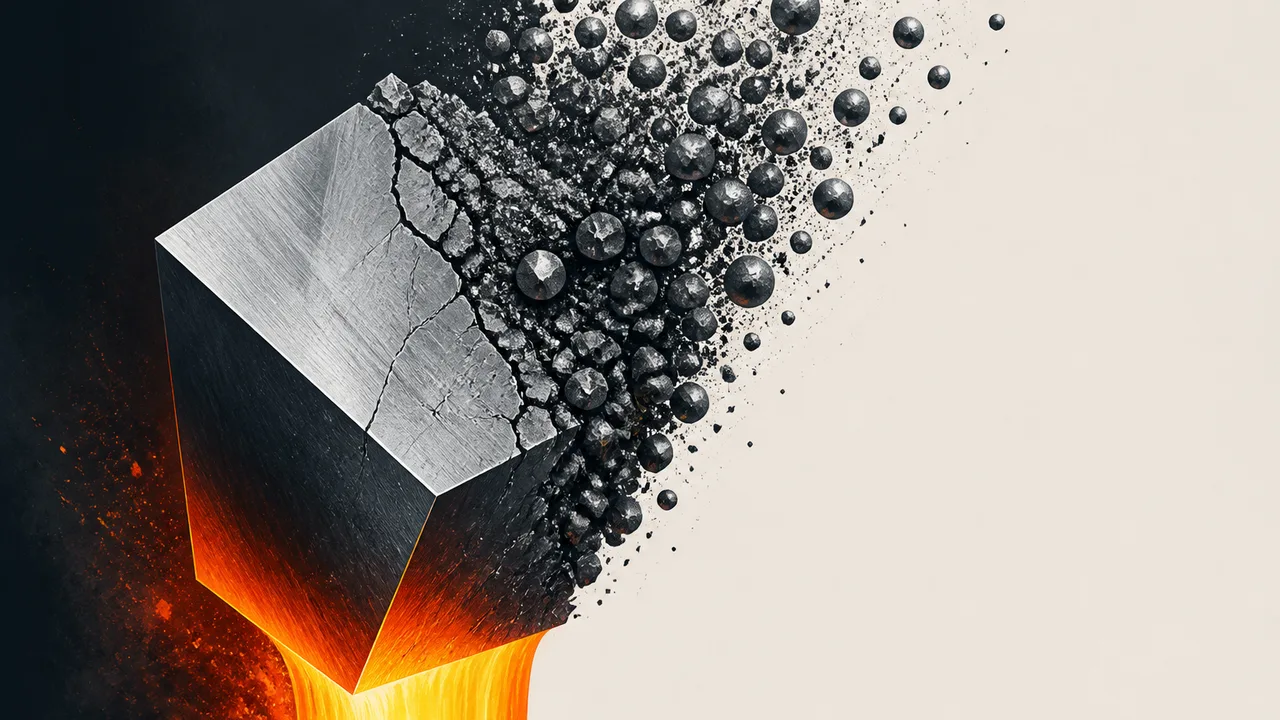
Photo: AI. Mika Sørensen
Pick up a tungsten cube—a small one, desk-ornament sized—and something in your brain misfires. The weight-to-volume ratio doesn't compute. You keep recalibrating, expecting it to feel hollow, waiting for the trick. There is no trick. That's just tungsten being tungsten: almost twice as dense as lead, harder than almost anything, and completely indifferent to your expectations.
The Unexpected History's recent short documentary on tungsten uses that sensory dissonance as its entry point, and it's an effective one. But the more interesting story isn't how tungsten feels in your hand. It's why getting it into your hand in the first place requires a manufacturing process that reads less like metalworking and more like an industrial hostage negotiation.
Built for extremes it barely tolerates
Tungsten holds the record for the highest melting point of any metal: 3,422°C. For context, that's nearly twice the melting point of steel. The number is extraordinary on its own terms—no solar-system comparisons needed.
That thermal ceiling is the product of tungsten's atomic structure. Its electrons are bound exceptionally tightly, and the metallic bonds between atoms are among the strongest in any element. This is what makes tungsten stable in conditions that destroy most other materials, and what makes it irreplaceable in applications where temperature is the governing constraint.
There's a distinction worth making clearly here, because it tends to get muddied: tungsten carbide—tungsten bonded with carbon—achieves a hardness of roughly 9 to 9.5 on the Mohs scale, placing it just below diamond. Pure elemental tungsten is genuinely hard, but it's the carbide form that earns the near-diamond comparison. The two are different materials with different properties, and conflating them obscures what's actually interesting about each. Tungsten carbide is in your drill bits and cutting tools. Elemental tungsten is in your light bulb filament and your welding electrode. The distinction matters.
The brittleness problem nobody headlines
Here's the tension the density-and-hardness narrative tends to skip over: at room temperature, tungsten is brittle. Not "harder to bend than steel" brittle—genuinely, ceramics-grade brittle. This is the property that makes tungsten so counterintuitive as an engineering material.
Most metals are ductile. They deform plastically before they fail—bending, warping, giving you some warning. Tungsten, at room temperature, doesn't do that. Apply enough stress and it fractures. This brittleness is a direct consequence of the same tight atomic bonding that gives tungsten its thermal resistance. You can't have one without the other; the physics doesn't offer a menu.
The Unexpected History describes the machining consequence directly: apply too much heat or pressure during a cut, and the part simply cracks. No deformation, no second chance. For precision components—the kind used in aerospace, medical imaging, or semiconductor manufacturing—that failure mode is not recoverable. The part is gone.
This is the real engineering challenge with tungsten, and it's more interesting than the hardness. Engineers aren't just fighting a material that's hard to cut. They're fighting a material that will punish any procedural error with total, irreversible failure.
Why you can't just melt it
Every conventional metal manufacturing workflow starts with the same assumption: you can heat the metal to liquid, shape it, and let it solidify. Tungsten's 3,422°C melting point puts that assumption out of reach for most industrial furnaces. But the melting point isn't even the primary barrier. The deeper problem is reactivity.
At the temperatures required to liquefy tungsten, the metal becomes aggressively reactive with atmospheric oxygen and nitrogen. Liquid tungsten will absorb both, and the result is a brittle, contaminated material—which is the opposite of what you needed. Casting tungsten isn't just impractical; it actively produces worse tungsten.
So engineers developed powder metallurgy, which The Unexpected History describes, accurately, as a process that "sounds less like metalworking and more like baking." It's a fair characterization.
The process begins with ore—wolframite or scheelite—which is crushed, chemically processed, and reduced using hydrogen gas into ultra-fine tungsten powder. That powder then gets pressed into a mold under pressures sometimes reaching tens of thousands of pounds per square inch, forming what's called a green compact: a shape that holds together but remains fragile, with roughly the structural integrity of compressed chalk.
The green compact then goes into a high-temperature furnace—around 2,000 to 2,500°C—in a carefully controlled atmosphere. At sintering temperatures, the particles don't melt. Instead, atoms migrate across particle boundaries through a process called atomic diffusion, fusing the powder into a dense, solid mass. What emerges is a real tungsten component.
And then the machining starts, which is where the process earns its reputation. Conventional cutting tools fail on contact with sintered tungsten. Diamond-coated tooling is required. Feed rates are kept deliberately slow. Coolant runs continuously. A cut that takes seconds in aluminum takes minutes in tungsten and destroys tooling worth hundreds of dollars in the process. The margin for error is essentially zero—too much heat or pressure and the part cracks.
The productive tension at the center of materials science
Every material property exists in a system. Tungsten's thermal stability and its room-temperature brittleness are both products of the same underlying atomic structure. You cannot engineer away the brittleness without also degrading the properties that make the material worth using. This is the fundamental trade-off that governs extreme materials, and it's why tungsten occupies such a specific, irreplaceable niche rather than displacing everything else.
This trade-off also explains why powder metallurgy exists at all. It's not a workaround for an inconvenient material—it's the only manufacturing pathway that respects what tungsten actually is. You can't force tungsten to behave like steel. The process has to conform to the material, not the other way around.
That's a useful principle beyond tungsten. Materials science is full of situations where the property that makes something extraordinary also makes it difficult or dangerous or expensive to use. The interesting question is never "why can't we have all the good properties without the bad ones?" The interesting question is what we're willing to pay, in process complexity and manufacturing cost, to access the good ones.
Where the cost becomes worth it
Tungsten's applications cluster around a common logic: conditions where alternatives simply fail. That's the frame, and it connects what would otherwise read like an unrelated list.
Tungsten filaments sustained the incandescent bulb for over a century—nothing else could survive the operating temperatures without burning out or deforming. Tungsten electrodes are in the welding torches that fabricate structural steel; the electrode needs to conduct enormous current without melting. Tungsten shielding protects against radiation in hospitals and nuclear facilities, because its density stops ionizing radiation more effectively per unit volume than any practical alternative.
And then there's the military application, which deserves its own sentence: tungsten penetrators—long, dense rods fired at high velocity—can defeat tank armor through mass and hardness alone, without explosives. The physics is straightforward; the implications are not.
The cost of precision tungsten components, even small ones, is substantial. That cost is a direct accounting of the powder metallurgy process, the diamond tooling, the controlled-atmosphere furnaces, and the irreplaceable parts lost to machining error. None of that cost is waste. It's the price of access to a material that does things nothing else can do.
The cube on the desk doesn't look like it should cost what it costs. But that's because the work happened before it got there—and the process that made it is, by any fair measure, more impressive than the material itself.
More Like This
The Deeper Geometry Behind the Pythagorean Theorem
Explore why the Pythagorean Theorem appears in unexpected places, from geometry to relativity.
Mountain Pass Mine and the U.S. Rare Earth Supply Gap
The Mountain Pass mine once supplied 70–80% of global rare earths. Here's how the U.S. surrendered that dominance—and what it actually takes to rebuild it.
IBM NanoStack and the Future of Chip Architecture
IBM's NanoStack stacks transistors from separate wafers using atomic bonding. The physics works. The harder question is whether anyone can manufacture it at scale.

Why Light Beams Seem to End: Physics Explained
Discover why searchlight beams appear to stop and how physics and atmospheric conditions contribute to this phenomenon.
Hacking a Ball Bearing for Precision on a Budget
A father-son engineering duo modified a standard ball bearing with a grinder to achieve wobble-free precision — no expensive parts required.

Donald Hoffman: Evolution Hid Reality From Us
Cognitive scientist Donald Hoffman argues on StarTalk that evolution gave us a VR headset, not a window—and the math behind Darwin backs him up.

Gravity's Strangest Effects, From Time to Cosmic Voids
From gravitational time dilation to the Dipole Repeller and LIGO's detections, here's what gravity actually does—and what it still can't explain.

JWST's Little Red Dots May Be Cocooned Black Holes
New JWST spectral data on a single "little red dot" galaxy offers the strongest case yet that they're supermassive black holes wrapped in dense gas cocoons.