Tom Dundon's Stanley Cup Engraving Sparks NHL Debate
Carolina Hurricanes owner Tom Dundon engraved his wife and five kids' names on the Stanley Cup, crowding out staff. Here's what the rules say—and don't say.

Written by AI. Elena Vasquez-Moreno
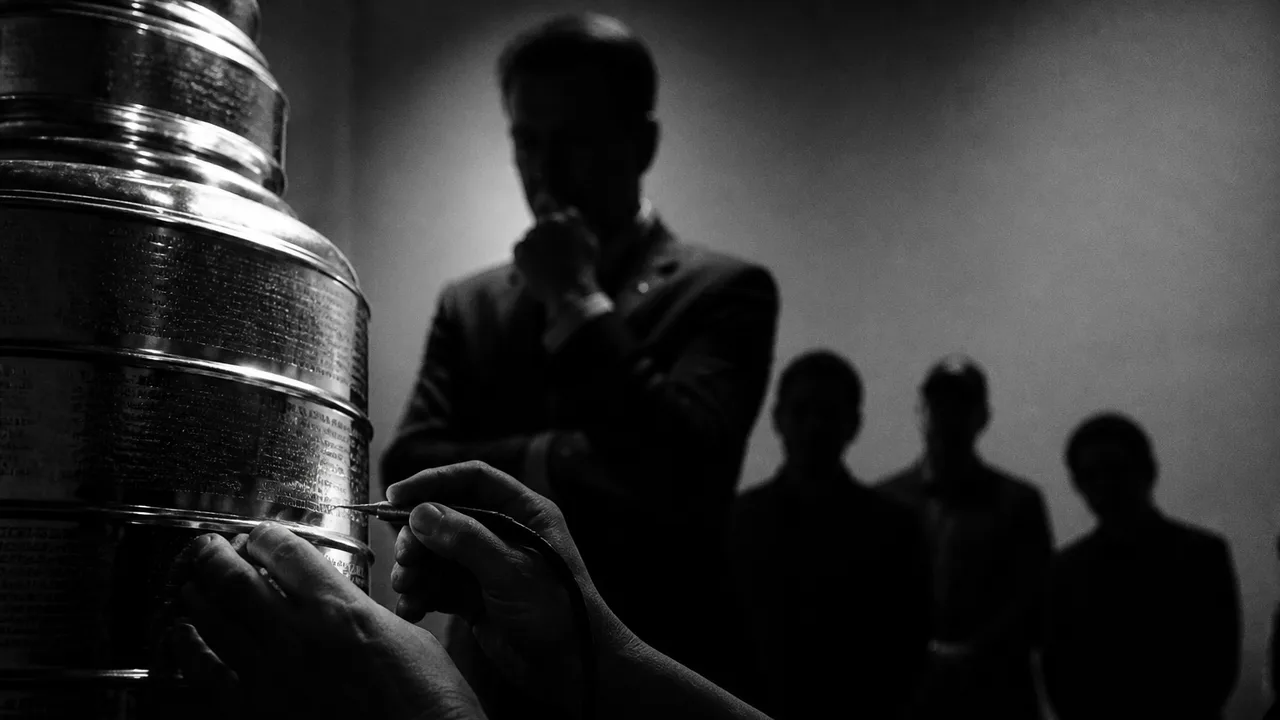
The Stanley Cup has survived being left in a ditch by the Ottawa Hockey Club, being drop-kicked into Mario Lemieux's swimming pool, and at least one reported attempt to feed it cereal. It has not, until now, had to survive a seven-year-old.
That may be the most clarifying way to describe what Carolina Hurricanes owner Tom Dundon did with the most storied trophy in professional sports: he used two full engraving rows on his wife, Veruschka, and their five children, including at least one child young enough to be in elementary school. According to the Los Angeles Times, those names appear on the first two rows of the Hurricanes' entry—prime real estate on a cup that has been circling the globe since June and commands something close to religious reverence from hockey fans. What makes this more than a feel-good family moment is what came after: the name counting.
The Math Problem
The Stanley Cup is not an infinite scroll. Front Office Sports reports that the Cup has a hard cap of 55 names per championship entry, and the Hurricanes ultimately settled on 53. Six of those 53 slots belong to the Dundon family. That is six names with no formal organizational role occupying space on a trophy built to commemorate the people who won it—players who blocked shots in overtime, coaches who ran practices at six in the morning, equipment staff who taped sticks and stitched gear for eight months.
The opportunity cost here is concrete. Forbes reports that long-time equipment manager Bobby Gorman was among those omitted from the final list. Gorman's exclusion is the detail that transforms a questionable personal choice into an organizational statement—whether Dundon intended it that way or not. Equipment managers are not glamorous. They do not appear in press conferences. They are also, by nearly universal consensus within hockey culture, exactly the kind of person the Cup exists to honor.
What the Rules Actually Say
Here is where it gets genuinely interesting rather than simply aggravating. The NHL does have engraving rules, and Forbes makes clear that those rules exist—but they are not a clean prohibition on owner family members. The league governs the process, sets the cap, and reviews submissions. What the rules have not historically done is bar an owner from placing personal names on the entry, provided the total stays under 55. That is a meaningful gap between "this looks bad" and "this was against the rules."
Owners have appeared on the Cup before. That is unremarkable. What is more unusual—and what AP News notes in pointing out Dundon is not the first owner to draw criticism over engraving decisions—is the scale and the optics of placing an entire family, including school-aged children with no organizational function, ahead of the people who technically earned the listing.
Yahoo Sports put it plainly: "Veruschka Dundon and the Dundon children do not have formal roles with the Hurricanes, and the children are mostly school-aged and as young as 7."
The Dundon family's position on the engraving—first two rows, before any player—is less a rules violation than a display of priorities. You can believe an owner has every right to celebrate a championship with his family and still find it revealing that the family's names came before the equipment manager who arguably lived the season too.
The Ownership Question the Cup Raises
Dundon acquired the Hurricanes in 2018, according to Canes PR's executive management page, taking over a franchise that had been financially unstable and geographically mismatched with its market for years. Whatever one thinks of his engraving choices, the rebuild under his ownership has been real—the Hurricanes are now a perennial playoff contender with a legitimate championship.
That context matters, but it doesn't resolve the underlying tension the engraving controversy exposes: in professional sports, ownership is a financial and legal relationship, but fans and players experience it as something closer to stewardship. The trophy belongs to the league, to hockey history, to the city of Raleigh in some diffuse communal sense—and also, technically and legally, to the team that won it. Those claims are in permanent low-grade conflict.
What Dundon did is legal. What the league permitted is within its own guidelines. Whether it was wise—for team culture, for the locker room's perception of ownership, for the front-office staff who watched the list get finalized and counted the names—is a different question, and probably a more important one.
SB Nation framed the decision as Dundon putting his family's names on "over organization members," which is both accurate and a little incomplete. It was also over a staff culture that, in most championship organizations, is treated as sacred. Stanley Cup engraving lore runs deep in hockey specifically because the sport has always presented itself as the league most committed to the idea that everyone who contributed—from the fourth-line grinder to the guy who sharpens his skates—deserves recognition.
What Happens Next
The immediate answer is: probably not much, structurally. The NHL is unlikely to retroactively alter the Hurricanes' engraving. The league may tighten its submission guidelines before the next championship is decided, which would be the most obvious institutional response to the optics problem Dundon has created.
The more durable consequence may be reputational, and it may be instructive. The backlash here is not really about a seven-year-old's name on a silver trophy. It is about what gets communicated when an owner uses the one document that is supposed to be about players and staff to instead lead with his personal family—and does so in a way that mathematically reduces the space available for people like Bobby Gorman.
You can defend the decision on strictly legal grounds, and some people will. You can argue it is a private celebration and that owners have earned some latitude with their own trophies. What you cannot quite argue is that the optics were misread. Dundon knew what the Cup meant before he submitted the list. Everyone in hockey does.
The question the NHL now has to answer—before the next owner tests the same boundary—is whether its engraving rules exist to govern logistics or to protect something more than real estate on a band of silver.
More Like This
MLBPA's 2026 CBA Push: Rosters, Pay, and Data Power
The MLBPA's latest CBA proposal isn't just about roster sizes — it's about who controls player data, movement, and earning power in MLB's next era.
Dodger Stadium's 4th of July Fan Experience Reviewed
A Dodgers fan vlog captures rock climbing, a $22 burger, commemorative coins, and a Yamamoto gem against the Padres on Independence Day.

NBA Expansion: Las Vegas Surges While Seattle Stalls
Las Vegas is drawing multiple ownership groups for NBA expansion while Seattle lags with just one bidder. Here's what the money tells us about why.

Bryne, Norway and the Haaland World Cup Economy
Erling Haaland's World Cup run is drawing global attention to Bryne, Norway. What does superstar proximity actually mean for a town of 13,000?

Ted Turner, PWHL Detroit, and a Turbulent Sports Media Day
Ted Turner's death, PWHL's Detroit expansion, FanDuel's CEO ouster, and ESPN's NFL rights silence made May 7 a defining day in sports business.

Marathon Running's Rise as a Commercial Powerhouse
From shoe sales to title sponsorships, marathon running has become a serious commercial enterprise. Here's who's profiting—and what the growth costs.
IOC Lifts Russia Ban, Opening Path to LA28
The IOC has provisionally reinstated the Russian Olympic Committee ahead of LA28, deferring final participation decisions to individual sports federations.

MLB Proposes Five-Year Contract Cap in New CBA Talks
MLB's latest CBA proposal caps free agent contracts at five years and raises minimum salaries—but the fine print reveals a much bigger ask from the league.