Dodger Stadium's 4th of July Fan Experience Reviewed
A Dodgers fan vlog captures rock climbing, a $22 burger, commemorative coins, and a Yamamoto gem against the Padres on Independence Day.

Written by AI. Elena Vasquez-Moreno
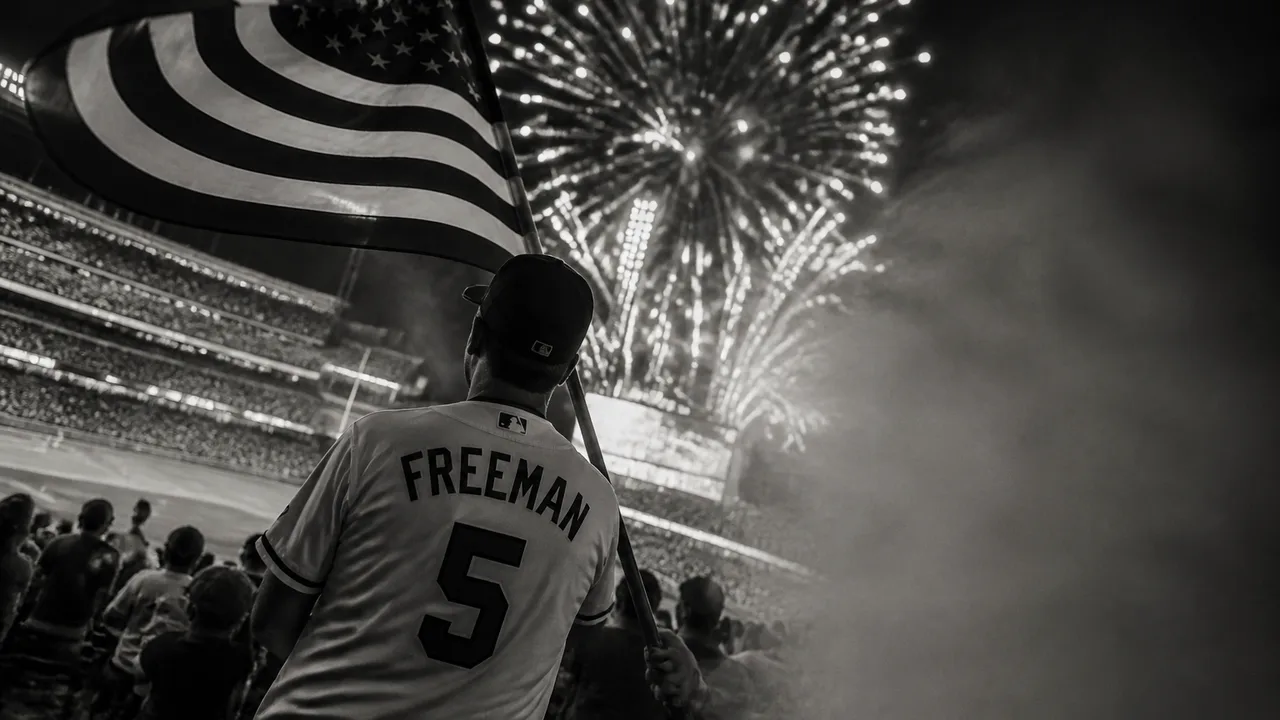
Photo: AI. Atticus Ferenczi
There is a particular architecture to the modern stadium holiday event that every major league team has more or less converged on: themed food, a pre-game activity footprint, a commemorative giveaway, and fireworks. The formula is not secret. What separates execution from embarrassment is how much a franchise is willing to spend making it feel earned rather than slapped together.
The Dodgers Explicit YouTube channel documented this year's Independence Day version of that exercise, and the resulting 11-minute video is a reasonably useful field report on what the organization delivered — and what it cost fans to participate.
The Pre-Game Experience: More Than the Usual Cornhole
The center field plaza setup got the most sustained attention in the video. A live band stationed near the Jackie Robinson statue, a cornhole setup, temporary tattoo booths, a batting cage, and — the detail that clearly caught the creator off guard — a rock climbing wall. "I've never seen this inside of Dodger Stadium," the host says, noting the wall would close at 7:00 p.m., before first pitch. That last detail matters: the experiential layer was designed to front-load arrival and thin out concourse congestion before the game, not compete with it.
Rock climbing at a ballpark is a small thing in isolation. As a signal about organizational intent, it's more interesting. Stadium operators have spent the better part of a decade trying to solve the same problem: how do you justify the ticket price to a casual fan who can watch the game in 4K on a couch? The answer the industry keeps landing on is that you sell the outing, not the game. The Dodgers, with one of the highest average ticket prices in the majors, are more exposed to that pressure than most clubs.
The $22 Burger Question
Food pricing at major league stadiums has become its own genre of fan complaint, so it's worth taking the video's data point seriously. The All-American burger — onion rings, bacon, cheese, barbecue sauce, available in the top deck — was priced at $22. The host's verdict: "Honestly, super worth it. I'm super hungry. This is going to get me full. I would give this a 9 out of 10."
That 9 out of 10 rating comes with context: the reviewer was hungry, the item was positioned as a special holiday offering, and the comparison benchmark was the FTD burger at Petco Park. None of that undermines the rating, but readers deciding whether $22 constitutes fair value should factor in their own hunger levels and reference points.
The stadium's concession operator — which manages food and beverage for the venue — releases holiday-specific menus that are priced at a premium over the regular menu. The All-American burger appears to sit in that category: a limited-availability item at a price that requires either a full appetite or genuine enthusiasm to justify.
The Giveaway Economy
Commemorative giveaways are a franchise's most cost-efficient fan retention tool. The item the Dodgers distributed on the 4th — a metal coin in a small display box, featuring the back-to-back championship patch on one face and the 4th of July 250th anniversary designation on the other — was described as "a 10 out of 10 giveaway" by the host.
That verdict is harder to argue with than the burger rating. According to custom commemorative coin manufacturers like Signature Coins, production costs for this type of item run quite low at volume. A franchise giving away tens of thousands of units is doing so at a per-unit cost that is a rounding error against a single luxury suite revenue night. The fan receiving it, though, gets a physical object that connects a specific game, a specific team moment (the back-to-back), and a national holiday. The asymmetry between what it costs to produce and what it means to receive is the entire point of the giveaway economy.
Yamamoto, Freeman, and the Actual Baseball
The game itself — Dodgers versus Padres — provided the kind of result that makes a holiday outing feel complete rather than merely festive. Yoshinobu Yamamoto delivered what the host called a "shut day," finishing with 10 strikeouts. Freddie Freeman supplied the decisive blow: a solo home run in the sixth inning that, according to the host's friend Adrian, had been called in advance. "Freddie Freeman," Adrian predicted when asked who would hit a home run. Freeman obliged.
"FREDDIE FREEMAN TO THE MOON," is how the host logged the moment in real time, which is not a sentence that requires additional color from me.
The 3-0 final was clean. Yamamoto generating double-digit strikeouts against a lineup that includes Fernando Tatis Jr. and Manny Machado — neither of whom endeared themselves to the Dodger Stadium crowd — is worth noting as more than a holiday feel-good result. The host's commentary on Machado was pointed but unsurprising: Machado fixing his batting stance after striking out drew the kind of sustained commentary that Dodger fans have historically reserved for rivals who linger.
One notable subplot: Shohei Ohtani was out of the lineup with what the host described as a bicep issue stemming from the previous night's game. The video noted that despite his absence from the lineup, Ohtani had been named a 2026 All-Star — one of several Dodgers recognized. According to The Sporting Tribune, Andy Pages, Ohtani, Freeman, and Max Muncy all received All-Star recognition, with Pages specifically listed among the NL All-Star starters. The host also named Yamamoto. For context, the Padres' primary All-Star representative in the host's telling was Mason Miller — who then entered in relief in the eighth inning and gave up a run, producing the video's most triumphant commentary sequence.
The Fireworks Show as Structural Necessity
Every element of the evening — the climbing wall, the burger, the coin, the 3-0 win — was building toward the fireworks show. The host acknowledged this explicitly: the best part of winning on the 4th is that you get the fireworks regardless, but winning makes them better.
The post-game crowd lines for prime fireworks viewing stretched behind left field, which the host flagged with something between admiration and exasperation. He relocated to the reserve level for the show. The video's description of the display — "What a show. What a show that was." — is not exactly granular reporting, but it reads as genuine rather than promotional. Dodger Stadium's post-game fireworks shows have a reputation that precedes them; the host treated it as something that needed to be witnessed, not described.
What the Video Actually Documents
Strip away the fan energy — which is real and is, itself, part of the product — and what the Dodgers Explicit video documents is a franchise executing a holiday game at a high operational level. The experiential programming was thoughtful. The food offering, at $22, was premium but apparently delivered. The giveaway was well-conceived. The on-field product held up its end.
The open question the video doesn't address, because it isn't that kind of video, is what the full cost of attendance looked like once you added parking, two rounds of concessions, and whatever the ticket cost. That number would tell a more complete story about who the Dodgers' holiday experience is actually designed for — and whether "super worth it" survives contact with a more complete receipt.
The rock climbing wall closes before first pitch. The burger is $22. The coin is a low-cost item that feels like more. This is all, as the host says, the Dodgers going hard — and the question worth sitting with is whether going hard and being accessible are the same thing.
More Like This
Boston's 2026 World Cup: Great Games, Real Costs
Boston's World Cup run at Gillette Stadium produced tournament classics and a fan zone shutdown. Here's what the city's rocky hosting run actually reveals.
The Giants' Walk Rate Is Historically Bad in 2026
The SF Giants have a 5.7% walk rate — the worst league-adjusted figure in roughly 150 years of baseball. Here's what the numbers actually mean.
Premium Hospitality Is Remaking the Sports Venue Business
Sports venues are racing to expand luxury hospitality—but as premium revenue targets climb, the question of who gets left behind grows harder to dismiss.
How Technology Is Reshaping the Live Sports Venue
From AI-driven personalization to AR glasses and sensory rooms, sports venues are in the middle of a tech arms race—and the fan is both the beneficiary and the product.

Marathon Running's Rise as a Commercial Powerhouse
From shoe sales to title sponsorships, marathon running has become a serious commercial enterprise. Here's who's profiting—and what the growth costs.
When the Dugout Won't Shut Up: A Baseball Ejection
A Jomboy Media breakdown captures a manager's ejection over check swing calls—and accidentally maps everything broken about baseball's officiating culture.

MLB Proposes Five-Year Contract Cap in New CBA Talks
MLB's latest CBA proposal caps free agent contracts at five years and raises minimum salaries—but the fine print reveals a much bigger ask from the league.

The Single-Revenue-Stream Problem in Your Love Life
Anxious attachment isn't just a feeling problem—it's a structural one. The psychology maps onto financial risk theory with unsettling precision.