The Zipper Began With Shoes and Took Decades to Catch On
Whitcomb Judson patented a shoe clasp in 1893. Later designs made zippers practical, while rubber footwear helped give the fastener its enduring name.

Written by AI. James Morrison
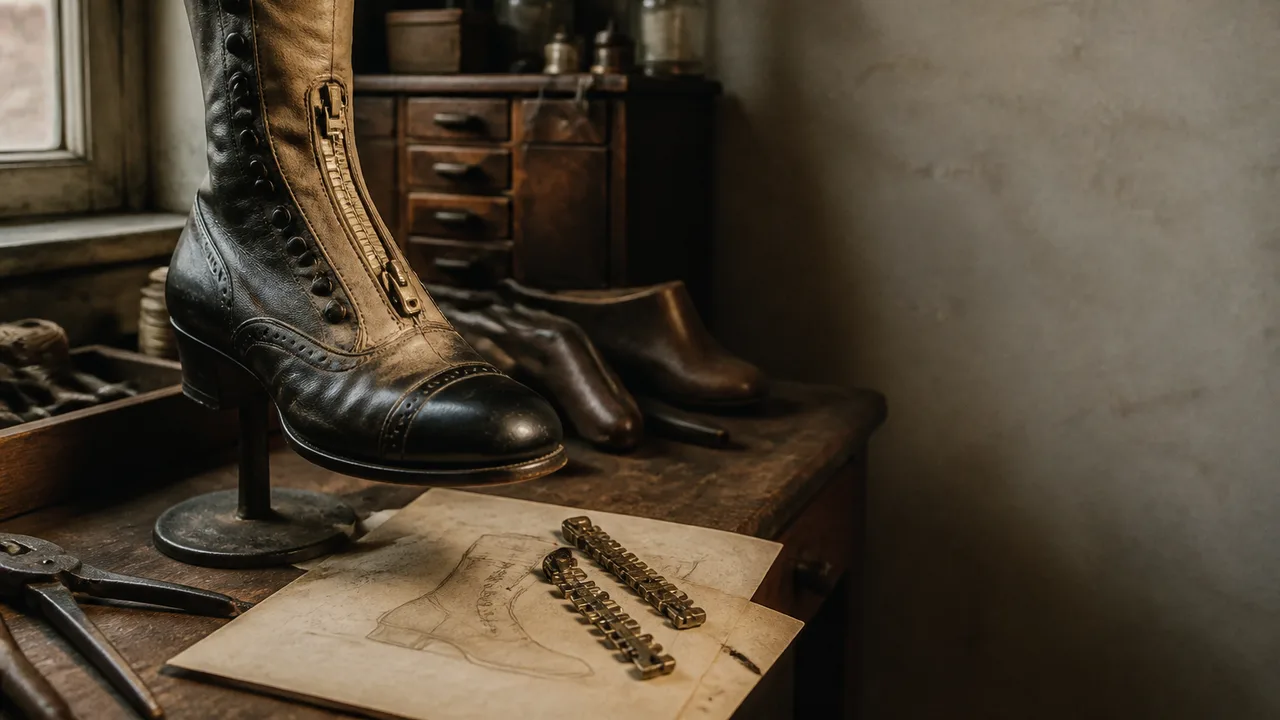
Whitcomb Judson patented a fastener for shoes in 1893, aiming at a chore familiar to anyone who had dealt with long laces: getting footwear closed and keeping it closed. His device, called a “clasp locker or unlocker,” offered a mechanical answer. It also began a long demonstration of how far an answer can be from a dependable product.
The clasp-locker resembled today’s zipper only superficially. The modern zipper closes a row of interlocking elements as a slider moves along it; pulling the slider back separates them. Judson had identified a useful task, but the familiar arrangement that now performs it took further development.
Shoes provide a precise starting point for this history. Their wearer needs a closure that works repeatedly, often in a hurry, on an object that bends and moves. A fastening method saves little effort if closing it requires patience or if it comes apart during use. Judson’s patent established a route away from laces. Turning that route into something people could trust was another undertaking.
Who Gets Credit for a Zipper?
The invention has a history before Judson. Elias Howe patented an “automatic, continuous clothing closure” in 1851. Howe’s idea complicates any neat claim that one man invented the zipper on one day. It also points to an early ambition broader than footwear: a continuous closure for clothing.
Judson’s 1893 patent, by contrast, addressed shoes. The two filings help explain why histories of ordinary objects so often assign credit differently. A patent may capture an early concept, a device aimed at a recognizable problem, or a design that later workers make useful. Those are separate contributions, even when a century of retelling compresses them into a single inventor’s name.
The shoe problem gave Judson’s device a prospective customer. Long laces take time to handle, and a closure operated with one movement has an obvious appeal. That appeal did not settle the engineering question. As the account of Judson’s early clasp-locker makes clear, his imperfect precursor did not become an everyday convenience as soon as he patented it. Users had to be able to close it reliably; makers had to produce it consistently enough for the mechanism to work.
Drawings and legal claims can describe a promising mechanism. A shoe manufacturer must consider what happens after someone opens and closes it again and again. If the fastener fails, the customer sees a faulty shoe. The invention’s value depends on the whole article doing its job, not on the ingenuity of the clasp considered alone.
From Clasp-Locker to Slide Fastener
Gideon Sundback’s later work occupies a central place in the development of the modern zipper. Improvements to the interlocking elements and the mechanism that guides them made the slide fastener more practical. The name “zipper” can make the history sound like a single quick motion from idea to finished product. In practice, the motion depended on parts meeting accurately along the length of the closure.
That requirement shaped the fastener’s prospects beyond shoes. A dependable slide closure could serve objects that opened along a line, provided makers could incorporate it into the item and buyers found it useful. Early applications included shoes and tobacco pouches. The pouch is a useful comparison: footwear and a small container have different purposes, yet each needs an opening that can be secured and reopened. The mechanism could travel between products once it worked well enough to justify fitting it to them.
Laces, buttons and other closures already did useful work. A zipper offered speed and a continuous closure, but it also placed the finished item’s usefulness partly in the hands of a small assembly. Makers had to decide whether that trade suited a shoe, a pouch or, later, a garment. The zipper gained ground because successive versions offered an increasingly workable answer across such uses, rather than because every object with an opening required one.
Manufacturing belongs in this account alongside invention. Interlocking elements must meet along the closure, and the slider must guide them repeatedly. A design can succeed as an idea yet disappoint when produced or fitted inconsistently. Improving the fastener meant making a repeatable article that other manufacturers could use. That work rarely survives in the popular shorthand of an inventor’s name, though it determines whether the invention ever reaches a second purchase.
The Name Arrived with Footwear
Shoes enter the story again when the fastener acquires its familiar name. A history from footwear research organization SATRA describes a popular account linking “zipper” to BF Goodrich’s rubber footwear in 1923. In that account, the company called the finished footwear “Zippers.” SATRA presents the naming story as popular legend, a qualification worth retaining: the account suggests how a product name may have helped popularize the word, without establishing every step by which the term spread.
The distinction between the device and its name keeps the chronology straight. Judson’s 1893 shoe clasp preceded the reported 1923 footwear name by three decades. Howe’s clothing-closure patent came earlier still. “Zipper” now supplies one label for a succession of mechanisms and products whose histories do not fit into a single moment of discovery.
The footwear connection also shows how a technology can become hard to see in its later forms. A customer buying shoes might have judged the closure by whether it saved time and stayed shut. Someone encountering a zipper on a pouch or a garment could make the same practical judgment without knowing its origin. Each successful application made the mechanism less remarkable and easier for another maker to consider.
There are limits to what this short record can tell us. The accounts establish a progression from early closure concepts through Judson’s shoe device to improved slide fasteners and wider uses. They do not establish a precise day when the public accepted the zipper, or a single product that made its adoption inevitable. The account of the name carries its own stated uncertainty. A history that fills those gaps with a smooth triumphal sequence would grant the inventors more certainty than the evidence allows.
What changed was the job the fastener could perform. Judson’s clasp-locker addressed long shoe laces; later designs could close other openings with a pull of a slider. The shoe remained in the story twice, first as the problem and then, perhaps, as the source of the name. Between those two points lay the work that made a patented convenience dependable enough to disappear into ordinary use.
More Like This

The KGB's Cyanide Newspaper Gun That Almost Worked
How a KGB poison weapon hidden in a rolled newspaper killed Ukrainian nationalist Stepan Bandera in 1957—and why one mistake unraveled the whole operation.

LIDAR Is Rewriting What We Know of Ancient Cities
Anthropologist Luke Caverns is planning the largest LIDAR scan ever done in the Amazon. What the technology finds may force a rewrite of ancient history.

Bodmin Moor's Bronze Age Village and Its Neolithic Cairn
Archaeologists confirm a Bronze Age village on Bodmin Moor—and find a 6,000-year-old cairn that may have outlasted the community that built it.

The Medici and the Borgia: Power, Banking, and Renaissance Italy
The Medici-Borgia rivalry was no simple feud. A look at how banking, papal power, marriage, and armies shaped Renaissance Italy's contested politics.
Benedict Arnold: Patriot, General, Traitor
Benedict Arnold won the Battle of Saratoga then betrayed his country. A new documentary examines the grievances, ambition, and political failures that made both possible.

Ray Dalio's Framework for Tracking Empire Decline
Ray Dalio argues empires follow measurable, repeating cycles of rise and fall. His framework deserves scrutiny—and raises questions relevant to today's geopolitics.