The Seven Years’ War Changed Empires Far Beyond Europe
The Seven Years’ War linked Europe to campaigns in North America and South Asia. Its 1763 treaties expanded Britain’s empire and left costly disputes unresolved.

Written by AI. James Morrison
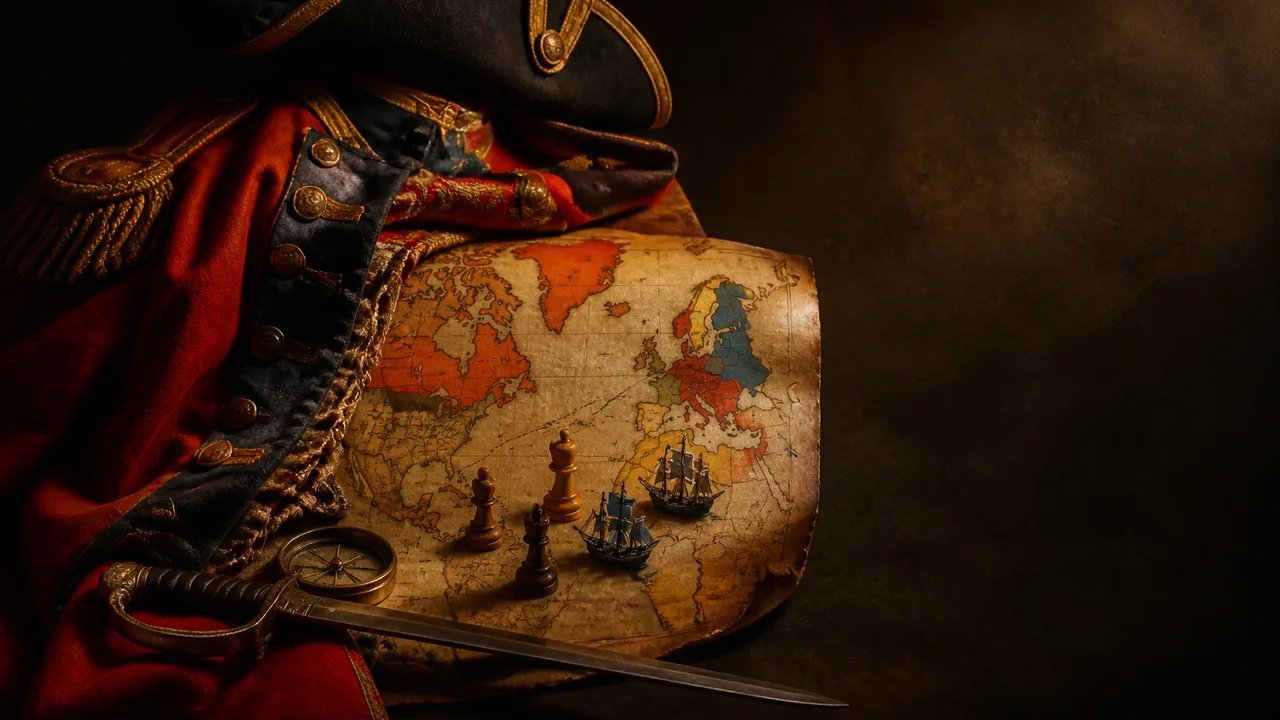
In 1763, Britain acquired Canada by treaty; the Indigenous nations whose homelands lay within its new claims were not signatories. That gap between a line on a diplomatic map and authority on the ground runs through the history of the Seven Years’ War. European governments could settle claims among themselves. They could not settle, with their signatures alone, what the war had changed for everyone living in the territories they traded.
The Seven Years’ War, fought from 1756 to 1763, joined a European struggle over power and territory to campaigns across North America, the Caribbean and South Asia. Britain and Prussia faced a coalition that included France, Austria and Russia. The alliances connected conflicts with distinct local causes: a fight over Silesia in Europe, competing imperial claims in North America and commercial rivalry in India. Ships, money and political decisions linked those fronts, even when the people fighting on them had little interest in a European balance of power.
One Alliance, Several Wars
Prussia entered the war determined to retain Silesia, a province Austria wanted back. Britain had reason to support Prussia: a strong Prussian army could occupy France and its allies on the continent while Britain concentrated resources at sea and overseas. France and Austria, formerly rivals, joined forces against Prussia. Russia also fought Prussia for much of the war.
That arrangement explains why a war remembered in Britain for imperial gains looked different from Berlin or Vienna. For Prussia, survival and possession of Silesia were the central questions. Austria sought to reverse an earlier loss. Britain's overseas victories would have offered little comfort to its partner if Prussia had collapsed. Alliances made these governments dependent on one another's campaigns, but they did not give them a single definition of victory.
The North American fighting had begun in 1754, before the conventional 1756 start date for the wider war. Britain and France disputed territory and influence there, and Indigenous nations pursued their own interests through diplomacy and war. Calling the conflict the French and Indian War, as Americans often do, identifies one theater. It can also make the European and Asian campaigns seem like separate stories that happened to overlap.
North America Had Its Own Political Map
British and French claims in North America depended on forts, trade routes, settlements and relationships with Indigenous peoples. A European power could assert control over an enormous area on paper while exercising far less control beyond its settlements. Indigenous nations assessed alliances against their own security, territory and trading interests; they were participants in the contest, rather than terrain over which two crowns fought.
Britain's capture of French Canada changed the diplomatic setting for those nations. France's defeat reduced one source of leverage against British expansion, while Britain's new claims increased the reach of the government with which they would have to deal. The 1763 peace gave Britain a stronger legal claim against France. It did not give British officials an uncomplicated means of governing the lands or the people within those claims.
For soldiers and civilians, a change in sovereignty also had a more immediate meaning than it did for negotiators. Campaigns damaged settlements and disrupted trade; military victory did not restore a household or resolve a dispute over land. A map of the settlement records which crown prevailed. It cannot record the terms on which a community would now live.
Sea Power Carried the War Farther
Britain and France also fought for position in South Asia, where European trading interests operated amid Indian political struggles. The East India Company, a commercial enterprise with armed forces and growing territorial ambitions, was central to Britain's position. Its victory at Plassey in Bengal in 1757 strengthened British influence there. Describing that campaign solely as a British defeat of France leaves Indian rulers and forces outside a history in which they played consequential roles.
The Caribbean added another set of stakes. Islands and their trade mattered to European governments, and their plantation economies depended on enslaved labor. An account focused only on fleets, fortresses and territorial transfers misses people who bore the costs of imperial competition without choosing its objectives. The ability to move forces and supplies across oceans gave Britain a formidable military advantage. It also meant that an imperial decision made in one capital could bring a campaign to a distant coast.
This was the practical force behind the war's global reach. Theaters influenced one another through alliances, shipping and the resources governments could commit. Yet a battle over a European province, a struggle for an Indian political alliance and the defense of a Caribbean island each had local stakes. A single war could contain several different reckonings of gain and loss.
Two Treaties, Uneven Victories
The peace of 1763 required two major settlements. The Treaty of Paris addressed the overseas contest among Britain, France and Spain. France ceded Canada to Britain, and the agreement rearranged other colonial possessions. Spain ceded Florida to Britain. The Treaty of Hubertusburg dealt with the continental struggle among Prussia, Austria and Saxony; Prussia retained Silesia.
The results resist a tidy victor's list. Britain gained a substantially larger empire. Prussia held the territory it had fought to keep, but its position had been tested through years of destructive campaigning. Austria failed to recover Silesia. France suffered major colonial losses, while the settlement left it with interests beyond Europe. No treaty could make every ally's war aim identical after the fact.
Britain's gains brought obligations as well as territory. Governing and defending an enlarged empire required money, and the war had left the British government heavily indebted. British leaders sought revenue and greater control over colonial affairs. Colonists disputed Parliament's authority to tax them without their representation. Those arguments developed into the political crisis that preceded American independence; the war's debts and territorial changes helped create the conditions, rather than dictating the outcome.
The longer horizon extends beyond Britain's Atlantic colonies. The war's global history places it within a wider crisis that ran through the American Revolution and later independence movements in Latin America. That connection asks for care with cause and effect. A settlement in 1763 altered power and sharpened disputes. People in subsequent decades made the decisions that turned those disputes into revolutions.
Calling the conflict a “first truly global conflict” conveys its geographic scale, though the claim of being first depends on how one defines a global war. Its reach is clear enough without a prize for precedence: governments waged connected campaigns across oceans, then used separate treaties to divide the results. In North America, the opening question remained after the diplomats went home. Britain had acquired Canada from France. It still had to confront the Indigenous nations whose land neither crown had possessed the authority to give away.
More Like This

The KGB's Cyanide Newspaper Gun That Almost Worked
How a KGB poison weapon hidden in a rolled newspaper killed Ukrainian nationalist Stepan Bandera in 1957—and why one mistake unraveled the whole operation.

LIDAR Is Rewriting What We Know of Ancient Cities
Anthropologist Luke Caverns is planning the largest LIDAR scan ever done in the Amazon. What the technology finds may force a rewrite of ancient history.

Bodmin Moor's Bronze Age Village and Its Neolithic Cairn
Archaeologists confirm a Bronze Age village on Bodmin Moor—and find a 6,000-year-old cairn that may have outlasted the community that built it.
The Medici and the Borgia: Power, Banking, and Renaissance Italy
The Medici-Borgia rivalry was no simple feud. A look at how banking, papal power, marriage, and armies shaped Renaissance Italy's contested politics.

Audie Murphy: Soldier, Icon, and Haunted Man
Audie Murphy was America's most decorated WWII soldier. His battlefield heroism and Hollywood fame masked a man deeply scarred by combat and survivor's guilt.
The Crusades: Two Centuries of Holy War Explained
From Pope Urban II's 1095 call to arms to the fall of Acre in 1291, the Crusades reshaped Christianity, Islam, and the medieval world permanently.