The Army of Northern Virginia and the War Over Slavery
Robert E. Lee's army shaped the Civil War. Its victories, defeat at Gettysburg and reliance on coerced labor reveal the stakes behind its battlefield history.

Written by AI. James Morrison
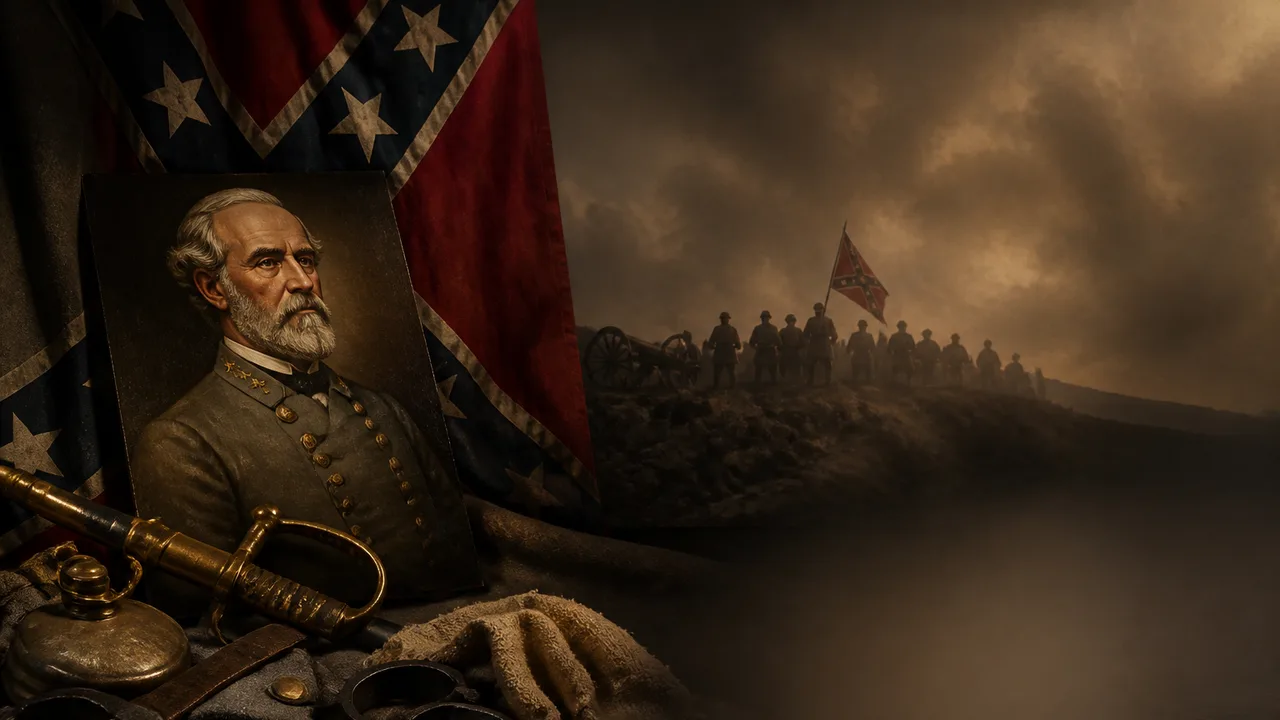
At Gettysburg in July 1863, the Army of Northern Virginia carried the Confederacy’s campaign into Pennsylvania and suffered a defeat that altered the course of the Civil War. Its soldiers had spent the preceding years fighting for an army celebrated for battlefield success. Many would continue fighting after Gettysburg. The campaign’s result changed what their commanders could hope to achieve, while the men in the ranks bore the immediate cost.
The army was the Confederacy’s principal force in the eastern theater, where some of the war’s most consequential campaigns unfolded. It became so closely identified with its commander, Robert E. Lee, that “Lee’s Army” remains a familiar name for it. That shorthand gives a general more room in the story than it gives the thousands of soldiers who fought under him, the enslaved people compelled to support Confederate operations, or the civilians whose homes and communities lay in the path of campaigning armies.
The Army of Northern Virginia can be studied as a fighting force: how it was organized, why it won battles and where its decisions failed. Its purpose also belongs in that account. The Confederacy emerged from a political crisis over slavery, and its armies fought to preserve that break from the United States. A battlefield map can explain where troops moved. It cannot, by itself, explain why they were there.
The Army Behind the Famous Commander
Lee’s association with the army is inseparable from its reputation. It was the best-known and most successful of the Confederate armies. That judgment concerns its record relative to other Confederate forces; it does not turn every campaign into a victory. Its history includes defeats with consequences as substantial as its successes.
Command was never a one-man occupation. Thomas J. “Stonewall” Jackson commanded one of the army’s corps, a large formation made up of smaller units, as Encyclopedia Virginia notes. Below commanders at that level stood officers responsible for turning plans into orders and soldiers responsible for carrying them out. Those layers help explain why an army could remain dangerous across successive campaigns even as casualties and setbacks changed its circumstances.
The army reached a reported strength of about 90,000 in 1862. That figure describes a reported strength at a point in its history, rather than a fixed number of men present at every battle. Armies change as units arrive, men leave the ranks and campaigns impose losses. Treating 90,000 as a permanent head count would give readers a false picture of what commanders had to work with from one operation to the next.
Numbers matter most when attached to decisions. A commander must decide where to concentrate troops, what ground to defend and whether a victory justifies the cost of seeking another. Soldiers experience those calculations at a different scale. A plan that looks coherent across a map still depends on people moving, fighting and surviving long enough to carry it through. The Army of Northern Virginia’s reputation rests partly on command, but no commander could act without them.
Gettysburg and the Limits of Success
The army’s advance into Pennsylvania placed the war before civilians beyond the Confederate states. At Gettysburg, July 1–3, 1863, it suffered a major defeat. The battle became a turning point because it ended a campaign that had brought Lee’s force onto Northern ground and changed the strategic possibilities facing his army.
“Turning point” needs careful handling. Gettysburg did not end the Army of Northern Virginia, and the Civil War continued for nearly two more years. Lee’s force remained a central opponent of the Union in the east. Yet its continued existence does not diminish the defeat. Armies can survive a battle and lose opportunities they cannot readily recover.
Gettysburg also exposes a weakness in histories told as lists of victories and defeats. A battle’s immediate outcome matters, but so does the question of what an army was trying to accomplish. A Confederate success in the east could threaten Union forces and strengthen the Confederacy’s position. A defeat on Northern soil could narrow those prospects. Such judgments require attention to political aims as well as troop movements. The army’s battlefield record and the cause it served belonged to the same war.
People Outside the Command Chart
Military histories often make their cast of characters easy to recognize: a commanding general, a subordinate such as Jackson, and the formations under them. That structure helps readers follow a campaign. It leaves much harder questions outside the command chart.
Enslaved people were compelled to support Confederate operations. Their labor sustained a war fought by a government defending slavery, while they had no comparable freedom to choose the work or the cause. A description of an army’s strength that counts only its soldiers therefore leaves out people whose coerced labor supported its ability to operate. Their lives cannot be reduced to a logistical footnote.
Civilians also lived with the consequences of marching armies, invasion and occupation. Gettysburg’s place on a map was a place where people lived before troops arrived and after they left. Describing the campaign only in terms of Lee’s options and the Union’s response can make civilian exposure seem incidental, even though the movement of armies brought war into communities.
The soldiers themselves deserve attention without being turned into symbols of a single, simple motive. Men served within an army established to fight for the Confederacy; individual reasons for serving need not have been identical. The distinction allows room to examine a soldier’s experience without assigning every man an invented private belief. It also leaves the Confederacy’s purpose in plain view. Individual experience and national policy operated at different levels, and both shaped the war.
What the Army’s Memory Leaves in View
There is a serious military-history case for studying Lee’s command on its own terms. How an army held together, used subordinate commanders and responded to defeat can tell us something about the conduct of the war. Readers trying to understand Gettysburg need that operational account. Omitting it would make the Confederate army appear powerful or doomed by reputation alone, rather than through decisions made under wartime conditions.
The risk comes when operational skill becomes the entire measure of the army. A commander can make effective battlefield decisions in the service of a political cause that deserves separate scrutiny. For the Army of Northern Virginia, that cause was the Confederacy’s defense of slavery. Putting it in the account does not settle every question about leadership or soldiers’ motives. It establishes what the organization fought to sustain.
The Union’s aims also changed during the war, making the conflict larger than the contest that began when secession fractured the country. By the time Lee’s army reached its end, slavery and freedom stood alongside the survival of the United States in any account of the war’s outcome. A history confined to eastern battlefields would miss that change even while recording every campaign.
On April 9, 1865, Lee surrendered the Army of Northern Virginia at Appomattox Court House to Union general Ulysses S. Grant. The surrender dealt a decisive blow to the Confederate war effort, though fighting elsewhere did not cease that day. It closed the history of this army as a field force. It did not close the argument over how Americans should remember it: as an army whose campaigns demand careful study, and as one that fought for a Confederacy built to defend slavery.
More Like This

The KGB's Cyanide Newspaper Gun That Almost Worked
How a KGB poison weapon hidden in a rolled newspaper killed Ukrainian nationalist Stepan Bandera in 1957—and why one mistake unraveled the whole operation.

LIDAR Is Rewriting What We Know of Ancient Cities
Anthropologist Luke Caverns is planning the largest LIDAR scan ever done in the Amazon. What the technology finds may force a rewrite of ancient history.

Bodmin Moor's Bronze Age Village and Its Neolithic Cairn
Archaeologists confirm a Bronze Age village on Bodmin Moor—and find a 6,000-year-old cairn that may have outlasted the community that built it.
April 1865: How the Civil War's End Was Decided
The History Channel's documentary on April 1865 examines how decisions made in a single month determined whether the Civil War's end would bring peace or prolonged guerrilla conflict.

Audie Murphy: Soldier, Icon, and Haunted Man
Audie Murphy was America's most decorated WWII soldier. His battlefield heroism and Hollywood fame masked a man deeply scarred by combat and survivor's guilt.
The Crusades: Two Centuries of Holy War Explained
From Pope Urban II's 1095 call to arms to the fall of Acre in 1291, the Crusades reshaped Christianity, Islam, and the medieval world permanently.