Thanksgiving's History Extends Far Beyond Plymouth
The 1621 Plymouth gathering involved Wampanoag diplomacy. Lincoln's 1863 proclamation and later traditions made Thanksgiving a national ritual with a longer history.

Written by AI. Helen Papadopoulos
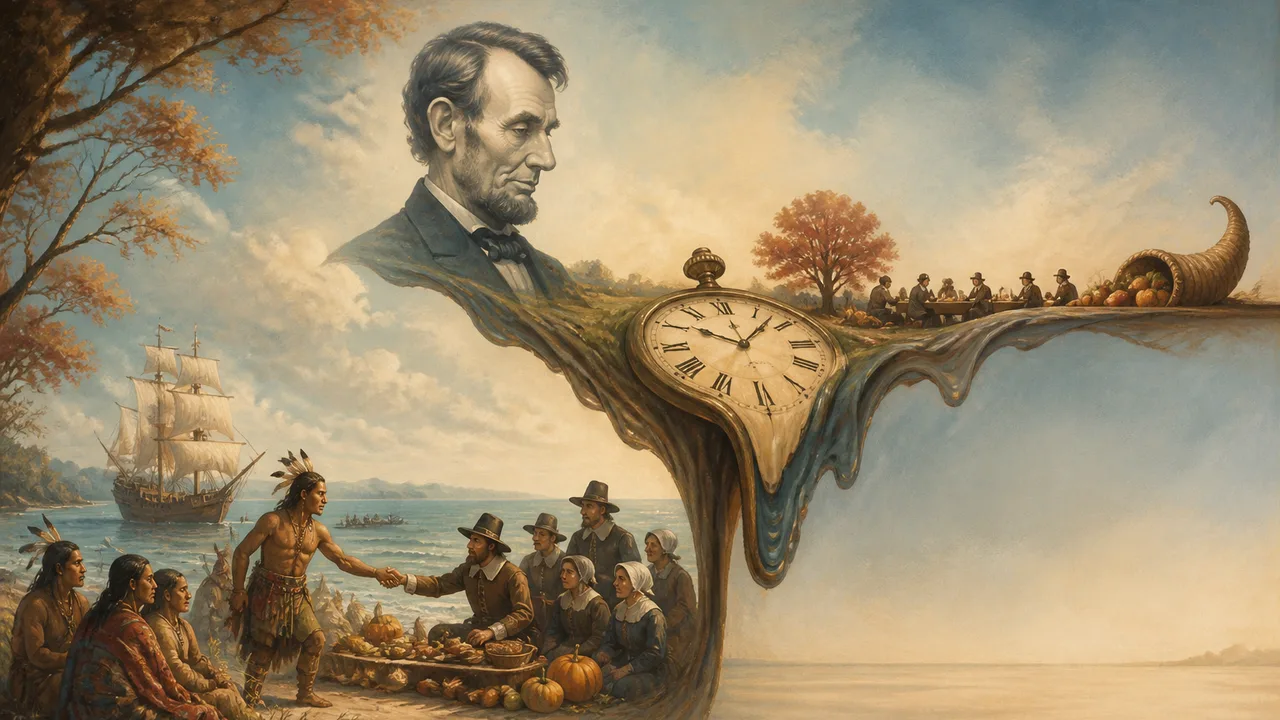
Abraham Lincoln proclaimed a national day of thanksgiving in 1863, more than two centuries after the harvest gathering at Plymouth that Americans now place at the beginning of the holiday. His proclamation came during the Civil War. The Plymouth gathering took place in 1621, during an alliance between English colonists and Wampanoag people. Putting those dates side by side changes the question: How did a meal in one colony become the opening scene of a national tradition?
The familiar answer gives Plymouth an extraordinary amount of work to do. A gathering becomes a founding moment; its participants become stand-ins for two peoples; an annual holiday appears to follow almost naturally. Each step needs examining. Thanksgiving has a history at Plymouth, a history in the United States, and histories among Native peoples who have lived through colonization and its aftermath. They intersect, but they do not fit neatly into one dinner scene.
What Happened at Plymouth?
English colonists and Wampanoag people took part in a 1621 harvest gathering at Plymouth. Edward Winslow, one of the colonists, described a celebration lasting three days and the presence of Ousamequin, the Wampanoag leader also called Massasoit, with about 90 men. The surviving English accounts give only a narrow view of the gathering and do not tell us how its Wampanoag participants understood it.
That narrow view has shaped a remarkably expansive national picture. The usual classroom scene fills in expressions, intentions and a shared understanding of the occasion. Winslow could describe whom he saw and what the colonists did. He could not speak for the Wampanoag. A picture in which everyone has come to celebrate the beginning of the United States asks people in 1621 to know a future that had not happened.
The Wampanoag were central actors in the region's politics. Ousamequin's people had interests and choices of their own, and relations with the English developed amid the upheaval that European arrival brought to New England. Their participation in a gathering at Plymouth deserves to be understood within that setting. Otherwise, a political relationship becomes a scene in which Native people arrive to welcome the protagonists of somebody else's history.
We can say who attended and place the gathering in the context of an alliance. We cannot turn every participant into a spokesperson for a single, agreed meaning of the meal. The disciplined answer leaves room for Wampanoag agency without inventing a Wampanoag speech.
How a Gathering Became an Origin Story
People gave thanks long before Lincoln made a national proclamation. Colonists held observances of gratitude, and harvest celebrations were hardly unique to Plymouth. The 1621 event acquired its familiar place in the American story through later choices about what to commemorate. Calling it the first Thanksgiving suggests a straight line from that gathering to today's holiday. The line was drawn afterward.
Lincoln's 1863 proclamation shows a different use for a day of thanks. The president called for a shared observance while the country was at war with itself. Sarah Josepha Hale, an editor who had advocated a national Thanksgiving for years, had argued for the value of a common holiday. In the Civil War, national togetherness was an urgent political hope, rather than a settled fact.
A proclamation also does something a harvest gathering cannot: it addresses a nation. Plymouth's colonists and their Wampanoag neighbors were navigating circumstances in a small part of seventeenth-century New England. Lincoln asked Americans in a divided nineteenth-century republic to observe a common day. The holiday's association with each moment tells us about each moment's concerns. Plymouth offers a story of encounter. Lincoln's proclamation speaks to a nation trying to imagine its continued existence.
The calendar kept developing. Congress established the fourth Thursday of November as the federal Thanksgiving holiday in 1941. By then, the family meal had long since accumulated expectations of its own. Public spectacle and mass travel belong to the holiday's later history, too. No one at Plymouth was establishing a timetable for a parade or an interstate journey to a relative's house. Those customs show how generations make a holiday usable in their own lives.
The People Left Outside the Picture
For many Americans, Thanksgiving is an occasion to eat with family and express gratitude. Those experiences do not depend on believing that colonization was harmonious. Yet the Plymouth story has often encouraged precisely that impression when it ends with the gathering and leaves out what happened to Native communities afterward.
Wampanoag history continued through conflict, dispossession and survival. The people in the familiar picture were neither the first chapter of a vanished population nor anonymous guests who disappeared once the colonists had a successful harvest. Wampanoag communities remain present. An account that acknowledges their continuing existence changes the shape of the story: the descendants of people caught up in early colonial New England are part of the present in which Thanksgiving is observed.
This is also why Americans can approach the same Thursday with different purposes. Some celebrate gratitude and family. Some use the day to mourn the violence and loss bound up with colonization. Those responses need not be treated as rival descriptions of what happened at one meal. They address different parts of a long history. A family gathering may be precious to its participants; a national origin story still deserves scrutiny when it assigns Native people only a brief, cheerful role.
The disagreement can become harder to hear when it is framed as a choice between keeping Thanksgiving and telling the truth about Plymouth. Holidays regularly carry meanings that change over time. The sharper question concerns which meaning gets presented as history. Families can keep their customs without asking a seventeenth-century gathering to certify a comforting account of colonial America. Readers who value the holiday may find more, rather than less, to discuss when its history includes the Wampanoag as people with a history of their own.
What a National Ritual Chooses to Remember
Thanksgiving compresses several centuries into one annual day. That compression helps explain its staying power: a meal offers a form of belonging that a history lecture cannot. It also explains the risk. A picture of colonists and Native people eating together can make the later course of colonization seem irrelevant to the occasion. A holiday born as a national observance during the Civil War can seem ancient and inevitable if its nineteenth-century creation goes unmentioned.
The familiar Plymouth scene contains an event worth understanding. Winslow's account places English and Wampanoag participants at a gathering in 1621. Lincoln's proclamation places a national day of thanksgiving in 1863. The holiday Americans observe today grew across the years between and after them. Each point belongs on the timeline, alongside the Wampanoag history that continued well beyond the scene selected for the beginning. What a nation remembers at its table is a choice made in the present.
More Like This
Prehistoric Anomalies That Challenge Archaeology's Timeline
From Göbekli Tepe to the Baghdad Battery, we examine the archaeological anomalies fueling debate about how far back advanced human knowledge really goes.
California Mastodon Tooth Opens a Pleistocene Window
A Pacific mastodon molar found in a California creek may reveal diet, climate and extinction, provided researchers can recover its geological context.
Syd Barrett and the Limits of Pink Floyd's Rock Myth
Syd Barrett helped create Pink Floyd's early sound. His departure, psychedelic drug use and later fame reveal the limits of rock's neat stories of illness and genius.
Stoicism as a Political Philosophy, Not a Retreat
Massimo Pigliucci argues Stoicism's dichotomy of control isn't passive resignation—it's a framework for smarter, more durable political engagement.
Sweet Potatoes and Potatoes Tell Different Food Histories
Sweet potatoes and potatoes share a name, but their plant families and journeys differ. Trace Indigenous cultivation, Pacific routes and colonial exchange.
The Homestead Act at 160: A Promise With a Price
The Homestead Act of 1862 shaped who owns American land and who doesn't. Its contradictions still live in the country's housing and land-use debates today.
South Carolina's 1860 Secession and the Civil War
On December 20, 1860, South Carolina voted unanimously to leave the Union. The document it produced tells us exactly why—if we bother to read it.
The Eighth Book of Moses and Ancient Magic's Complexity
The Eighth Book of Moses is a 42-day ritual from the Greek Magical Papyri blending Egyptian, Jewish, and Hermetic traditions to reveal a supreme divine name.