The Eighth Book of Moses and Ancient Magic's Complexity
The Eighth Book of Moses is a 42-day ritual from the Greek Magical Papyri blending Egyptian, Jewish, and Hermetic traditions to reveal a supreme divine name.

Written by AI. Helen Papadopoulos
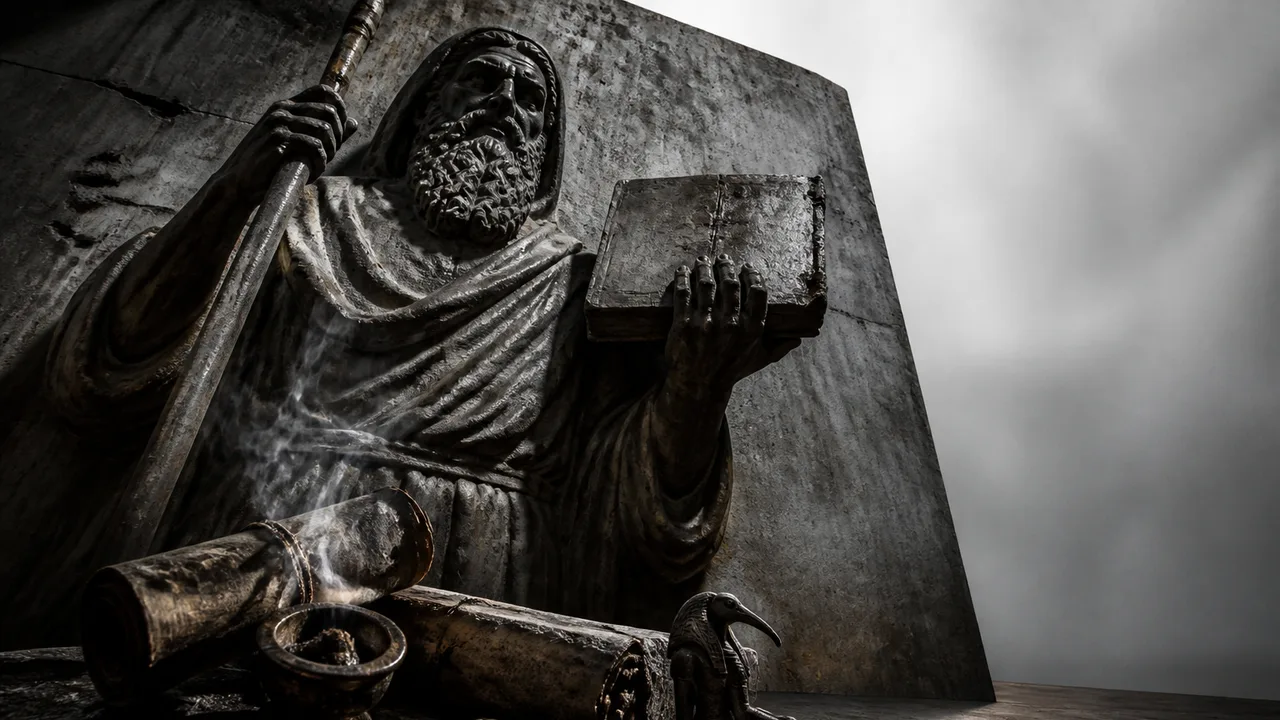
Photo: AI. Kasper Winter
The central conceit of ancient magic, as Dr. Justin Sledge of the Esoterica channel puts it, is deceptively simple: know a thing's secret name, and you hold power over it. Demons, angels, planetary spirits, even gods — all vulnerable, in principle, to the practitioner who possesses the right syllables. The Greek Magical Papyri, that vast and still poorly understood collection of ritual texts from Greco-Roman Egypt, is crowded with such names: long palindromes, hybrid compounds of Greek, Hebrew, and Egyptian, vowel sequences that read like throat exercises for a divine throat.
What makes PGM XIII — the Leiden Papyrus J 395, now held in the Netherlands — genuinely unusual within this tradition is that it refuses to simply hand you a name. Instead, it describes, across more than 730 lines and in two distinct versions, the elaborate process by which you earn a name through direct revelation from the highest god. The text calls itself The Eighth Book of Moses. Its goal, as Sledge summarizes it in a nearly three-hour episode devoted to the text, is nothing less than learning "the divine name above all others" — one that, once obtained, grants knowledge of one's fate and the power to avert it.
That is not a modest ambition.
A Manuscript Shrouded in Uncertain Origins
The codex arrived in Europe via one Giovanni Anastasi, who, according to Wikipedia's account of the merchant, was a figure of Armenian or Greek origin who represented Swedish commercial interests in Egypt during the nineteenth century — a man of genuinely murky provenance who came into possession of what may have been an entire library of ancient papyri, possibly the contents of a single buried cache, possibly the yield of tomb robbing. Nobody knows. The collection was eventually auctioned and dispersed across European institutions, with PGM XIII landing in Leiden.
The manuscript itself dates to the mid-fourth century CE, a moment of acute cultural pressure in Egypt: indigenous religion being suppressed, Christianity consolidating its institutional grip, the last known hieroglyphic inscription — the Graffito of Esmet-Akhom, carved at the temple of Philae — dating, according to Wikipedia, to 394 CE. Sledge contextualizes the codex squarely within that twilight: a text being copied, edited, and adapted at precisely the moment when the religious ecosystem it emerged from was being dismantled.
This context matters because the text itself is a product of that ecosystem's complexity. It is named for Moses, claims to be extracted from the original Torah, swears by the Temple in Jerusalem, and references other Mosaic texts — including a Key of Moses and an Archangelical Book of Moses — that no longer survive. And yet it also employs Hermetic invocations and includes what Sledge identifies as Gnostic elements, all composed in Koine Greek, the Mediterranean's shared administrative tongue.
Two Versions, One Argument
The codex preserves two versions of the same ritual — the A version, more elaborate and heavily Judaized, with Christian interpolations; the B version, briefer, more distinctly Egyptian in feel, with ritual timings keyed to the Nile flood cycle and a cameo from "the angel Sarapis." Sledge and his guest, Dr. Kirsten Dzwiza — a specialist in ancient magic whose ongoing work includes new translations of the Egyptian and Greek magical papyri — suggest that B likely represents an earlier, more pagan text, with A being a later "mosaification": an editorial adaptation designed to make the ritual legible and appealing to Christianizing clients.
This is not cynicism on the authors' part. It is adaptation. Sledge puts it plainly: "Magic simply adapts to the times."
What the two versions share is more telling than what divides them. Both aim at a direct encounter with the highest deity. Both are performed exclusively by the practitioner — no audience, no clients, no performance. Both require resources — imported materials, a specific spatial arrangement, weeks of preparation — that effectively restrict participation to the educated and financially solvent. Dzwiza is categorical about where this places the text in the landscape of ancient ritual: "These two rituals are the most complex, comprehensive rituals in the Greek Magical Papyri. They were both performed by far advanced and experienced practitioners."
Forty-Two Days of Serious Work
The ritual itself resists summary, and Sledge is honest about that resistance. But the broad shape is remarkable. The practitioner must calculate the next new moon in Aries — the ritual's anchor point, occurring roughly once a year — and then maintain purity for 41 days beforehand. During this period, the ritual space must be prepared: a ground-floor room where no one has died in the past year, a door facing west, an earthen altar, a canopy inscribed around its edges with the names of the 365 Egyptian gods of the days. Those names are not provided in the text itself; they presuppose access to technical astrological manuals, the kind of specialized knowledge visible in temple inscriptions still standing at Dendera and Edfu.
Seven flowers of the seven planetary stars — madder, white lily, lotus, and others — must be pulverized and dried to make a sacred ink. A laurel-root amulet must be carved with an image of Apollo, a tripod, a Python serpent, and lengthy palindromes, then worn around the neck. A natron tablet — natron being the salt used in Egyptian mummification — must be inscribed on both sides with divine names and images, including a falcon-headed crocodile deity named Sonophoios, surrounded by an ouroboros.
At the culmination, around 11 p.m. on day 42, the practitioner enters the canopy, sacrifices a pigeon and a rooster, lights incense and two oil lamps, and then — in one of the text's stranger practical requirements — licks the inscription off the natron tablet. The other side is dissolved into a mixing bowl of wine, seawater, and milk from a black cow. The practitioner drinks the mixture and lies down on a rush mat to await the god.
Whether in dream or waking vision, the deity appears. The practitioner is instructed not to look at the god but to fix their gaze on the deity's feet, and to write down whatever is revealed.
A Creation Told in Laughter
Before the revelation, the text delivers something unexpected: a full cosmogony. The primal divinity creates the cosmos not through speech — not through the logos, not through divine command — but through seven instances of laughter. Each laugh generates a deity: light, earth from primordial water, mind, fertility. A fifth laugh generates Moira, fate, which then contends with Hermes for jurisdiction over the lower world. A sixth produces Kairos, opportune time. Soul follows. Then the god hisses — crocodile symbolism — and from that hiss comes either the Pippian serpent (version A) or Phobos, fear (version B). A click generates Iao, the Lord of All, recognizable as a version of the Israelite god and present in Gnostic cosmologies as a demiurgic figure.
The image is genuinely strange: a creator deity whose primary mode of expression is laughter, and whose last two significant productions are Fear and the God of Israel, the former an echo, the latter a real utterance, both given dominion over the seven planets.
Sledge and Dzwiza note that this cosmogony has structural parallels elsewhere: the Merkavah literature, Jewish mystical texts concerned with ascent to the divine throne, contains similar patterns of extended purification, prohibited gazing, and revelatory encounter. Whether these connections are genetic or simply reflect shared ritual logic operating in overlapping communities is, as Sledge puts it, an open question — but "it would be unsurprising to me in such a highly syncretistic text."
The Scholarship Problem
Running beneath the whole discussion is a methodological argument about how ancient magical texts have been read. Morton Smith — a significant scholar of the previous generation — annotated his work on the Eighth Book of Moses with dismissals. Sledge quotes from the footnotes: "hokum." Smith's approach, Dzwiza argues, was to treat the text as raw material for proving his own theories rather than as evidence of what it actually was: a sophisticated, expensive, privately performed initiatory practice carried out by people with serious technical knowledge.
"When your comportment to the text is dismissive out of the gate, a priori, I don't trust it," Sledge says. It is a point worth sitting with. The practitioners of PGM XIII needed to know Egyptian astrology, Hermetic theology, Jewish textual tradition, and Greek ritual practice — and needed the wealth and leisure to spend 42 consecutive days in private preparation. Dismissing them as frauds requires either ignoring the evidence or, as Dzwiza suggests of Smith, bending it.
Dzwiza's own approach is to translate as close to the Greek as possible, from the perspective of a practitioner rather than a theorist, and to check apparent nonsense against Egyptian temple sources before declaring it meaningless. The "blood of gods" and "semen of gods" in PGM XII's ingredient lists, which earlier scholars dismissed as theatrical grossness, turn out to be Egyptian priestly code for specific organic materials traceable to temple records.
The 365 gods of the days, whose names must be written around the canopy's edge and whose knowledge is simply assumed by the text, survive in temple inscriptions at Edfu — 365 gods and 365 goddesses, facing one another. The text is not making them up. It is requiring that the practitioner already know them.
What Dzwiza is building — a sourcebook, a catalog, a handbook, new translations — is the infrastructure for reading these texts as their authors intended: as technical documents produced by highly educated specialists operating in a rich and combative intellectual culture.
The rivalry between Mosaic and Hermetic traditions encoded in the text is, as Dzwiza and Sledge note with some relish, almost comically personal. The Eighth Book of Moses complains, in an early passage, that Hermes plagiarized its incense recipes. It then, a few hundred lines later, incorporates a Hermetic prayer as one of its central invocations. "It's really rivalry," Dzwiza says, "but not to the degree that you say I'm not going to use anything of your knowledge anymore."
That dynamic — competitive, collegial, cross-pollinating — is probably the most accurate description of the world that produced PGM XIII. Practitioners from different traditions arguing about incense recipes and stealing each other's methods while working toward the same goal: to stand in the presence of the highest god, look at the floor, and learn one's true name.
Whether that goal was achieved, and what any of them wrote down afterward, is the one thing the text cannot tell us.
More Like This
Middle Platonism's Hidden Role in Western Esotericism
ESOTERICA's new crowdfunded seminar argues Middle Platonism built the foundations of Hermeticism, Gnosticism, and early Christian theology. Here's what that means.
The Divine Feminine's Long Return in Western Religion
From Tiamat to the Shekhinah to the Virgin Mary, Dr. Justin Sledge traces the suppressed and resurgent divine feminine across millennia of Western religious history.
WW1 Trench Life: What the Western Front Was Really Like
From Pals' Battalions to the Vickers gun, a new documentary unpacks the grim machinery of survival on the WW1 Western Front in unflinching detail.
Do DMT Entities Point to Alien Consciousness?
Cognitive scientist Donald Hoffman claims DMT entities may be real alien minds. The math is real. Whether it proves anything about consciousness is a different question.
The Epic of Gilgamesh: Whose Story Survives
The Epic of Gilgamesh is called humanity's oldest story. But whose story is it really? A look at who the archive kept and who it discarded.
The Plato Nobody Taught You: Middle Platonism
Middle Platonism shaped Christianity, Gnosticism, and Western esotericism—yet it's barely taught. A new free seminar asks why, and what we've been missing.
Pliny the Younger's Letters on the Eruption of Vesuvius
Pliny the Younger's two letters to Tacitus remain the only eyewitness account of Vesuvius's eruption in 79 AD — and they still read like dispatches from the end of the world.
How the Square Root of 2 Shook Ancient Greek Mathematics
The Pythagoreans believed whole numbers governed all of reality. One diagonal line—and one brave mathematician—proved them catastrophically wrong.