Starship Flight 15 Misses Booster Catch After Guidance Issue
SpaceX says a guidance issue aborted Starship Flight 15's booster catch on November 13. The missed recovery tests abort logic and raises questions about reuse plans.

Written by AI. Nadia Marchetti
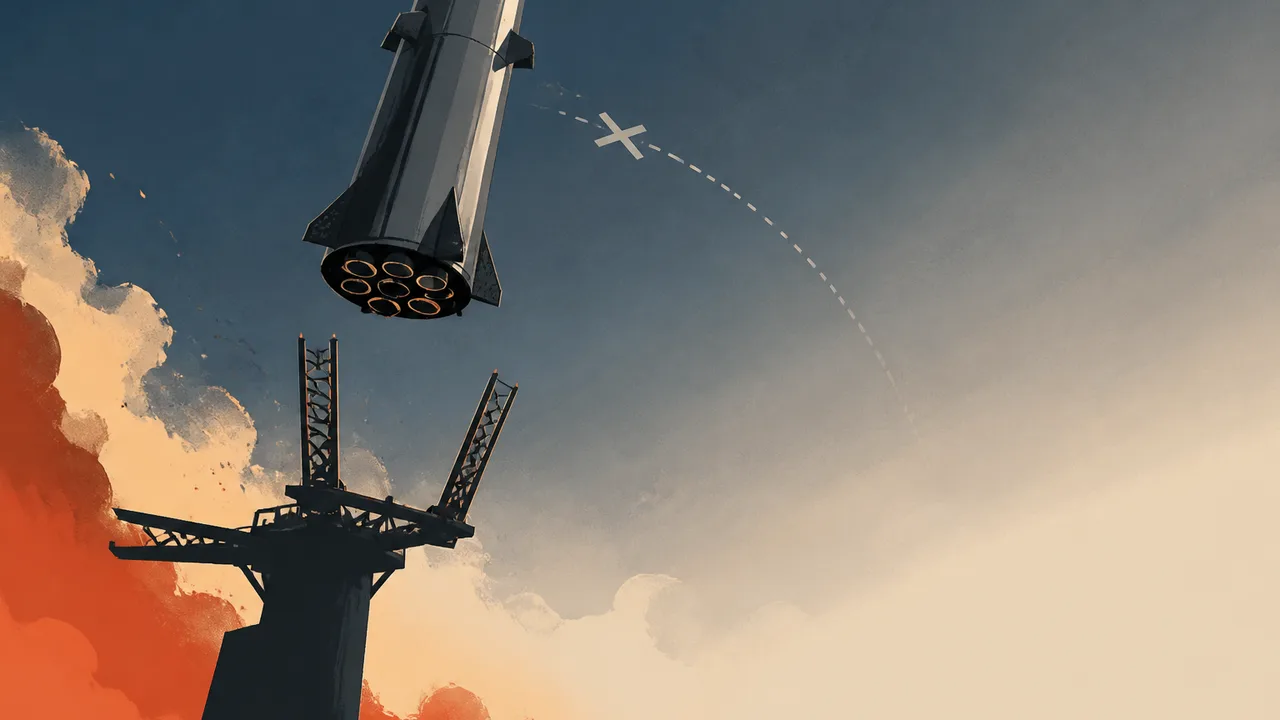
SpaceX’s Starship Flight 15 lifted off on November 13 with a booster catch planned at the launch site. The booster never attempted it. SpaceX says a guidance issue prompted the abort, leaving one of the flight’s two planned landing-related objectives unfinished.
The word guidance sounds precise until you ask what went wrong. SpaceX spokesperson Dan Huot initially said a guidance issue appeared to be the cause. SpaceX has not disclosed the fault data, the condition that triggered the abort or a corrective action, so that explanation remains preliminary. It identifies an area for investigation, rather than a failed component.
A missed catch is easy to picture: a rocket returning toward a tower, then no rocket in the tower’s arms. The engineering question sits one step earlier. What did the booster’s systems determine about its ability to reach the catch safely, and was that determination correct?
What an Abort Can Tell Engineers
A tower catch leaves little room for a vehicle whose predicted position or movement has slipped outside acceptable limits. The catch depends on the booster arriving at the right place, with its motion controlled closely enough for the tower to receive it. Guidance helps determine where the vehicle is going and how to get it there. Engineers would need to compare those predictions with the vehicle’s measurements and commands to understand why this approach ended before the catch attempt.
A guidance issue could involve the information entering a decision, the calculation made from it or the vehicle’s response to a command. The phrase alone does not choose among them. Nor does an abort tell us whether a recovery attempt would have failed. A safety rule may reject an approach because confidence has fallen below a threshold, even if someone later concludes that the vehicle could have made it.
There is a second possibility engineers must take just as seriously: a system might permit an approach that ought to have been rejected. A conservative abort can cost a booster. An overly permissive decision could put a booster near recovery hardware when it no longer meets the conditions for a catch. Testing recovery rules means examining both errors, rather than treating every aborted approach as evidence of excessive caution.
SpaceX has demonstrated that a catch can happen; the earlier recovery of part of a Starship rocket established that milestone. Flight 15 asks a different question. Can the system decide reliably, on each attempt, when the booster should approach the tower and when it should stay away? Reusability depends on repeating the operation, including the decision to stop when its conditions are not met.
Two Landing Objectives, Two Sets of Answers
Flight 15’s plan included another landing-related objective beyond the booster catch. After the booster abort, Starship’s upper stage was still set for its return to Earth. The two objectives exercise different parts of the flight. The booster’s missed catch cannot settle how the upper stage performs on return; an upper-stage result cannot explain the booster’s guidance issue.
A launch can gather information about ascent, separation, return and recovery, while leaving a planned operation undone. Counting completed objectives helps, but it can conceal the reason one was missed. A vehicle that stops an unsafe recovery attempt has exercised a safeguard. Engineers still have to determine whether the safeguard responded to the intended condition, whether it responded at the intended time and whether the condition points to a problem that could recur.
The booster recovery rules deserve attention alongside the upper stage’s return for precisely that reason. One tests a decision near the launch site; the other follows the spacecraft through a later phase of flight. Folding them into one score would hide which system needs work.
The same care applies to the phrase “missed catch.” It describes the planned outcome that did not occur, without explaining the sequence that led there. A catch attempt that fails at the tower would give engineers a different problem from a catch attempt that the booster declines before reaching it. Flight 15 belongs to the second category. Where in the decision sequence the abort occurred would shape the next test, but the public explanation has not pinned that down.
The Questions Before Another Catch Attempt
A useful account of Flight 15 would start with a timeline. When did the booster first detect a condition outside the limits for recovery? What position and trajectory did its systems estimate at that point? Which rule made the catch unavailable, and what command followed? Engineers could then compare those records with independent measurements of the vehicle’s path, if they have them, and check whether the decision matched the behavior the system was designed to enforce.
The next question is reproducibility. If engineers can recreate the issue in testing, they can examine what changed the guidance decision and whether a proposed fix prevents a repeat. If they cannot recreate it, they can still investigate the conditions surrounding the abort and watch for the same pattern on later flights. Either route requires more than naming the broad subsystem involved.
A corrective action could also take different forms depending on the finding. A bad input would call for a different response from an incorrect calculation or a recovery rule set at the wrong limit. What readers should look for in a subsequent update is a link between the triggering condition, the change SpaceX makes and the test used to check that change.
That standard does not demand that every internal flight record become public. It does keep the claim proportionate to the explanation. “Guidance issue” answers why SpaceX says the booster abandoned the catch; it does not yet tell us whether the problem lay in the vehicle, its decision rules or the circumstances of this flight.
The tower’s arms were left waiting on November 13. Before the next booster approaches them, the revealing result will be whether engineers can show that the decision to turn away came from the right rule, applied to the right information.
More Like This

Neil Turok's Case for Quantum Gravity Without Strings
Neil Turok argues quadratic gravity—a 1970s idea—may solve quantum gravity without strings or extra dimensions. Here's what that claim actually rests on.

Statins May Cut Dementia Risk in Type 2 Diabetes
A major study finds early statin use after a type 2 diabetes diagnosis is linked to up to 15% lower dementia risk. Here's what the evidence actually shows.

SpaceX Hits 600 Falcon 9 Booster Reuses
SpaceX reached 600 flight-proven Falcon 9 booster launches on July 13-14, 2026. Here's what that number actually means for spaceflight economics.

NASA’s Starliner Return Depends on More Than a Test Flight
NASA plans an uncrewed Starliner flight before a 2028 crewed target. The test can check thruster changes, but more repairs and certification remain ahead.

NASA's Swift Telescope Will Crash to Earth Uncontrolled
NASA's Swift telescope will reenter Earth's atmosphere uncontrolled after a private rescue mission failed. Here's what it reveals about how we design—and don't design—for endings.

NASA's Swift Telescope Re-Enters After Failed Orbit Boost
NASA's Swift observatory re-entered on Nov. 4 after a failed orbit boost. Its loss exposes the scientific stakes and engineering risks of rescuing aging satellites.

Static Electricity Still Puzzles Scientists After Centuries
Static electricity has baffled scientists since ancient Greece. New research on carbon compounds and oxide surfaces may finally offer a clue to how tribocharging works.

The Physics of Sound: Ocean Acoustics and Musical Scales
A Royal Institution talk with Helen Czerski and Philip Ball asks whether underwater sound and the musical scale we use are governed by physics or cultural habit.