NASA's Swift Telescope Re-Enters After Failed Orbit Boost
NASA's Swift observatory re-entered on Nov. 4 after a failed orbit boost. Its loss exposes the scientific stakes and engineering risks of rescuing aging satellites.

Written by AI. Olivia Meng
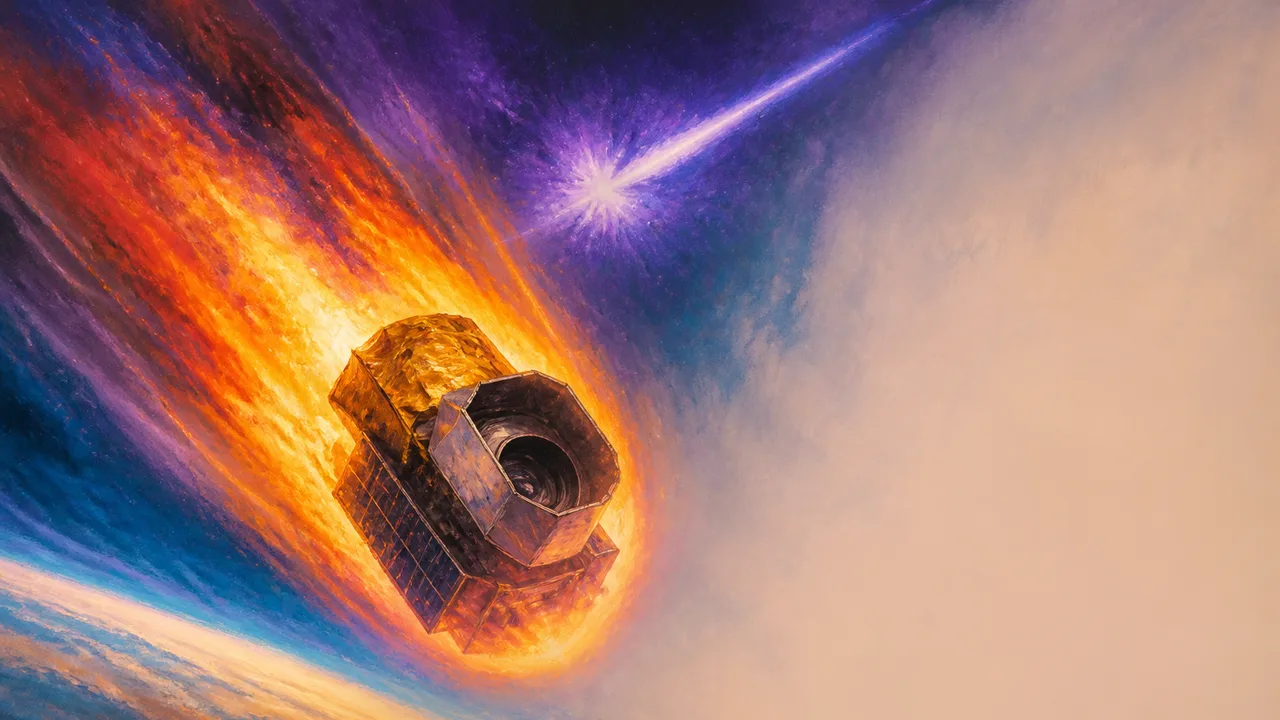
NASA’s Swift space telescope re-entered Earth’s atmosphere on Nov. 4 after an effort to raise its orbit failed. A private spacecraft had been expected to give the aging observatory a boost. That rescue did not happen, and Swift could no longer remain aloft.
For astronomers, the loss is about time as much as hardware. Swift was built to catch brief, energetic events in the universe, especially gamma-ray bursts, and help scientists observe what followed. A transient event does not wait for a replacement telescope to be approved, built and launched. If the right eyes are absent when it happens, that observation is gone.
Swift’s end also leaves a practical question for space agencies and commercial operators: when does an orbital rescue give an old scientific mission a second life, and when does the rescue plan become another deadline the mission cannot survive? The precise sequence that ended this boost effort, Swift’s final observing status and details of its re-entry remain unclear as of Nov. 5. The outcome, however, is plain: an attempt to extend the observatory’s time in orbit ended without the extension.
What Swift Could Catch
Swift spent more than two decades studying cosmic explosions. Its value lay in a chain of observations that begins when something sudden happens far away. Gamma-ray bursts can be extraordinarily bright and short-lived. Detecting one is the first step; tracking its fading emission helps astronomers work out what happened and study the environment around it.
Swift could observe across gamma-ray, X-ray and ultraviolet/optical wavelengths. That combination made it a useful bridge between an initial alert and the wider network of telescopes that might follow up. Different wavelengths reveal different parts of an event as it evolves. Delay the observations, and the signal changes or fades. The sky will produce another event, but it will not rerun the one astronomers missed.
This is the scientific cost of losing a time-sensitive observatory. An archive of Swift measurements remains valuable, and other instruments can continue studying energetic events. Neither proposition restores Swift’s ability to respond to the next alert. Its loss changes what the observing network can do at a particular moment, even where the network as a whole remains active.
Astronomers were facing the prospect of Swift’s loss before re-entry. That long view belongs alongside the immediate disappointment. A spacecraft launched for science can exceed its original working life by years, producing discoveries long after its designers’ first plans are complete. Eventually, keeping it useful depends on more than whether its instruments still have something to measure.
Why an Orbit Boost Became the Test
A satellite in low Earth orbit encounters a thin atmosphere. The air is sparse, but drag accumulates over repeated trips around the planet and lowers the orbit. At lower altitudes, drag increases, accelerating the descent. An orbit-raising maneuver can buy time by moving a spacecraft away from the denser reaches of the atmosphere.
For an observatory without a workable way to raise its own orbit, outside assistance offers a possible alternative to accepting re-entry. That is the logic behind the unsuccessful Swift rescue mission. It is also why a failed intervention has a hard endpoint. Scientists can stretch an observing schedule or find new uses for an aging instrument. They cannot ask atmospheric drag to pause while another plan takes shape.
Servicing a spacecraft involves separate capabilities that must converge in orbit. A visiting vehicle has to reach the right orbit, approach safely and transfer the force needed to change the target’s trajectory. The target must remain in a condition that makes the operation feasible, and the maneuver must happen before its orbit falls too far.
The calendar is part of the engineering. A rescue arranged while a satellite still has substantial altitude leaves more room to address setbacks. As its orbit falls, each delay consumes some of that margin. For future missions, planners will have to weigh the potential scientific return from extra years against the cost, complexity and schedule risk of a visiting spacecraft. Swift shows why that calculation cannot end with the question of whether a boost is possible in principle.
The Choice Facing Future Missions
The strongest case for rescuing an aging observatory is straightforward. If it continues to produce useful science, raising its orbit may preserve a capability faster than building and launching a successor. A boost could also avoid discarding functioning instruments because the platform carrying them has run out of time aloft. Each extra year could bring events no one can schedule in advance.
There are reasons to be selective. A servicing attempt uses resources and adds operational risk, while an older spacecraft may have other components nearing the end of their useful lives. An orbit boost addresses altitude. It does not renew every instrument, battery or communications system. The expected gain therefore depends on the health of the whole mission and on what other observatories can do if it ends.
Those trade-offs resist a single rule. A telescope that supplies a rare, rapid view of fleeting events has a different value from a satellite whose measurements several other spacecraft can readily replace. A rescue that can happen well before orbital decay becomes urgent is a different proposition from one that must beat a tightening deadline. The questions concern scientific coverage, spacecraft condition and timing together.
Swift’s re-entry sharpens the need to decide how those questions will be answered before a mission approaches its final orbit. Agencies planning long-lived observatories can consider whether future servicing is worth designing for from the start, rather than treating a visit as a late addition. They can also plan for the scientific handoff: which observations a successor must preserve, and how researchers will know when a gap in coverage has opened.
Swift’s 22-year run ended with re-entry. Its accumulated observations remain, but the next brief flash will arrive on the universe’s schedule. The question for future missions is how early their operators must act to keep a capable instrument in place when it does.
More Like This

Stroke Risk Peaks in the First Three Months After a Cancer Diagnosis
New research in Cancer finds stroke risk rises 2.5-fold in the first three months after a cancer diagnosis, especially with pancreatic and lung cancers.

A Victorian Train Delay Exposes Space Weather Risk
A disputed Victorian train delay links geomagnetic activity to telegraph faults, showing how space weather affected systems before satellites and power grids.

Montana's JM Reef and America's Platinum Supply Problem
The JM Reef in Montana is America's only platinum and palladium source. What that means for clean energy, emissions tech, and supply chain security.

Magnetic Shielding for Space Radiation: What's Possible
A new study assesses neodymium permanent magnets as radiation shields for spacecraft. Here's what the physics allows, what it doesn't, and why this problem won't go away.
Quantum Mechanics as Computation: A Primer
IBM's Kevin Sung breaks down quantum vs. classical information using Qiskit—and why the math underlying quantum computing matters far beyond the lab.
AI Finds 7 Quasar Lenses That May Explain Black Hole Growth
An AI trained on simulated data found 7 rare quasar lenses in 800,000 DESI objects. The method reshapes how astronomers—and scientists everywhere—search for rare phenomena.