Starship Flight 14 Tests the Leap From Rocket to Utility
Starship Flight 14 aims for orbit, 26 working satellites and controlled deorbit, testing whether SpaceX's prototype can begin functioning as infrastructure.

Written by AI. Nadia Marchetti
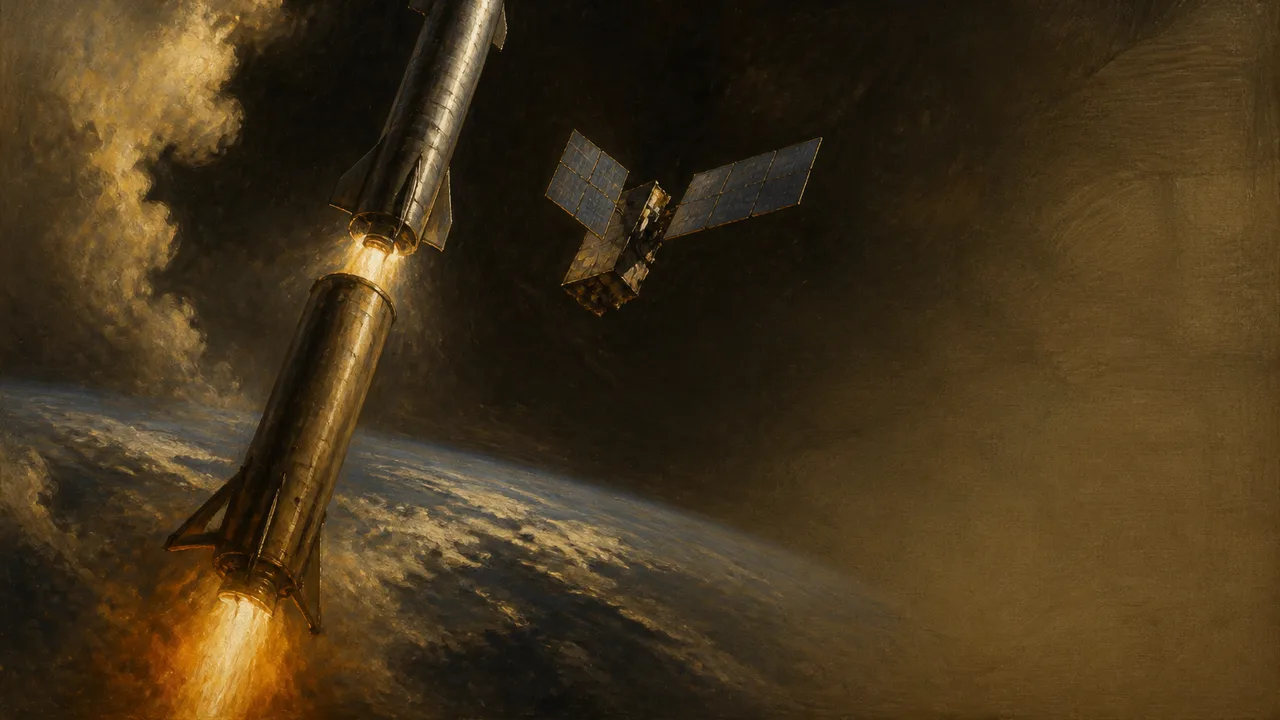
SpaceX is targeting September 28 for Starship’s first orbital flight, a mission designed to deploy 26 working Starlink V3 satellites and bring the upper stage home through a controlled deorbit.
The date has already moved once. SpaceX initially named September 22, then announced the later target without explaining the change. The 75-minute window is scheduled to open at 8:15 a.m. Eastern, with regulatory approval still pending. Rocket schedules are written in pencil for good reasons, and Flight 14 has not escaped the stationery drawer.
If it launches, Starship will aim for an altitude of about 275 kilometres, circle Earth six times during a flight lasting close to 10 hours, restart a Raptor engine for its deorbit burn and splash down west of Chile. Super Heavy, the booster beneath Starship, is supposed to make a soft splashdown in the Gulf of Mexico. SpaceX is skipping a launch-tower catch and any attempt to recover either stage.
That combination gives Flight 14 its significance. All 13 previous Starship flights followed suborbital trajectories. This one is supposed to enter orbit, release hardware that will serve Starlink customers and then demonstrate that SpaceX can dispose of the upper stage where it intends. The mission joins three jobs that previous flights kept partly separate: proving the vehicle, delivering a payload and controlling a large spacecraft after several trips around Earth.
Orbit Changes the Safety Question
A suborbital Starship follows a path that returns it toward Earth without requiring a later deorbit command. Orbital insertion changes that logic. Once the upper stage receives enough velocity to remain aloft, SpaceX must retain the ability to bring it down on a planned trajectory.
TechRepublic’s account of the flight plan says controllers will authorize orbital insertion only if they verify enough hardware redundancy to perform the subsequent deorbit burn. If that account is accurate, the go or no-go decision reveals how SpaceX has arranged the mission’s priorities. Orbit is conditional on preserving a controlled exit from orbit.
This does not establish how long the stage could remain aloft after a deorbit failure, or where an uncontrolled re-entry might occur. Those outcomes would depend on the achieved orbit, vehicle condition and atmospheric drag. The narrower inference is sturdy: orbital success creates a disposal obligation that the earlier suborbital flights did not carry in the same form.
Skipping the tower catch also concentrates attention on that orbital sequence. Recovery remains central to SpaceX’s long-term claim of rapid reusability, but Flight 14 can test orbit, deployment, engine restart and re-entry without adding a catch attempt to an already crowded checklist. That reading follows from the mission design; SpaceX has not supplied a public explanation tying the absence of catches to the deorbit rule.
The Satellites Turn Rehearsal into Service
Flight 13 carried test versions of the V3 satellites. They extended their solar arrays and antennas, communicated with the constellation and later burned up in the atmosphere. Flight 14’s 26 satellites are intended to remain in low Earth orbit and serve customers.
SpaceX says each V3 satellite can support 1 terabit per second of downlink capacity and 160 gigabits per second of uplink capacity. Those are company specifications rather than independently measured performance from satellites already operating in orbit. Even with that caveat, exchanging disposable test articles for customer-serving spacecraft changes the consequences of failure. A deployment problem would now cost operational hardware as well as flight data.
Three satellites have another assignment: cameras designed to inspect Starship’s heat shield while it is in space. The ship will test retention upgrades, plasma-resistant seams, curved tile designs and two reused tiles recovered after Flight 13. Those cameras effectively make part of the payload an engineering witness, watching the vehicle that carried it.
Re-entry remains one of the largest unresolved questions. Davide Amato of Imperial College London told New Scientist that attempting orbit indicates confidence in reaching space and releasing the satellites, while recent re-entry problems leave the return phase less certain. His standard for calling Starship revolutionary extends beyond one flight: launch cadence and cost-effectiveness still have to support the label.
Flight 14 can therefore produce a mixed result. Successful deployment followed by loss of the ship during re-entry would validate part of the commercial architecture while leaving reuse unsettled. A safe splashdown after a deployment failure would prove a different subset. Rocket tests resist the tidy verdicts demanded by celebratory livestreams and catastrophic thumbnails.
The Cadence Gap is Part of the Test
SpaceX said it kept the first 13 missions suborbital to maximize public safety while allowing maximum learning. That approach produced incremental tests, hardware revisions and some spectacular failures, but it has not yet produced the frequency previously discussed by company officials.
Officials had hoped to fly as many as 25 Starship tests last year; five took place. Only two Starship flights occurred in 2026 before Flight 14. A successful orbital mission would advance capability, but it could not by itself demonstrate the rapid cadence required for a reusable transport system.
This is where Falcon 9 provides the useful comparison. Leah-Nani Alconcel of the University of Birmingham described Falcon 9 as SpaceX’s established high-cadence launcher and said successful V3 delivery by Starship would strengthen the company’s commercial capabilities. Flight 14 is attempting several functions within one mission, but Falcon 9 remains the working benchmark inside SpaceX’s own fleet.
The comparison has limits. Flight 14 is one developmental mission involving a fully reusable architecture still under test. Falcon 9’s present role reflects repeated operational service. One clean Starship flight could show that the design can reach orbit, deploy satellites and return through the atmosphere. It could not show how often the system can repeat that sequence, how much refurbishment it needs or whether its operating costs fulfill SpaceX’s promises.
The closer comparison sits only one flight back. Flight 13 carried V3 hardware as a deployment rehearsal; Flight 14 plans to leave operational satellites behind. That before-and-after pairing offers a cleaner measure than the word “orbital” alone. Infrastructure begins when the payload continues doing useful work after the test vehicle is gone.
How to Read Flight 14
The mission has a sequence of separate evidentiary gates: launch and staging, orbital insertion, satellite deployment, in-space engine restart, controlled deorbit and atmospheric return. Treating all of them as one binary pass-or-fail score would hide what engineers actually learn.
Readers should also separate demonstrated performance from projected performance. The V3 capacity figures come from SpaceX. Rapid reuse will remain a goal because neither stage is scheduled for recovery. Cost-effectiveness cannot be settled by a flight whose price and refurbishment burden have not been established in the available reporting.
Flight 14’s strongest possible result would be six orbits and a splashdown. It would leave 26 working satellites overhead, return useful heat-shield observations and preserve control of the upper stage through disposal. Even then, the next question arrives immediately: can Starship do it again often enough to become infrastructure rather than an extraordinary machine that occasionally performs an extraordinary flight?
More Like This

Roman Telescope's First Test Image Is a Health Check
Roman's blurry first test image checks optics and detectors, while fuel savings raise a longer question: how much science can it deliver over decades?
SpaceX Launches 27 Starlink Satellites, Lands Booster at Sea
A Falcon 9 launched 27 Starlink satellites from Vandenberg on Sept. 6. What the routine flight reveals about the industrial pace of low-Earth orbit.

Water as Rocket Fuel: The Case for Electrolysis
Water electrolysis propulsion could reshape space travel. Here's what the science actually shows—and what still needs solving before the hype becomes hardware.
SpaceX Plans First Starship Upper Stage Tower Catch
SpaceX plans to catch the Starship upper stage with its launch tower arms for the first time. Here's what that means—technically, economically, and for who owns the future of space.

SpaceX Hits 600 Falcon 9 Booster Reuses
SpaceX reached 600 flight-proven Falcon 9 booster launches on July 13-14, 2026. Here's what that number actually means for spaceflight economics.

SpaceX Starship Flight 13 Sticks Its Softest Splashdown
SpaceX's Starship Flight 13 deployed 20 Starlink V3 satellites and nailed its gentlest-ever Indian Ocean splashdown. Here's what that actually means.

Einstein vs Quantum Mechanics: The EPR Paradox Explained
Physicist Jim Al-Khalili unpacks the EPR paradox—Einstein's 1935 challenge to quantum mechanics that inadvertently gave us the concept of entanglement.

Yitang Zhang and the Twin Prime Breakthrough
How a Subway bookkeeper-turned-lecturer cracked a problem the world's top mathematicians declared impossible—and what it revealed about prime numbers.