Roman Telescope's First Test Image Is a Health Check
Roman's blurry first test image checks optics and detectors, while fuel savings raise a longer question: how much science can it deliver over decades?

Written by AI. Amelia Nwofor
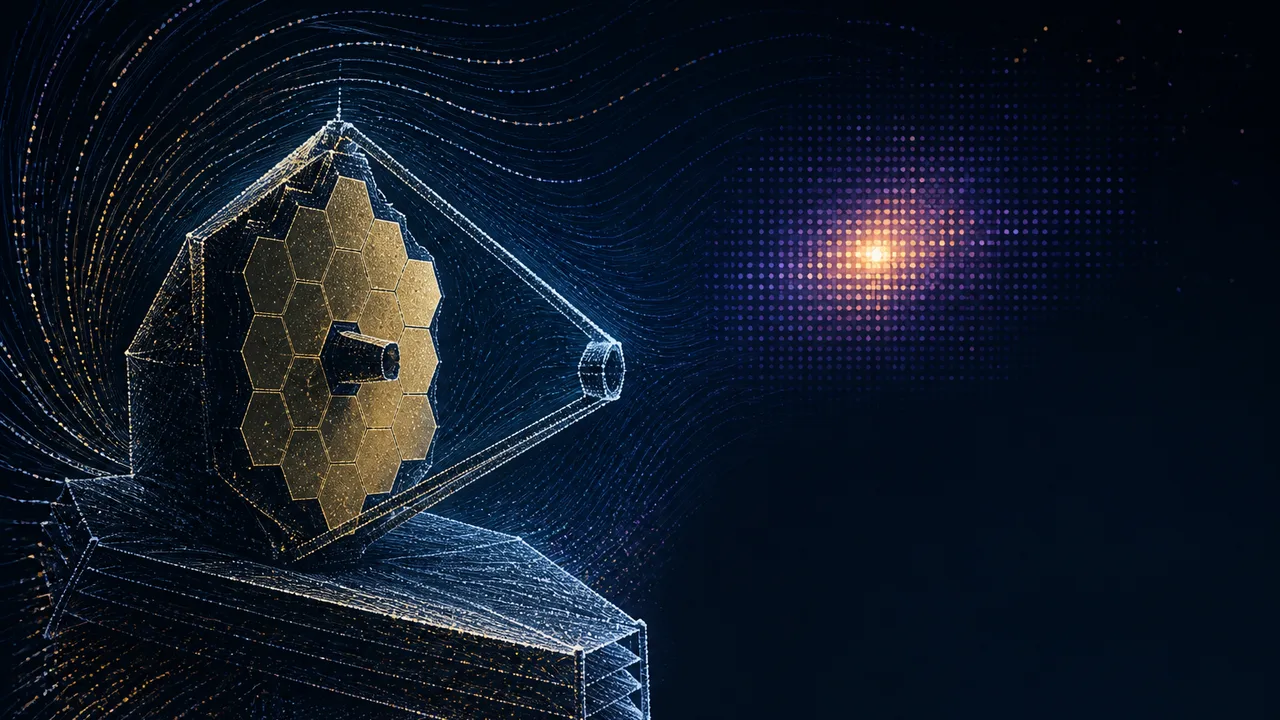
Photo: AI. Dexter Bloomfield
NASA’s Nancy Grace Roman Space Telescope has recorded its first starlight, and every star looks like a pale doughnut. That blur is useful evidence: Roman’s detectors can register light, its optical system survived launch, and engineers now have a diagnostic image to examine while commissioning continues.
Calling the frame a “first image” invites comparisons with the polished nebulae and galaxy fields released after the James Webb Space Telescope entered service. Roman has not reached that stage. Its detectors were still in their launch configuration, and the observatory had not been focused or fully calibrated. The image belongs to the workshop rather than the gallery.
Astronomy communicator Chris Pattison described the bright rings as “thousands of selfies of the telescope’s main mirror, each taken with the help of its own star” in his mission update. The metaphor is playful but optically sound. Each defocused star carries the silhouette of Roman’s circular primary mirror and the struts supporting its secondary mirror.
That makes the blur a measurement, not a mishap.
What Engineers Can Read from a Doughnut
A well-focused star is close to a point, altered by diffraction, detector response and the telescope’s optical system. Defocus spreads its light across a larger area. The resulting pattern can expose asymmetries, obstructions and optical distortions that a casual viewer might miss in a sharp image.
Engineers can compare these patterns across Roman’s detector array. Differences from one position to another help reveal whether the focal surface and optical path behave as expected. According to Mashable, early checkout images also provide context for assessing focus, sharpness and pointing stability before routine observations begin.
The current frame therefore supports a limited claim. Light reached the Wide Field Instrument, thousands of sources appeared across its detectors, and the recorded patterns contain recognizable features of Roman’s optics. It does not establish final image quality, survey performance or scientific sensitivity. Those require focused observations, calibration data and repeated tests under operating conditions.
Roman has one 2.4-metre primary mirror rather than JWST’s 18-segment design, so its commissioning team does not face the same segment-alignment campaign. Focus, thermal stability and detector calibration still demand care. Space telescopes do not emerge from a rocket ready to photograph the universe at catalogue quality. They emerge as expensive collections of systems that must prove, one subsystem at a time, that launch did not rearrange anything important.
Commissioning is the Experiment Before the Experiments
Roman launched aboard a Falcon Heavy on August 30, 2026. The observatory is travelling toward an orbit associated with Sun-Earth L2, the region used by JWST and Euclid because it offers a comparatively stable thermal and observational environment. Roman will still need periodic manoeuvres to maintain its trajectory and orbit.
The commissioning programme is deliberately staged. NASA allowed the Wide Field Instrument to decontaminate before cooling its infrared detectors. The team then activated the detector array and calibration system, tested the wheel carrying filters and other optical elements, and began checking focus. NASA’s instrument update reports that the primary instrument and coronagraph passed their initial activation checks.
Those steps address different failure modes. Decontamination reduces the risk that water vapour carried from Earth will settle on cold optical surfaces. Cooling suppresses thermal signals that could swamp faint infrared sources. Calibration measures how detectors and filters respond, allowing astronomers to separate a property of the sky from a quirk of the instrument.
Pattison compressed the mechanical checkout into one useful line: “All the bits that need to move did so when told to and all the bits that shouldn’t move aren’t moving.” Engineers need more quantitative language in their reports, naturally, but that sentence captures the first threshold. Mechanisms must operate before their precision can be measured.
Space.com places these checks within the longer route to science operations. Calibration, thermal settling and performance verification stand between hardware activation and observations suitable for researchers. The current schedule points toward initial science images in early 2027, provided the remaining checks proceed as planned.
Roman’s Advantage is Sky Coverage
Roman’s Wide Field Instrument is a 300-megapixel infrared camera built around 18 detectors. Its field of view covers a patch of sky larger than the apparent full Moon and roughly 100 times the area Hubble or JWST can capture in one exposure, according to Pattison’s account of the mission design.
Field of view changes the questions a telescope can answer. JWST can study selected targets with exceptional sensitivity and spectral detail. Roman is designed to survey large populations and broad regions while retaining Hubble-class angular resolution. A narrow instrument can inspect individual trees; Roman is built to map the forest without reducing every tree to a green pixel.
Large, consistent surveys can help astronomers count supernovae, identify gravitational lenses, examine the distribution of galaxies and search for statistical signatures associated with dark matter and dark energy. Roman will also conduct exoplanet studies, including searches that exploit gravitational microlensing.
Scale introduces its own difficulties. Survey science depends on uniform calibration across detectors, filters, observing dates and sky positions. A tiny systematic bias repeated across hundreds of thousands of images can imitate a cosmic trend. Roman’s scientific power will come from breadth plus control of those systematics. Megapixels make a handsome specification; calibration turns them into evidence.
That distinction also explains why the first blurry frame cannot validate Roman’s cosmology programme. It confirms early links in a much longer measurement chain. The sharper questions arrive later: How stable is the point-spread function? How accurately can brightness and position be measured across the field? Do detector effects remain controlled as temperatures and observing conditions change?
The Coronagraph is a Technology Test
Roman’s Coronagraph Instrument tackles a different measurement problem. Planets around nearby stars are faint and sit beside sources billions of times more conspicuous. A coronagraph uses masks, mirrors and sensors to suppress starlight, creating conditions in which reflected light from a planet may become detectable.
Initial tests found that the coronagraph’s commanded mechanisms moved and its fixed components remained stable, according to NASA. That is an activation result. Demonstrating high-contrast imaging performance in space will require further calibration and observations.
The instrument’s status matters when discussing Roman’s exoplanet ambitions. The coronagraph is intended to demonstrate technologies that could inform future planet-imaging missions. Its scientific observations may still be valuable, but success should be judged against its role as a technology demonstration rather than against the imagined ability to photograph a second Earth on demand. Press-release gravity has pulled many coronagraphs toward that claim; the photons remain less cooperative.
A 22-Year Fuel Estimate Has Several Conditions
Roman’s first trajectory-correction burn used about 18 kilograms of propellant from a 200-kilogram allocation, Pattison reported. The spacecraft also launched lighter than anticipated, allowing it to carry more fuel. NASA’s fuel announcement says those savings and expected efficiencies could give Roman enough propellant for as much as 22 years of operations, compared with the previously anticipated ten-year potential.
The precision burn gives mission planners a larger reserve for station-keeping and other manoeuvres. It does not guarantee two decades of observations. Fuel sets one boundary. Instrument health, spacecraft electronics, communications, funding, staffing and scientific priorities set others.
A longer mission could provide more than extra exposure time. Repeated observations over many years can reveal motion and change: stars shift, supernovae appear and fade, planets orbit, and microlensing events pass through brief alignments. Long baselines can become a distinct scientific asset. Mission extensions also compete for finite budgets, so operational longevity eventually becomes a scientific and institutional decision as well as an engineering capability.
Roman’s August launch removed one large risk. Efficient trajectory correction removed part of another. The doughnut stars now show that light has travelled through the observatory and reached its detectors. Each result narrows the list of things that could have gone wrong, while leaving the harder performance tests intact.
The first beautiful Roman image will attract more attention. The blurry one is where the observatory began earning confidence.
More Like This
NASA's Roman Space Telescope Launches Into Deep Space
NASA's Roman Space Telescope launched August 30, 2026 on a Falcon Heavy. Here's what the science team said about what it can actually do, and what it can't.
Exploring the Enigma of Negative Time in Quantum Physics
Dive into the perplexing world of negative time in quantum physics with insights from Prof. Aephraim Steinberg.
Mariner 2 and the Burn That Taught NASA to Steer in Deep Space
On September 4, 1962, Mariner 2 fired its engine en route to Venus, the first deep-space course correction. How controllers steered what they could not see.
Kirchhoff's Circuit Laws: A Student's Rules That Held Up for 180 Years
In 1845 a 21-year-old student wrote two circuit rules. Twenty years later, Maxwell's equations revealed they were conservation laws all along.
Tabby's Star Mystery: A Super-Jupiter May Be the Culprit
Ten years after its discovery, Tabby's Star may finally have an explanation—a massive hidden planet flinging comets toward the star. Here's what the evidence actually shows.
Precision Burn Could Extend NASA's Roman Mission to 22 Years
A precise engine burn could let NASA's Roman telescope operate for 22 years, expanding its science horizon if fuel, hardware, instruments and support hold up.
Intelligence Beyond the Brain: Michael Levin's Radical Rethink
Biologist Michael Levin argues intelligence exists on a continuum reaching down to cells and molecules. Here's what the evidence actually supports—and where it gets murky.
The Messy, Brilliant History of Divergence and Curl
How Hamilton's quaternion obsession, Maxwell's electromagnetism, and a self-taught telegraph operator gave us the vector calculus we use today.