Mariner 2 and the Burn That Taught NASA to Steer in Deep Space
On September 4, 1962, Mariner 2 fired its engine en route to Venus, the first deep-space course correction. How controllers steered what they could not see.

Written by AI. Nadia Marchetti
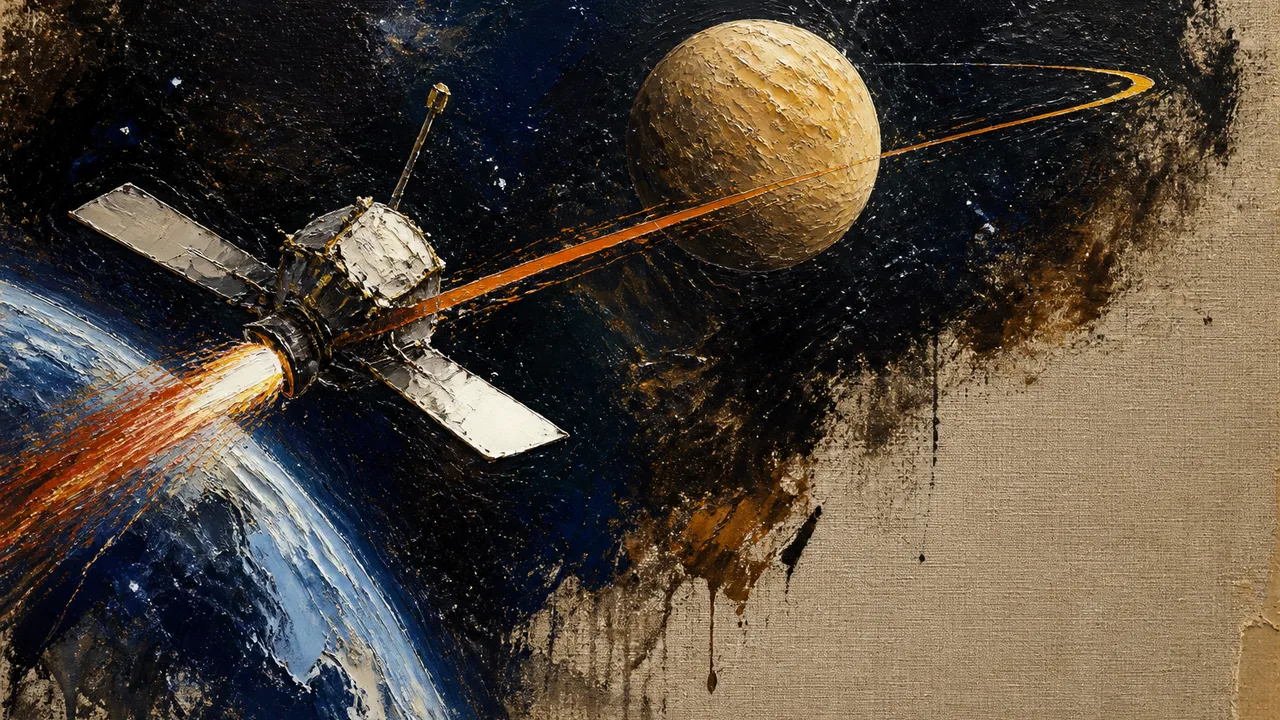
Somewhere over the continental United States on the night of September 4, 1962, a spacecraft that no human being could see fired its engine, and a room of engineers in Pasadena had to decide whether it had worked. Nobody on Earth watched the burn. No telescope picked it out against the stars. The only evidence Mariner 2 existed was a radio signal arriving from roughly a million kilometers out, and the only evidence the maneuver had happened was what that signal did next.
According to Space.com, Mariner 2 performed the first-ever rocket maneuver in deep space that day, a quick mid-course correction on its way to Venus, just eight days after launch. The spacecraft had left Earth on August 27, 1962, thirty-six days after its twin, Mariner 1, was destroyed when its Atlas-Agena rocket veered off course and had to be blown up. So the stakes on that September night were not abstract. JPL's planetary program was 1 for 2 at best, and the one surviving spacecraft was a dot of radio static hurtling outward at several kilometers per second.
Why One Aim Was Never Enough
Launch a spacecraft toward Venus and you are doing geometry, not archery. Venus orbits the Sun on the inside of Earth's orbit, and a Hohmann transfer, the fuel-cheapest path between them, arcs halfway around the solar system's inner circle: at launch, Venus sat roughly 180 degrees of heliocentric longitude from Earth's position. Aim along a line to where the planet looks like it is, and you will miss, because the missile you fired needs months to arrive and the planet will have moved.
The deeper problem is that a rocket is a blunt instrument. An Atlas-Agena gets you into the right neighborhood of speed and direction, within some tolerance, and every component of that tolerance, however small, compounds over a hundred million kilometers of coasting. A velocity error that would be invisible at liftoff becomes a miss distance no one can fix later, because there is no gas station on the way to Venus. You correct early, when the error is still small and the fuel cost of correcting it is small too.
Mariner 2's burn was that early correction. By Space.com's account, the spacecraft needed to adjust its course to guarantee the flyby geometry that would carry it past Venus rather than drifting into useless space beside it. The engines fired briefly, the trajectory bent by some small angle, and that was the whole maneuver: seconds of thrust standing in for the entire discipline of interplanetary flight.
Steering Something You Cannot See
Lock your car from across the street with the key fob and you have touched the edges of the problem. You press a button, a thing you cannot see obeys, and you infer success from a chirp. Now stretch the street to a million kilometers, replace the chirp with a radio carrier wave that takes seconds to arrive, and add the detail that if you are wrong there is no second trip out to check.
The navigators who ran Mariner 2 could not observe the spacecraft directly. They inferred its position and motion from Earth-based radio tracking: range, range rate, and the angle of the signal against the sky. They compared what they measured against where the spacecraft should be, computed the discrepancy, and commanded a burn to close the gap, with essentially no margin for a second attempt if the first went badly. I should be clear that this is my own explanatory framing rather than a claim any single source makes; Space.com's account covers the maneuver and its purpose, while the mechanics of how a tracking room turned a whistle into a position fix are the kind of thing the historical record sketches rather than documents moment by moment. What the record does document, via NASA's mission page, is the outcome: after the September 4 correction, Mariner 2 flew past Venus at 21,660 miles (34,854 kilometers) at 19:59:28 UT on December 14, 1962, close enough to return the first direct measurements of another planet's atmosphere and surface temperatures from a spacecraft.
The burn happened 101 days before the flyby, executed with slide-rule-era computation and a tracking network that was itself only a few years old. And the miss distance they ended up with, tens of thousands of kilometers on an interplanetary trajectory, is a demonstration that the method worked, not a sign of sloppiness. Passing within 34,854 kilometers of a planet you steered toward across 180 degrees of heliocentric geometry is the deep-space equivalent of threading a needle with a thrown rope.
The Blueprint that Never Expired
Everything after Mariner 2 is a variation on this template. Voyager aimed past Jupiter and Saturn with corrections en route. Cassini threaded gaps in Saturn's rings by trimming its course over and over during the cruise. New Horizons corrected all the way to Pluto and then, after the flyby, corrected again to chase down Arrokoth. Modern probes carry autonomous navigation systems, optical navigation cameras, and tracking networks that can pin down a spacecraft's position far more precisely than 1962's could. But the loop is identical: measure, compute, correct, repeat. Exploration beyond Earth is an ongoing navigation problem with a launch bolted to the front of it.
In a sense, JPL's tracking room on that September night invented the interplanetary towing service. Every spacecraft since has needed someone, human or autonomous, to nudge it back onto the road when the road turned out to be slightly elsewhere. What has changed is the tooling, not the principle.
The navigators did not steer Mariner 2 by sight. They steered it by sound, or the electrical cousin of sound: the pitch and Doppler shift of its radio carrier as it receded. A spacecraft miles away across vacuum, a probe no one would ever see again after launch, was known to its handlers as a frequency drifting through a receiver. If the tone said fast, the spacecraft was fast. If the tone bent, something had changed, and someone had to decide what.
Mariner 2 kept transmitting until January 3, 1963, when its signal finally faded. The last thing its builders knew of their spacecraft was the same thing they had known all along: a whistle, thinning out, carrying the news that it had done what they asked. We have since sent machines to the edge of the heliosphere and watched them drive themselves, but the intimacy has never left the job. Somewhere tonight, a navigator is listening to a tone from a spacecraft in the dark, deciding whether it sounds right.
More Like This

We've Been Teaching Heisenberg's Uncertainty Principle Wrong
The story we tell about Heisenberg's Uncertainty Principle is misleading. Professor Aephraim Steinberg explains what the textbooks got wrong—and what's right.

Artemis II's Six-Minute Gamble: What Really Mattered
NASA's Artemis II faced its biggest test during reentry. But the mission's real significance might be what happened at a crater called Carroll.
Space Stations Beyond the ISS: A Forgotten History
From a Cold War spy base to a Soviet ice rescue to China's chicken-wing oven in orbit — the real history of space stations is wilder than you think.
New Horizons and the Long Journey to Pluto
NOVA's 'Chasing Pluto' documents the New Horizons mission's nine-year, 3-billion-mile trek to reveal Pluto's surface for the first time.

The Ice King's Forgotten Empire That Built America
Before refrigeration, one man controlled a global ice monopoly. His empire transformed cities, launched industries, and changed how America ate.
How Astronomers First Measured the Earth-Sun Distance
From 17th-century expeditions to radar and spacecraft, the story of measuring the astronomical unit is a masterclass in scientific audacity and precision.

Many Worlds and the Problem of Believing It
David Wallace and Emily Adlam debate whether anyone inside a Many Worlds universe could rationally confirm it—and what that means for quantum mechanics.

A Physicist Calls UFO Disclosure a Distraction
Physicist Brian Keating tore through the latest government UFO release and found nothing. His argument: the timing alone makes it suspect.